


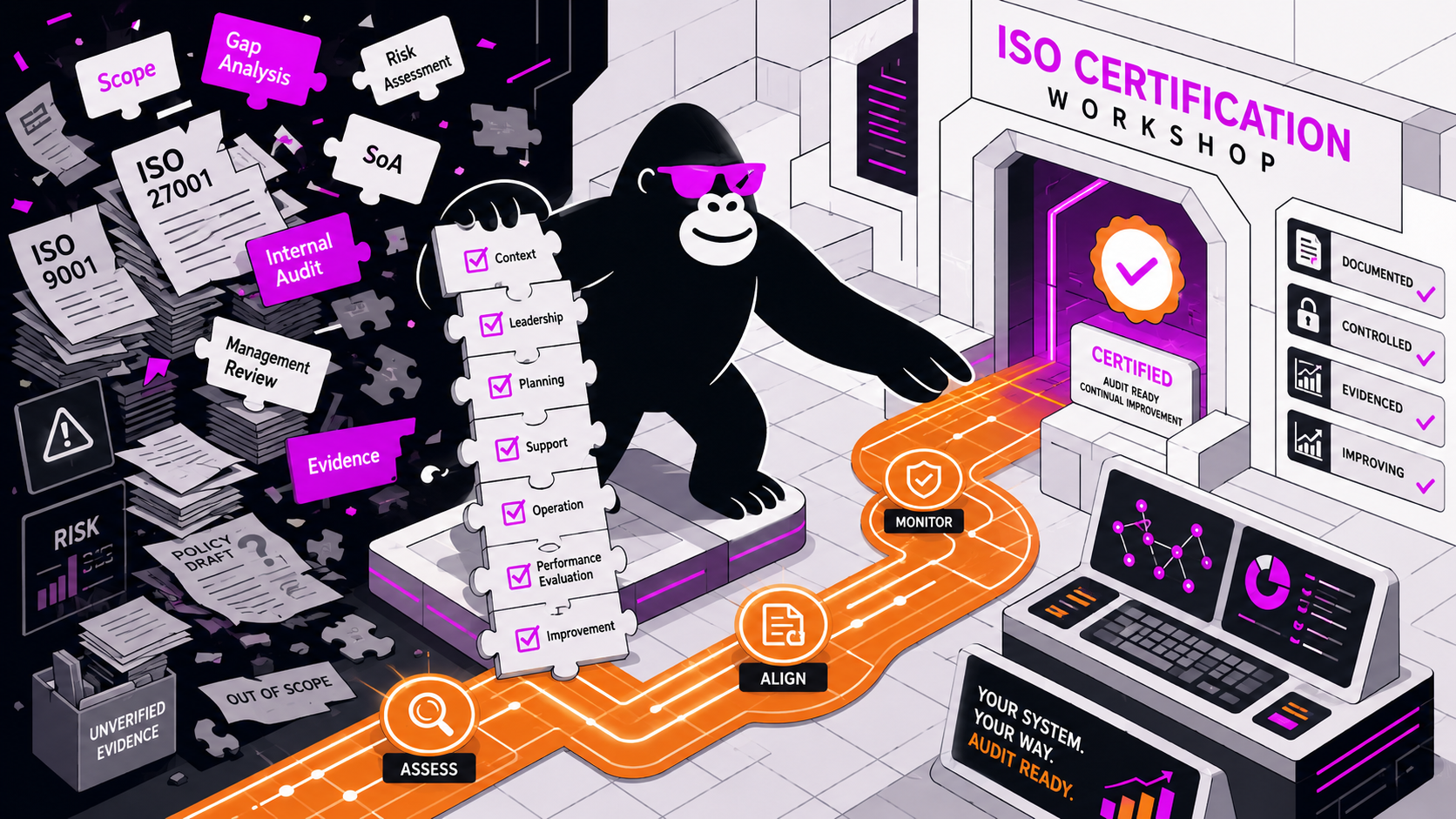


An ISO compliance checklist takes the dense, clause-by-clause language of standards like ISO 27001 and ISO 9001 and turns it into a concrete, trackable set of tasks your team can actually execute. Instead of reading hundreds of pages of normative text and hoping you covered everything, a structured checklist tells you exactly what needs to happen, who owns it, and what evidence to collect. The controls matter, but so does the scoping, the documentation structure, the risk assessment methodology, and the audit preparation that surrounds them. Most compliance failures happen outside the controls themselves: an incomplete scope definition, a risk assessment disconnected from control selection, or documentation that does not meet audit expectations.
This matters now more than ever. Many organisations pursuing certification find themselves scrambling weeks before an external audit, only to discover gaps in documentation, missing risk registers, or outdated policies. For European fintechs and regulated tech firms facing obligations under DORA, NIS2, and GDPR, the stakes are higher still. ISO 27001 certification enhances stakeholder trust, supports compliance with data protection law, and provides a structured framework for managing information security risk. With the ISO 27001:2013 to 27001:2022 transition deadline having passed in October 2025, every organisation holding a certificate now operates under the 2022 standard. This checklist covers every stage from initial scoping through certification and ongoing maintenance, with ISO 27001 as the primary reference since it is the most commonly pursued ISO certification for information security. If your organisation is still evaluating whether ISO 27001 is the right framework, the introduction to ISO 27001 provides the foundational context before you work through the steps below.
ISO Compliance Checklist: Quick-Start Overview
Here is the end-to-end certification process as a high-level project plan. Each step is expanded in the sections that follow.
- Study the standard. Obtain and read the full ISO text (for example ISO 27001:2022 or ISO 9001:2015). Understand Clauses 4 to 10 and any annexes.
- Define your scope. Specify which locations, business units, services, and assets are included.
- Build your implementation team. Establish an ISMS team and assign roles across IT, operations, HR, legal, finance, and an executive sponsor.
- Conduct a gap analysis. Compare the current state against every clause and control to identify shortcomings before an auditor does.
- Develop and implement policies. Create or update your policy framework, risk methodology, Statement of Applicability, and documented procedures.
- Run a formal risk assessment. Identify threats, rate risks, and build your risk treatment plan.
- Perform internal audits. Test your system against ISO requirements and fix nonconformities.
- Complete management review. Senior leadership reviews system performance and approves resources.
- Pass the certification audit. Stage 1 (documentation) followed by Stage 2 (operational effectiveness).
- Maintain and improve. Enter the surveillance audit cycle and drive continual improvement.
An effective checklist follows the Plan-Do-Check-Act methodology. For most SMEs, ISO 27001 certification takes 6 to 12 months to achieve, after which you enter a three-year cycle with annual surveillance audits.
Understand the ISO Standard and Certification Process
Every compliance checklist must start from the actual ISO text. If you have not read ISO 27001:2022 or ISO 9001:2015 in full, your checklist is built on assumptions, and assumptions create audit findings.
Both standards share the same high-level structure across Clauses 4 to 10: context of the organisation, leadership, planning, support, operation, performance evaluation, and improvement. The certification process follows a predictable path: preparation (build the management system, run internal audits, conduct management review), a Stage 1 audit (documentation and design review by the certification body), a Stage 2 audit (operational effectiveness tested through interviews, evidence sampling, and observation), certification (certificate valid for three years), and annual surveillance audits.
Two concepts drive everything. Risk-based thinking requires you to identify risks and opportunities rather than follow a static rulebook. The Plan-Do-Check-Act cycle structures how you build, operate, measure, and improve the system. For ISO 27001 specifically, the 2013 version included 114 Annex A controls; the 2022 revision reorganised these into 93 controls across four themes (Organisational, People, Physical, Technological) and added 11 new controls covering cloud security, secure coding, threat intelligence, and more.
Define Scope and Build Your Implementation Team
The accuracy of your checklist depends on two things: a clear scope and the right people.
Defining scope means specifying exactly which parts of your organisation are covered. For an information security management system under ISO 27001, base the scope on critical assets: which business units, locations, services, information systems, and data flows are included. The scope statement must consider internal and external issues (Clause 4.1), the needs of interested parties (Clause 4.2), and the interfaces and dependencies with activities performed by others (Clause 4.3). Document it in a formal scope statement, date it, and update it when operations change.
Top management must provide active support and resource allocation. ISO 27001 Clause 5.1 requires top management to demonstrate leadership and commitment, which in practice means a formal decision to pursue certification, allocation of budget and resources, and assignment of ISMS roles. Build your implementation team with representation from across the organisation:
- IT and security for technical controls and system configurations
- Operations for process documentation and day-to-day workflows
- HR for training records and competency management
- Legal and compliance for regulatory alignment and contracts
- Finance for budget and resource allocation
- An executive sponsor to demonstrate the organisation’s commitment
Appoint an internal ISO owner (CISO, Head of Risk, or Quality Manager) to drive the project. For fintechs without deep in-house expertise, Copla’s fractional CISO consultancy provides expert guidance on scoping, control design, and audit readiness.
Run a Structured Gap Analysis Against ISO Requirements
Once scope and team are set, your first major action is a structured gap analysis: comparing existing processes, policies, and controls against every clause and control in the standard. For ISO 27001 this means working through Clauses 4 to 10 plus all 93 Annex A controls. Catching problems here, when you can still fix them affordably, is the entire point.
For each clause or control, rate the current state as compliant (documented and evidenced), partially compliant (exists but incomplete, outdated, or lacking evidence), or not in place. Assign an owner and a target remediation date to every gap. Common gaps include a missing or undocumented risk methodology, incomplete access control policies, an absent incident response plan, weak supplier due diligence, and no formal Statement of Applicability, which is mandatory for ISO 27001. The Statement of Applicability documents which Annex A controls apply, which are excluded, and why. For organisations transitioning from the 2013 standard, the gap analysis also reveals where old control numbering no longer maps to the 2022 structure.
Develop Policies, Controls, and Core Management System Documents
Gap analysis tells you what is missing. Now you build it. Documentation is crucial for maintaining ISO 27001 compliance: auditors will ask to see it, and if it does not exist or is outdated, you will receive nonconformities. Your checklist should track the creation or update of these core documents:
- Policy framework – information security policy, quality policy, acceptable use policy
- Risk methodology – how you identify, assess, and treat risks
- Statement of Applicability – maps every Annex A control to applicability and evidence
- Documented procedures – incident response, change management, supplier management, backup and recovery, nonconformity and corrective action
For ISO 27001, controls must cover access control, asset inventory, backup, incident response, supplier security, and business continuity. Organisations transitioning from the 2013 version should specifically assess the 11 new controls introduced in the 2022 revision, including threat intelligence (A.5.7), cloud security (A.5.23), data masking (A.8.11), data leakage prevention (A.8.12), and secure coding (A.8.28). Keep policies concise and role-based, version-control everything, and store documents centrally so auditors can access them without chasing people down.
Risk Management, Internal Controls, and Operational Practice
ISO standards expect risk-based controls and day-to-day operational discipline, not paper-only compliance. Every control selection must trace back to an identified and assessed risk. A formal risk assessment works through these steps:
- Identify assets – data, systems, people, physical locations, intellectual property
- Map threats – phishing, ransomware, insider risk, supply chain attacks, and threats specific to your industry
- Assess vulnerabilities – where security measures are weak or absent
- Rate impact and likelihood – using a consistent methodology, such as a 5 by 5 matrix
- Determine treatment – accept, mitigate, transfer, or avoid
Document a risk treatment plan and maintain a risk register that records identified risks and their treatment. Update the register at least annually, or after major changes, security incidents, or new supplier relationships. A detailed methodology is covered in the ISO 27001 risk management guide. Key operational areas your checklist must cover include access control (role-based permissions, multi-factor authentication, regular access reviews), change management (risks assessed before implementation), incident response (documented playbooks and post-incident reviews), backup and recovery (tested, not just configured), and vendor risk (contracts, due diligence, ongoing monitoring).
Training, Awareness, and Internal Audit Readiness
Compliance is not just a documentation exercise; it lives or dies with your people. Your checklist should require mandatory onboarding training on information security, annual refresher sessions covering policy updates and emerging threats, phishing simulations, role-specific training for high-risk functions (developers, IT admins, finance), and maintained competency records. Train employees not only on what the policies say but on why they matter.
Internal audits are your rehearsal for the real thing. Clause 9.2 requires an internal audit at planned intervals, conducted by someone independent of the area being audited; many resource-constrained organisations bring in an external consultant, which is acceptable under the standard. Conduct internal audits quarterly or semi-annually depending on your size and risk profile, covering all clauses and applicable controls over a 12-month period. Your internal audit checklist should mirror the external auditor’s approach: clause-by-clause or control-by-control questions, evidence sampling and interviews, space for documenting findings, and assigned remediation owners with deadlines. Nonconformity found internally is far cheaper to fix than nonconformity found during an external audit.
Prepare for the Certification Audit and Surveillance Cycle
The certification audit is conducted by an accredited certification body and occurs in two stages. A detailed walkthrough of the full ISO 27001 audit process covers what to expect at each stage.
Before external auditors arrive, verify that the following are complete and accessible: all policies and documented procedures, risk assessments and treatment plans, incident logs, management review minutes, internal audit reports and corrective action records, and training and competency evidence. Stage 1 focuses on documentation and the design of your management system. Stage 2 tests whether controls actually work in practice through interviews, observation, and evidence sampling, and is where auditors may raise major nonconformities (which must be resolved before certification), minor nonconformities (resolved within a defined timeframe), or observations. After the audit, address nonconformities through corrective action, update your checklist with lessons learned, and store the final report for surveillance reference. Plan for ongoing surveillance audits (typically at months 12 and 24) and a full recertification audit in year three; begin recertification preparation at least three months before the certificate expires.
Build a Living ISO Compliance Checklist for Continual Improvement
ISO standards do not reward organisations that certify and forget. ISO 27001 mandates continuous improvement of the ISMS. Turn your checklist into a recurring cycle rather than a one-time project plan, with quarterly management reviews, annual risk reassessment, scheduled internal audits on a rolling calendar, and corrective and preventive action records tracked to closure. A small set of metrics keeps the programme visible to leadership:
| Metric | Frequency | Purpose |
|---|---|---|
| Incident response times | Per incident | Measure operational readiness |
| Audit findings closed on time | After each audit | Track remediation velocity |
| Training completion rate | Quarterly | Verify awareness coverage |
| Vendor risk scores | Annually | Monitor supplier relationships |
| Control effectiveness ratings | Semi-annually | Validate security controls |
Continuous monitoring of controls, evidence, and risks prevents drift between audits, and mapping multiple frameworks (ISO 27001, DORA, NIS2) to a single set of controls means you do the work once and satisfy several obligations at once.
Frequently Asked Questions
How long does it take to get ISO 27001 certified?
First-time certification typically takes 6 to 12 months from initial scoping to certificate issuance. The timeline depends on existing security maturity, the scope of the ISMS, and resource availability. Organisations with established practices and some existing documentation move faster; organisations starting from scratch should plan for the full 12 months.
What is the most common reason for failing an ISO 27001 audit?
Incomplete or inconsistent documentation is the most common source of nonconformities. A risk assessment that is not connected to control selection, missing evidence of control operation, and internal audits that lack rigour are also frequent findings. Technical control failures are less common than documentation and process gaps.
How much does ISO 27001 certification cost?
Costs vary by organisation size and scope. External audit fees from accredited certification bodies typically range from 5,000 to 25,000 euros depending on company size. Total first-year investment for a mid-sized organisation, including consultancy, platform tooling, and internal effort, often falls between 30,000 and 100,000 euros. Ongoing annual costs for surveillance audits and maintenance are lower.
How Copla Supports ISO Compliance Programmes
Working through an ISO compliance checklist requires structured project management, control tracking, documentation generation, and evidence collection. Copla’s platform covers each phase: the onboarding process uses a structured intake questionnaire to generate the core policy and procedure documentation, the platform tracks control implementation status and evidence against the Statement of Applicability, and Copla’s consultants work alongside your team to scope the ISMS, conduct gap assessments, and prepare for the Stage 1 and Stage 2 audits. For organisations pursuing ISO 27001 alongside SOC 2, NIS2, or DORA, the cross-mapping capability means controls documented once satisfy requirements across every applicable framework. The result is a checklist that stays continuously audit-ready rather than one that triggers a last-minute scramble.
Book a consultation with Copla to walk through how this would look for your team.


