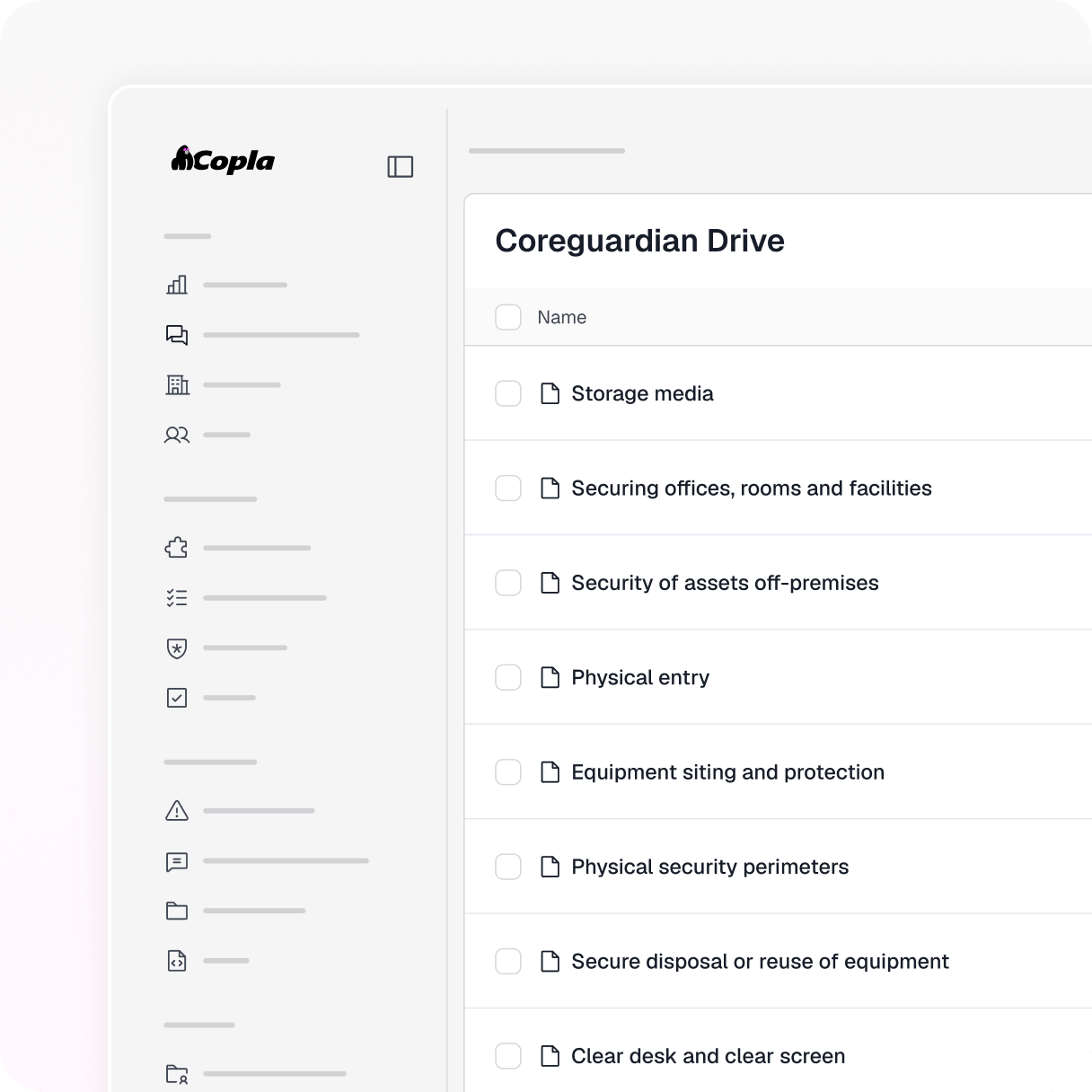
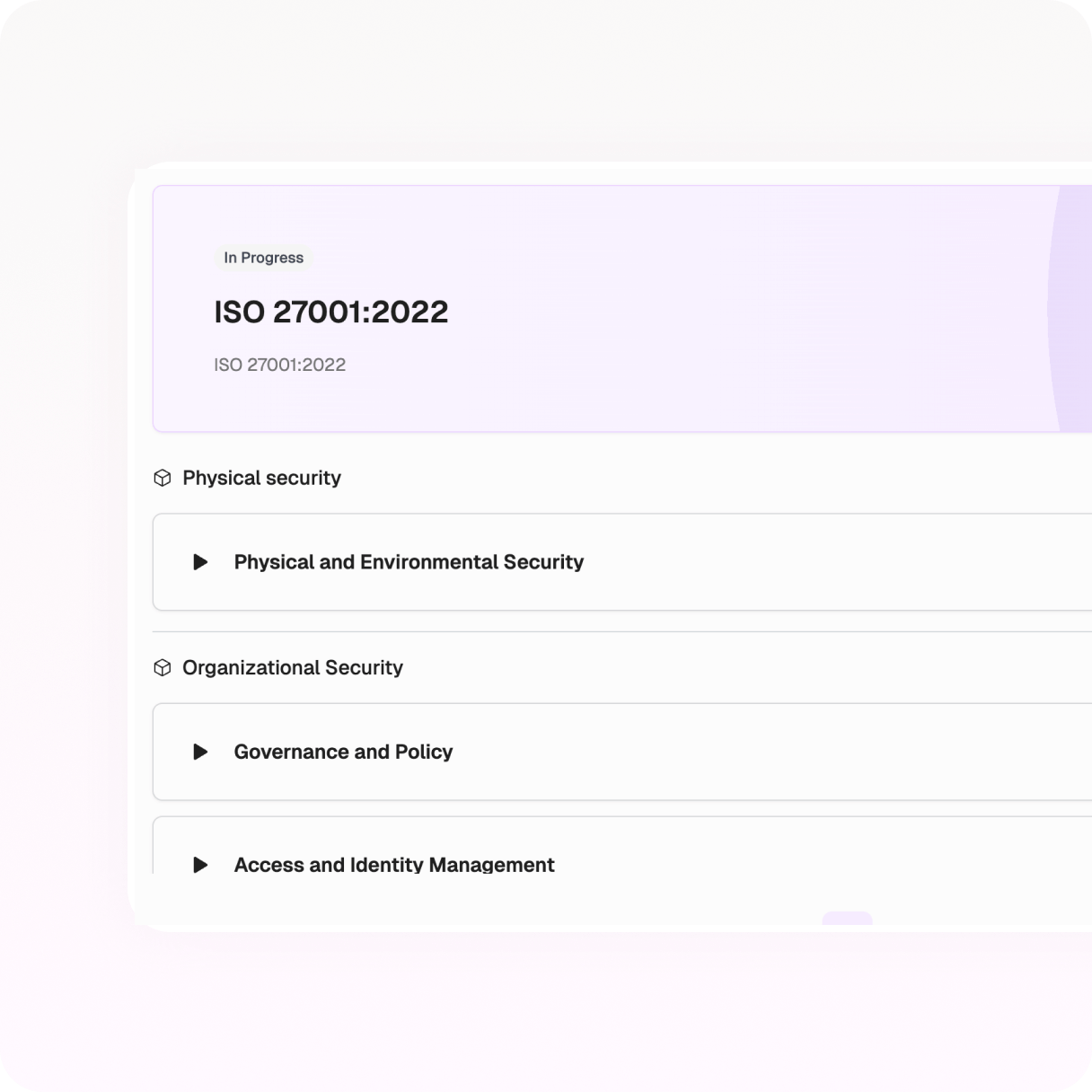
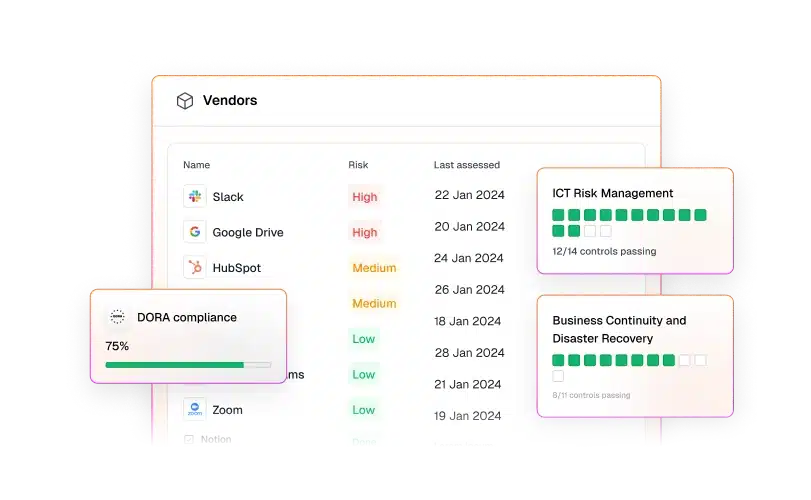
Compliance management software that does the heavy work for you

Copla built GRC and compliance management software that maps your risks, builds the controls and requirements that apply to your business, and runs the workflows that turn everyday work into audit-ready evidence, reviewed by in-house CISOs before an auditor sees it. Teams cut manual compliance work by up to 80%, save money against hiring consultants, and reach certification in a fraction of the usual time.

Trusted by companies of every size — from early-stage startups to established financial institutions — for DORA, NIS2, ISO 27001, SOC 2, PCI DSS, and Cyber Essentials compliance.

How Copla's compliance management software works

Most compliance programs live in spreadsheets, shared drives, and disconnected tools that fall out of date the moment the business changes. Copla replaces that with a single compliance management platform that keeps requirements, risks, controls, and evidence connected and current — visible at any moment rather than reconstructed before an audit.

Copla is not a collection of features.
It is a system that connects:

Assets

mapped through integrations, not inventoried by hand.

Risks

assessed for real business impact and exposure.

Controls

built to your risk profile, not a generic checklist.

Workflows

turn controls into tasks, collect the evidence, and guide your team through what's left.

Instead of creating compliance as a separate process, Copla ensures that standard operational work produces compliance automatically.

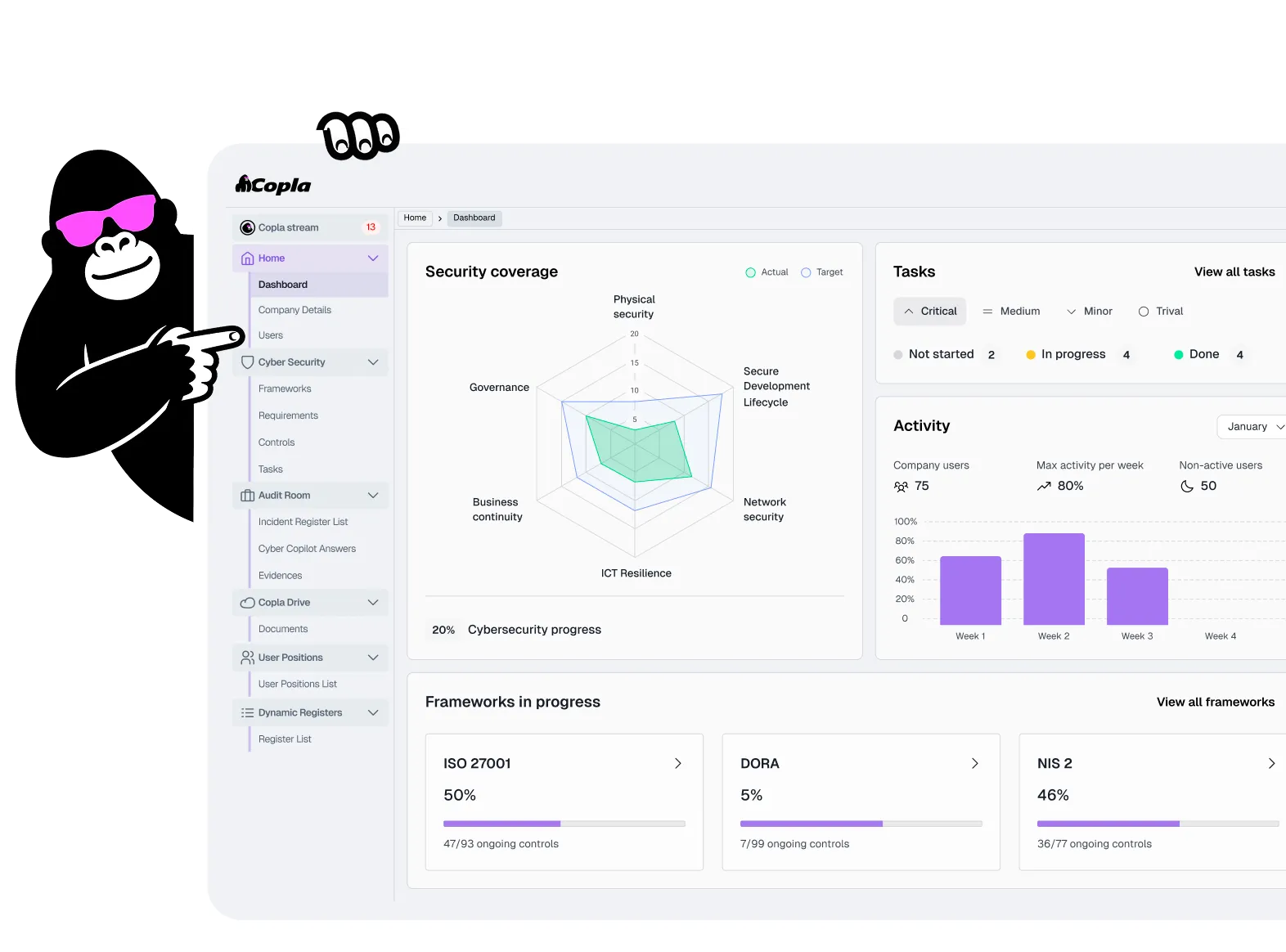
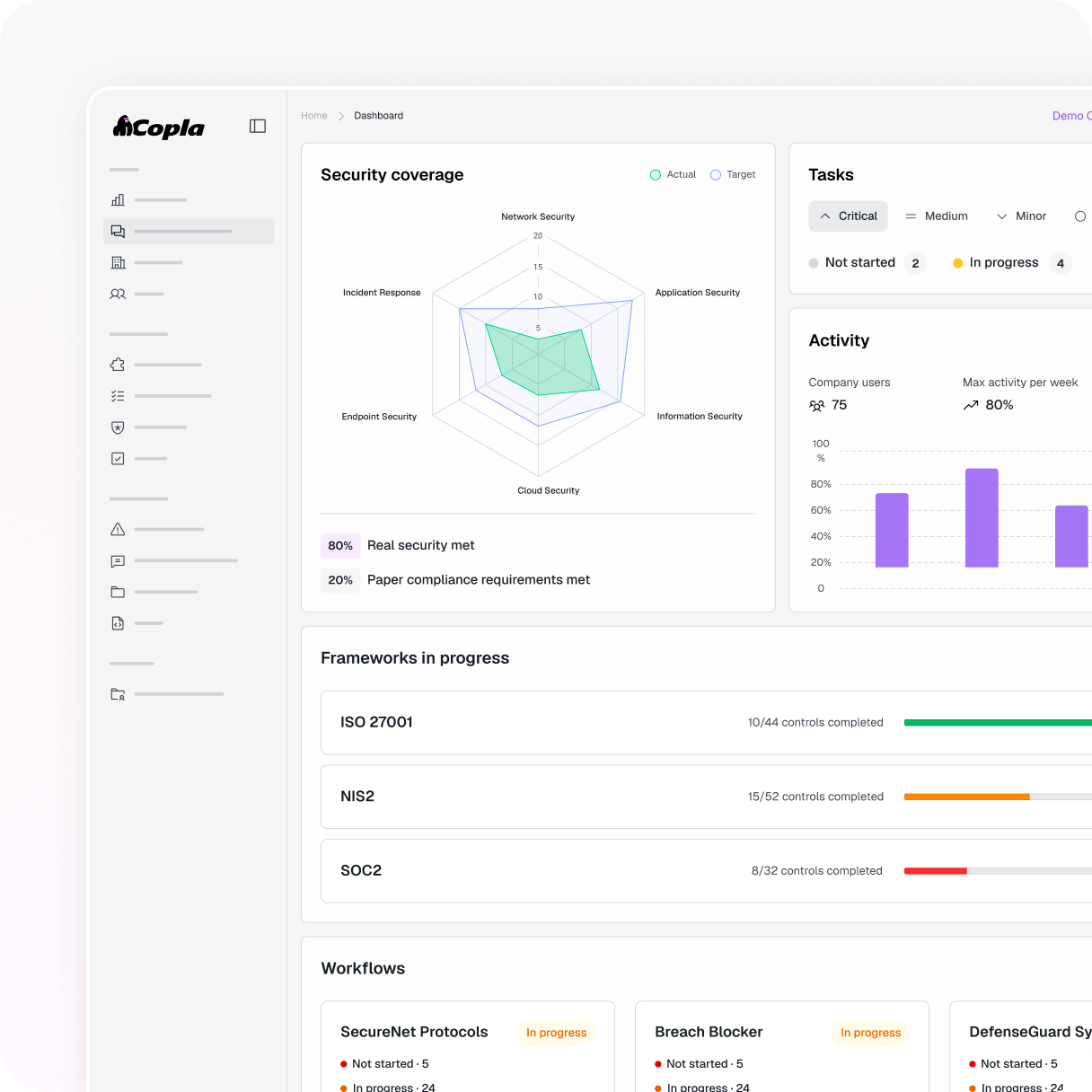
Copla Dashboard in short

Framework cross-mapping

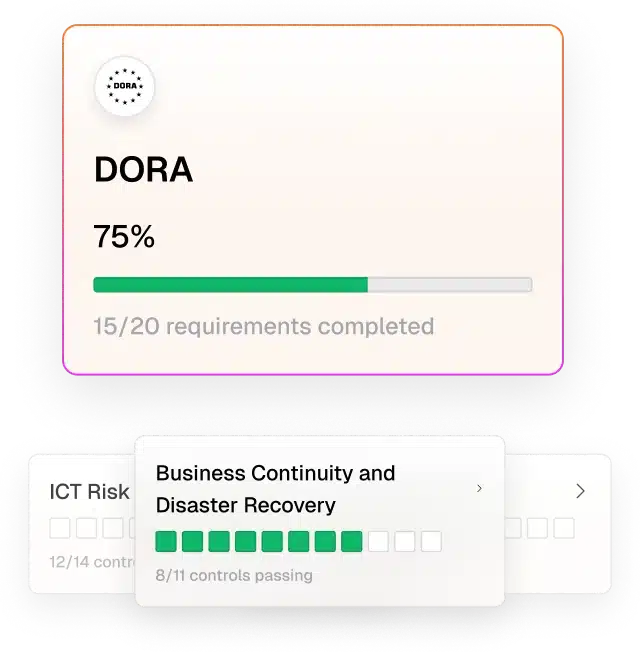
Stop doing the same work twice. As compliance management software, Copla automatically shows where controls overlap across ISO 27001, DORA, SOC 2, and NIS2, so evidence uploaded once satisfies every framework it applies to.

The "Human Touch": included CISO support

In-house CISOs work alongside the platform, reviewing your evidence, giving feedback, and mapping documents to how your business actually operates. It's expert guidance, delivered as part of the compliance management platform itself.

Smart evidence management & reminders

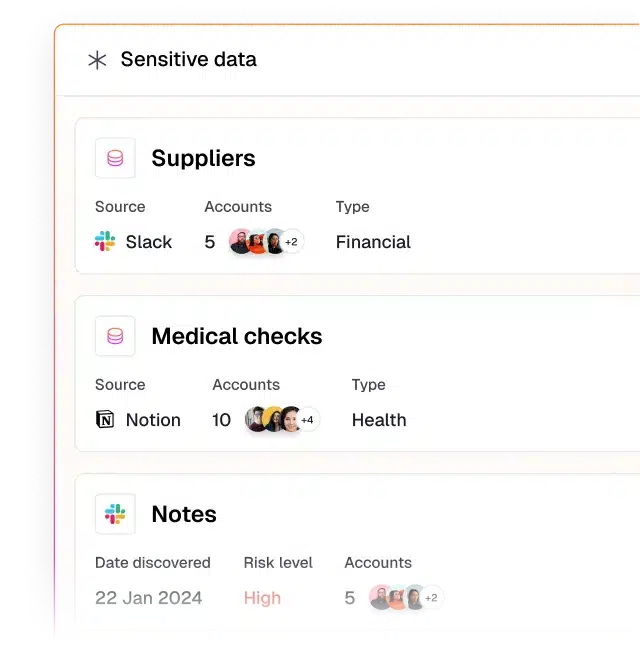
As compliance tracking software, Copla builds a centralized, shareable evidence database auditors can access directly, and sends automated reminders before evidence expires — so continuous certification, across every framework you hold, never lapses.

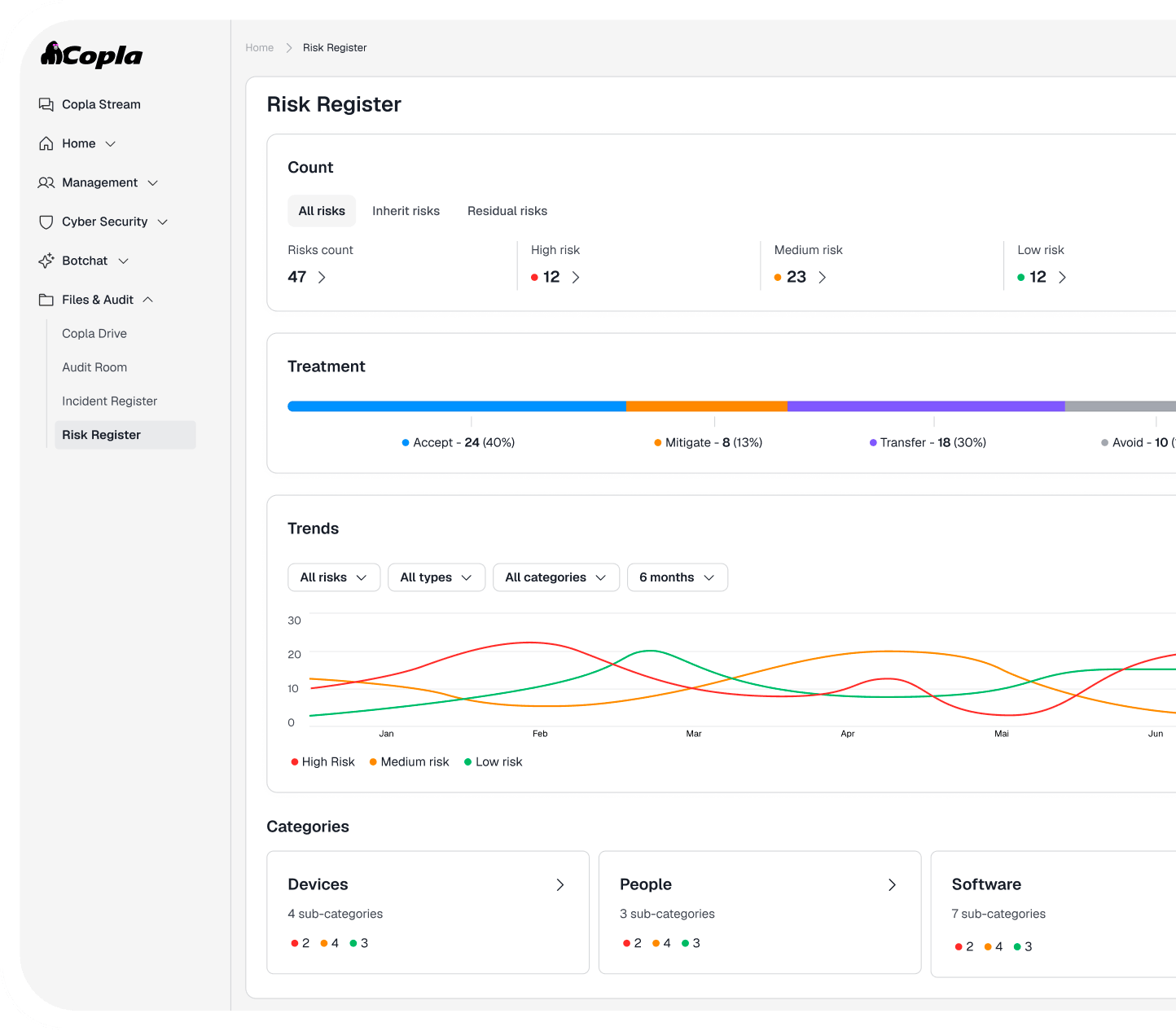
Security awareness training

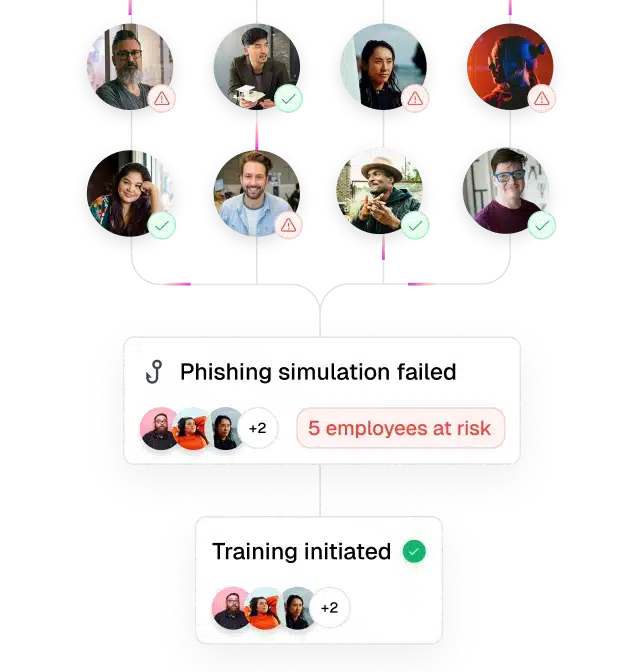
Roll out mandatory security training and quizzes to the teams that need them, then track completion on the same dashboard that proves compliance to auditors.

Hear From Teams Who Replaced Spreadsheets With Copla

“Copla saved us tens of thousands of euros and hundreds of hours. Their expert guidance made DORA compliance effortless.”

Zsolt Voros

Program Director, BlockBen

“Copla’s CISO-as-a-Service reduced our compliance burden and strengthened our cybersecurity posture, saving over €60K.”

Roman Loban

Managing Director, FMpay

“Copla’s expertise allowed us to offload 80% of compliance tasks, accelerating our certification.”


Algirdas Neciunskas

COO, Axiology

Where compliance management actually breaks down

Most companies handle compliance one of three ways, and each has a catch. They run it manually, through spreadsheets that quietly fall out of date. They bring in consultants, who take their expertise with them when the engagement ends. Or they lean on a platform — sometimes alongside an in-house team — and end up managing the software instead of the compliance. Underneath any route, the same four problems tend to surface.

Step 1

Where to start

Companies rarely know which framework to start with, or how much of it applies to their business — often losing weeks to scoping before a single control gets built.

Step 2

Documentation

Every framework comes with its own stack of policies and documents, and writing them from scratch, framework by framework, is one of the most time-consuming parts of the process.

Step 3

Risk assessment

Risk assessment sits underneath nearly every compliance activity, but doing it properly means gathering assets and vendors first — inventory most teams don't have ready. Done by hand, a business impact analysis alone can run past 200 hours.

Step 4

Evidence gathering

Once the frameworks are scoped and the risks assessed, the real work begins: collecting and storing evidence in an audit-ready format — usually manual, repetitive, and slow.

Every framework you need

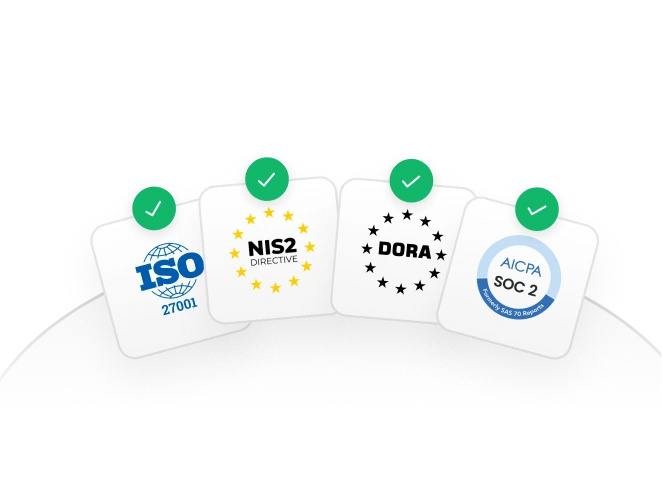
Copla ships with DORA, NIS2, ISO 27001, SOC 2, PCI DSS, and Cyber Essentials built in. Need one that isn't listed? Copla builds and implements it for you, typically within 1-2 weeks.

80–90%

less compliance work

24/7

Audit-ready at any point in time

Six figures

in avoided overhead

From requirements to continuous compliance - Personalized compliance management

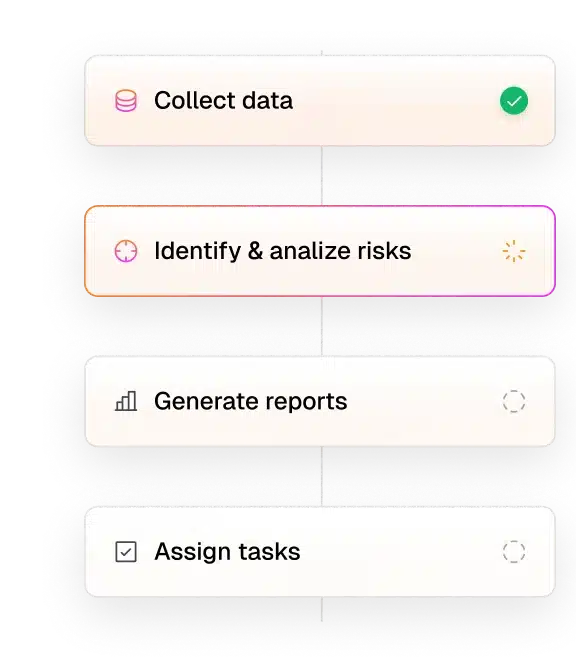
Most platforms hand you every task in a framework and leave you to work out which ones matter. Copla starts from your risk instead — your assets, vendors, and people — to build the tasks your business actually needs to get certified. From here, the path to continuous compliance runs in six steps.

Understand what applies.
Frameworks like DORA, NIS2, and ISO 27001 are mapped to your company, so Copla can identify what's relevant and filter out what isn't.

Prioritize based on risk.

Copla runs a Business Impact Analysis to find your critical processes and the vendors and assets inside them, then builds your risk register automatically with AI. You review and confirm it — the risk picture drives everything downstream.

Execute with guidance.

Workflows guide your team through each task with clear instructions, and Copla drafts the policies and documents each requirement needs.
Collect and validate evidence.

Evidence is captured as work happens, linked to the controls it satisfies, and reviewed by in-house CISOs before it counts.

Stay continuously audit-ready.

Copla flags expiring evidence before it lapses, logs audits automatically, and generates audit-ready packages on demand.

Scale across frameworks.

One task feeds multiple frameworks through cross-mapping, and your registers keep updating as the business changes.

Inside Copla's compliance management platform

Dashboard

Registers

Document repository

Business impact analysis

AI policy and document generation

Inside Copla's compliance management platform

Dashboard

Registers

Document repository

Business impact analysis

AI policy and document generation

Three things that make Copla stand out

Unlike other platforms that leave you to figure things out on your own, Copla pairs the tooling with dedicated expertise.

The platform

Your dedicated CISO

European framework depth

Frequently asked questions

It connects the work of getting and staying compliant — requirements, risk, controls, and proof for auditors. Copla goes further, doing much of that work for you, risk-first, with CISOs reviewing the output.

Copla maps the frameworks that apply to you, runs a risk assessment and business impact analysis, and builds the controls your risk calls for. Dashboards, registers, documents, and audit-ready packages all stay in one system, current as the business changes.

Yes — living registers, linked evidence, automated reminders, and guided workflows replace the manual side of the job entirely, without depending on someone remembering to update a cell.

It tracks requirements, controls, owners, and evidence against frameworks like DORA and NIS2, flags review deadlines before they pass, and keeps an audit-ready record year-round.

Compliance managers, GRC teams, CISOs, risk managers, internal audit teams, operations leaders, CTOs, and founders — anyone accountable for compliance who needs it visible without building a large internal team.

Yes. In-house CISOs work inside the same platform you do — reviewing evidence, validating risk, and supporting audits — while automation handles the repetitive execution.

Broadly, three types: all-purpose platforms (cross-industry, less regulator-specific depth), industry-specific tools (deep on one vertical, less flexible), and GRC platforms, which layer risk and governance onto compliance tracking. Copla fits the third group — a G2 Leader in GRC, built risk-first.

A risk register connected to controls, audit trails that hold up under scrutiny, cross-framework mapping so work isn't duplicated, and how easily the tool fits the systems you already run — plus expert support if you lack a full in-house compliance function.