




An IT risk assessment template takes a day to fill in and considerably longer to defend, because an auditor or supervisor can pick any row and ask who accepted the score and what evidence backs it. Below is one you can copy into any spreadsheet, with 14 fields, a worked example, the order to complete them in and the ISO 27001 and DORA requirement behind each field. It is written for whoever owns IT risk alongside other work, and it ends with the point where a spreadsheet stops being enough.
Free IT risk assessment template with a worked example
Free IT risk assessment templates circulate in Excel and Word. To use this one, put the 14 fields below across the top row of any spreadsheet as column headers, in the same order, and add one row per risk. With that layout, Likelihood sits in column D and Impact in column E, so a Risk score formula such as =D2*E2 updates whenever either input changes.
The worked row covers unpatched software on an internet-facing server, a risk supervisors keep raising. Likelihood and impact use 1–5 scales multiplied together, banded Low 1–4, Medium 5–9, High 10–19 and Critical 20–25. The bands, the 7-day patch deadline and the six-month review are the example organisation’s choices, so replace them with criteria that fit your own business.
| Field | Worked example (R-07) | Your entry (R-08) |
|---|---|---|
| Risk ID | R-07 | |
| Asset | AST-014: customer portal web server (internet-facing; supports online account access, a critical or important function) | |
| Threat / risk description | A publicly known vulnerability in the web server software stays unpatched after the vendor releases a fix. An external attacker exploits it to run code on the server, exposing client data and taking account access offline. | |
| Likelihood (1–5) | 4: exploit details are public and the asset is reachable from the internet | |
| Impact (1–5) | 4: client data exposed; outage longer than the recovery time objective set in the BIA | |
| Risk score (L×I) | 16 (High) | |
| Existing control | Monthly patch cycle for all servers; external vulnerability scan once a quarter | |
| Control gap | No deadline or escalation for critical patches on internet-facing servers; quarterly scanning for an asset that needs weekly scans; scan findings not logged against the asset ID | |
| Treatment | Mitigate. Infrastructure lead patches AST-014 by 4 Dec 2026. Set a 7-day deadline with escalation for critical patches on internet-facing assets; move AST-014 to weekly authenticated scanning; log every finding against the asset ID. | |
| Residual score | 8 (L2 × I4, Medium) | |
| Accepted by / date | CTO, 18 Dec 2026, after the patch and the first weekly scan were verified | |
| Owner | CTO (accountable for the risk) | |
| Review date | 18 Jun 2027, or earlier on any major change to AST-014 | |
| Framework reference | ISO/IEC 27001:2022 A.8.8 (SoA row 8.8); DORA Art 9(4)(f); Delegated Regulation (EU) 2024/1774 Art 10(2) and 10(4) |
What goes in each of the 14 template fields
The Asset column decides whether the rest of the row means anything. Enter an ID from your asset inventory, so the row points at one record rather than any of six machines called “web server”. An inventory that is just a list of names says nothing about the critical components each asset relies on. For DORA entities, Delegated Regulation (EU) 2024/1774 lists what the record should contain, including classification, recovery objectives, internet exposure and the end of supplier support.
A Threat cell that just says “hacking” cannot be scored. Write a cause and its consequence for that one asset, whether the threats targeting it are malicious attacks or human error.
Likelihood and Impact need a written definition for every level, taken from your risk assessment matrix. Tie each impact level to an effect on business operations a board member would recognise, without technical jargon. ISO 27001 asks for results that stay comparable from one assessment to the next, and that only happens when two assessors read a 4 the same way.
The next five fields record what is being done about the risk.
- Existing control: the security controls already running.
- Control gap: whatever the risk still needs, such as a requirement to enforce multi-factor authentication on admin accounts or security awareness training that new key staff have not completed.
- Treatment: a mitigation strategy for the gap, with a deadline and a named person, so you can track progress.
- Residual score: what is left once the work is done.
- Accepted by / date: who agreed to live with the residual score, when, and why.
Owner is the role with authority to accept the residual risk. ISO 27001 expects risk owners to approve the treatment plan and accept what remains, so the engineer applying the patch belongs in the Treatment cell. Review date and Framework reference depend on which framework you report against.
A residual risk accepted by the wrong person has not been accepted.
How to fill in an IT risk assessment template, step by step
Several columns rest on another being settled first, and those dependencies set the order.
- Asset first. Take IDs from the inventory, including assets at remote sites and processes that depend on third-party providers. DORA expects the assets identified, and ISO 27001 permits an asset-led method, so one inventory can serve both.
- Criticality before Impact. A business impact analysis gives each process its recovery objectives and business continuity requirements, and the Impact score takes its ceiling from them.
- Threat and vulnerability identification before the scores. Work from the latest vulnerability assessment for each asset and add emerging threats in your sector. Likelihood and Impact wait until the Threat cell says what is being scored.
- Treatment before Residual score and Accepted by. The residual score depends on what the treatment changes.
- Owner, Review date and Framework reference last, once the treatment is known.
An asset missing from the inventory never gets a row. Impact scores also drift when nobody wrote down the criticality criteria, and supervisors notice. The MFSA’s review of 2025 authorisation applications found criticality criteria insufficiently defined and asset policies that did not prescribe the records DORA’s technical standards require. Scoping and method choice come before the first row, and they belong to the IT risk assessment process as a whole.
How the template maps to ISO 27001 and DORA, including when to review it
Fill in the Framework reference and Accepted by columns and one sheet can answer both an ISO 27001 auditor and a DORA supervisor.
| Template column | ISO/IEC 27001:2022 | DORA and Delegated Regulation (EU) 2024/1774 | What the cell has to show |
|---|---|---|---|
| Asset | A.5.9 inventory with owners, where applicable | Art 8(1) and 8(4); RTS Art 4(2)(b) asset records | An ID that resolves to an inventory record |
| Threat / risk description | 6.1.2(c) risks to confidentiality, integrity and availability | Art 8(2) sources of ICT risk; RTS Art 3(b) | A cause and a consequence for that asset |
| Likelihood, Impact, Risk score | 6.1.2 criteria and comparable results | RTS Art 3(b) indicators of likelihood and impact | Scores against written definitions |
| Existing control, Control gap, Framework reference | 6.1.3(c) controls checked against Annex A; 6.1.3(d) Statement of Applicability | Art 9(4) protection measures; RTS Art 10 vulnerability and patch management | The control in place and the one the treatment relies on |
| Treatment | 6.1.3 risk treatment plan | RTS Art 3(c) treatment within risk tolerance | Action, deadline, who does it |
| Residual score, Accepted by / date | 6.1.3(f) owner acceptance of residual risk | Art 6(8)(b) risk tolerance; RTS Art 3(d) inventory of accepted residual risks | Who accepted, when, against which tolerance |
| Owner | 6.1.2(c) risk owners identified | Art 5(2)(a) management body responsibility; RTS Art 3(d) acceptance roles | A role with authority to accept |
| Review date | 8.2 planned intervals or significant change | Art 8(2), 8(3) and 8(6) | A date and a trigger |
The Review date column is where most templates mislead. A calendar date covers only part of what Article 8 of DORA asks, and the triggers differ by regime. ISO/IEC 27001:2022 sets no fixed interval at all.
| Regime | Calendar minimum | Event trigger |
|---|---|---|
| DORA, full framework | Yearly review of the classification of functions and assets and of the risk scenarios, plus a yearly risk assessment of legacy systems (Art 8); yearly review of accepted residual risks (RTS Art 3(d)) | A risk assessment on each major change to systems, processes or procedures (Art 8(3)), with inventories updated (Art 8(6)) |
| DORA, microenterprises | As above, without the yearly legacy-system assessment (Art 8(7)) | No change-triggered risk assessment under Art 8(3) |
| DORA, simplified framework (Art 16), e.g. small and non-interconnected investment firms | No yearly minimum; assessments documented periodically in line with the risk profile (RTS Art 31) | An assessment on major change (RTS Art 31) |
| ISO 27001 | Planned intervals the organisation sets (8.2) | Significant change, proposed or actual (8.2) |
Give every Review date cell a trigger rule as well as a date.
For ISO 27001, the Framework reference cell should match the Statement of Applicability. If R-07 cites A.8.8, the SoA should mark 8.8 applicable and say whether it is implemented. Entities in NIS2 scope answer to its Article 21, which requires risk analysis policies a standard template helps document, unless they are financial entities in DORA scope, which follow DORA for ICT risk. DORA’s proportionality principle lets small and medium-sized businesses keep each column short. The assessment is one part of the DORA ICT risk management framework, which is reviewed at least once a year (periodically at microenterprises and simplified-framework entities).
“The Statement of Applicability is the master document in the context of ISO27001. Auditors compare what description of implementation says with the practical reality. If a row says a control is reviewed every year and nobody can show the review, that’s a non conformity.”
Jonas Satkauskas, CISO, Copla
Where a spreadsheet risk register breaks down
Illustrative scenario. A crypto-asset service provider of around 70 staff, authorised under MiCA and so in DORA scope, keeps its register in a spreadsheet like this one. Row R-12, the customer API gateway, reads treated, with Owner and Accepted by both set to “Infrastructure team”. Mid-year, during incident response for an outage, an engineer restores the gateway from an older server image. The incident response plan said to restore service fast and said nothing about registering the new host, so it has no asset ID and the weekly scan, which runs against the inventory, never reaches it. Months later, internal audit samples R-12, and the register shows it closed. A manual scan finds the old vulnerability on a host the register does not contain.
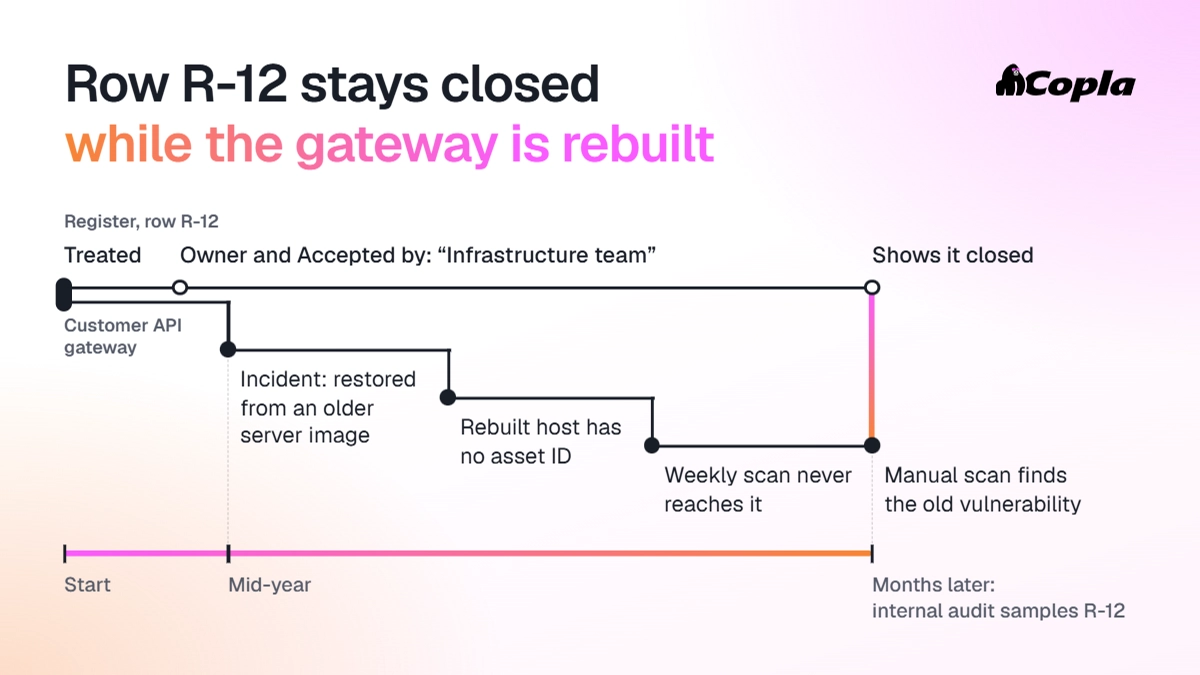
Each failure traces back to a column.
- Asset only covers what someone registered, so the rebuilt host had no row.
- Review date has no way of noticing that a rebuild during an incident may count as a major change.
- Owner and Accepted by name a team with no power to sign off. The CTO, who should have signed the acceptance, never saw the row.
- Framework reference cites the right controls, while the evidence is split across teams, with the patch ticket in infrastructure and the scan record in security.
Process owners, engineers, approvers and auditors all rely on the risk register, and keeping it current is rarely written into anyone’s role.
The MFSA’s report on its 2024 engagements found “insufficient documentation and review of ICT risk registers”. The AFM’s August 2026 DORA update singled out patch and vulnerability management, with logical access management, as areas where firms still have room to improve.
At this level of detail, a spreadsheet only stays accurate through steady manual upkeep. A risk register tool takes over that upkeep, and IT risk management software also connects the register to assets, controls and evidence. In Copla’s GRC platform, each asset is registered once with an owner, and an AI agent drafts risk rows from those records for the team to review. Each risk maps to framework controls for DORA, NIS2, ISO 27001, SOC 2, PCI DSS or MiCA, mitigation tasks are tracked to completion, and approved evidence is shown against the controls it supports. Copla’s in-house CISO team reviews the assessment and validates the gaps it finds. Acceptance stays with your named owners.
Two rules keep the template from becoming just another document for teams that stay on it.
- Nothing goes live without an asset ID.
- A change ticket marked major reopens every row linked to that asset.
To see that link kept for you, Book a demo.