




Vendor management software vs vendor risk management software differences come down to what each tool is built to do. Vendor management software runs the vendor lifecycle: sourcing, onboarding, contracts, performance, spend, offboarding. Vendor risk management software identifies, assesses, and monitors the risk a vendor introduces to your security and compliance.
They overlap at onboarding and contracts but answer to different owners. Most regulated or scaling companies end up needing the risk side, because auditors and enterprise buyers ask about it directly. This guide covers the core difference, where they meet, which one you need, how vendor risk maps to compliance, and what to check for in a compliance and risk management platform.
Vendor Management vs Vendor Risk Management Software, in Short
Vendor management software runs the vendor lifecycle: sourcing, contracts, performance, spend, offboarding. Vendor risk management software identifies, assesses, and monitors the risk a vendor introduces to your security, compliance, and operations.
- Vendor management software optimizes the relationship, the spend, and the process;
- Vendor risk management software protects against what a vendor can cause: a breach, an outage, a compliance failure, concentration risk.
Procurement and vendor managers reach for the first. Security, risk, and compliance teams reach for the second.
What Vendor Management Software Does
Vendor management software runs the vendor lifecycle end to end, and doubles as the central repository for vendor interactions, contracts, and documents, so nobody hunts through inboxes for the current version.
Procurement, finance, and the vendor management office live in it daily, keeping one source of truth for who the vendor is, what they were promised, and what they are being paid.
- Sourcing and selection: choosing and approving vendors before they enter the relationship.
- Onboarding and setup: getting a new vendor into the system; many platforms automate this step to cut the manual data entry that used to eat a coordinator’s week.
- Contract lifecycle management: terms, renewals, and obligations tracked in one place.
- Performance and SLA tracking: whether the vendor is delivering what was promised.
- Spend and payment visibility: tracking what is being paid against contracted terms, to catch drift before renewal.
- Renewals and offboarding: closing the relationship out on schedule, or ending it cleanly.
Its center of gravity is efficiency and the relationship, not risk. Fewer maverick vendors signing outside the approved process. Cleaner contracts with terms that actually get enforced. Some vendor management platforms bolt on risk features, a basic scorecard, a document upload field.
Treat these as a convenience, not a substitute: the software was not built to tell you whether a vendor’s security posture holds up.
What Vendor Risk Management Software Does
Vendor risk management software, also called third-party risk management (TPRM) software, covers the risk side of the same vendor relationships.
The risk itself breaks into a few recurring categories: financial (can the vendor stay solvent), operational (can they keep delivering without disruption), cyber (a vendor’s breach becomes your incident the moment shared data or system access is involved), legal (exposure that follows from handing a vendor sensitive information in the first place), and reputational (a vendor’s failure lands on your name, fairly or not).
- Identification and inventory: one list of every vendor, not three spreadsheets in three departments.
- Risk tiering and categorization: flagging which vendors are actually critical, and which barely matter.
- Due diligence and security questionnaires: vendor due diligence gates access, checking a vendor’s financial stability, security policies, compliance certifications, and reputation before onboarding grants them anything.
- Risk scoring and continuous monitoring: breach alerts, security ratings, and certification expiry, tracked between assessments, not just at renewal.
- Remediation tracking and compliance mapping: tying findings to SOC 2, ISO 27001, DORA, and GDPR.
Its center of gravity is exposure and evidence: can you show, on demand, that you assessed the risk, that it is acceptable or being remediated, and that someone is still watching it.
IT security, legal, compliance, and risk teams are the typical users, not procurement. The work also runs on a cycle, not a single event: due diligence at onboarding, monitoring through the relationship, and a controlled offboarding when it ends, access cut and data returned or destroyed on schedule.
The Core Difference: Efficiency vs Exposure
What question is each tool actually answering? Vendor management software answers: are we managing this relationship well, and are we paying the right amount for it? Vendor risk management software answers: what could this vendor cause, and can we prove we are on top of it?
Neither tool answers the other one’s question, no matter how many features get bolted on.
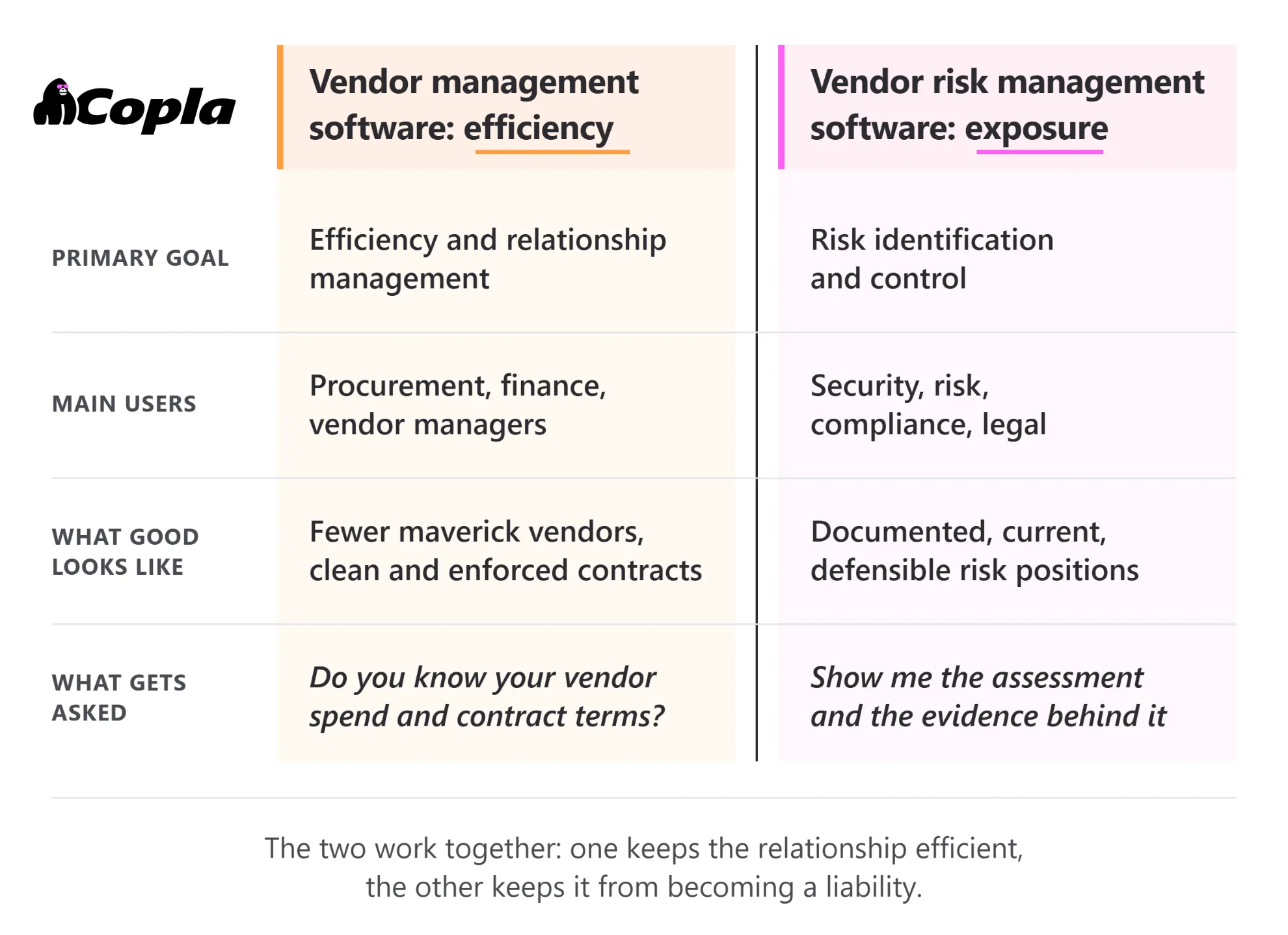
A vendor management platform can track a contract’s renewal date without ever checking whether that vendor’s security posture has slipped since signing. A vendor risk platform can flag a critical vendor’s expired certification without knowing whether you are overpaying for the contract behind it.
| Dimension | Vendor management software | Vendor risk management software |
|---|---|---|
| Primary goal | Efficiency and relationship management | Risk identification and control |
| Main users | Procurement, finance, vendor managers | Security, risk, compliance, legal |
| Core features | Sourcing, contracts, spend, performance tracking | Questionnaires, risk scoring, monitoring |
| Key question answered | Are we managing this relationship well? | What could go wrong, and do we know about it? |
| What “good” looks like | Fewer maverick vendors, clean and enforced contracts | Documented, current, defensible risk positions |
| What an auditor or buyer asks | Do you know your vendor spend and contract terms? | Show me the assessment and the evidence behind it |
The two work together: one keeps the vendor relationship efficient, the other keeps it from becoming a liability.
Where They Overlap
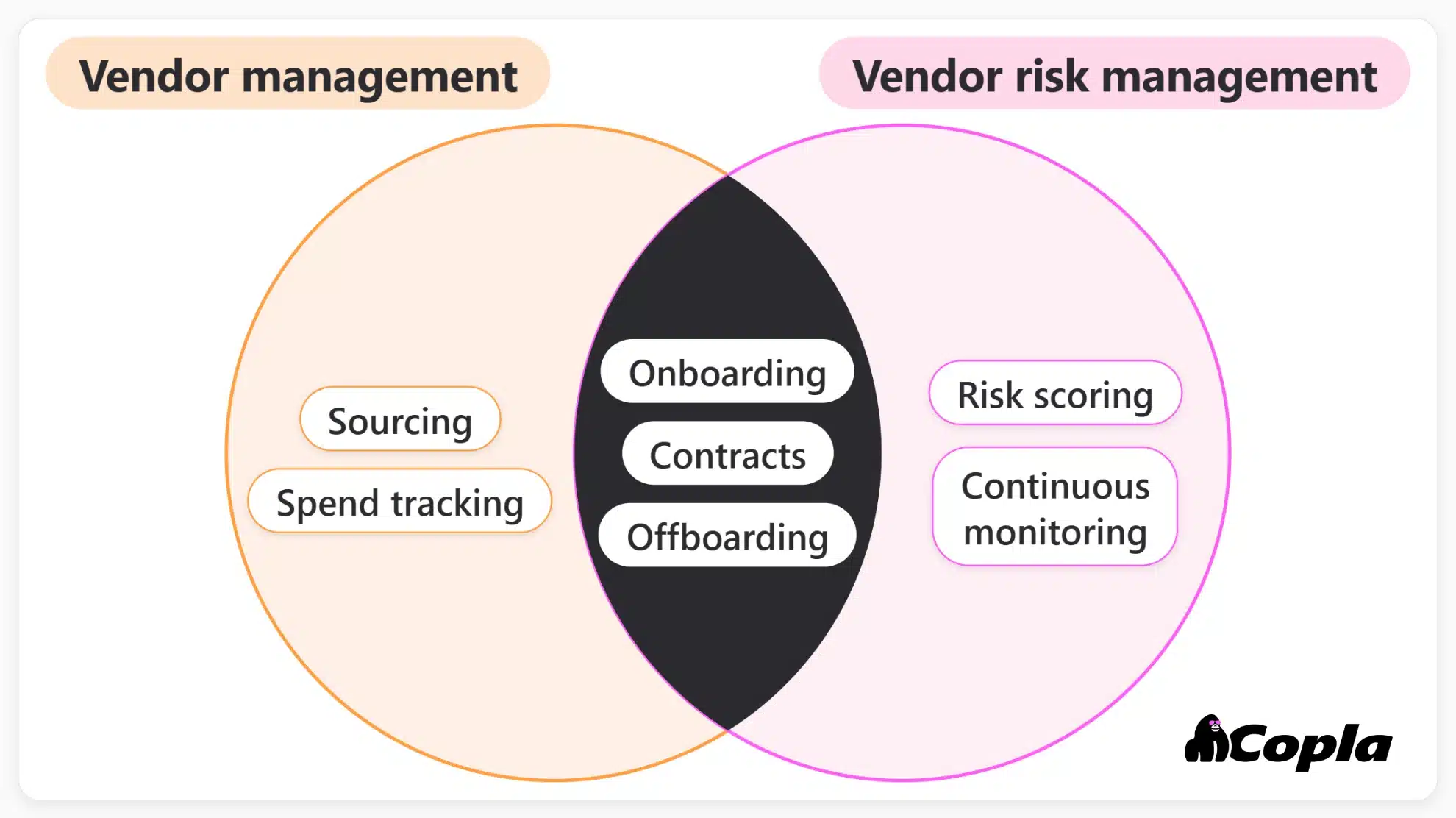
Some platforms claim to do both well. A few genuinely do; most bolt one function onto the other and call it complete. Vendor management and vendor risk management genuinely overlap in three places.
- Onboarding: you onboard a vendor (management) and assess its risk at the same moment (risk), which is why a vendor onboarding risk assessment is the natural place a risk check belongs, not a separate exercise months later.
- Contracts: security and data-handling clauses live inside the same contract lifecycle a vendor management tool tracks for renewal dates.
- Offboarding: revoking access and confirming data return is both a process step and a risk control.
Some platforms bundle both functions; more often, vendor risk management is sold as a module inside a broader GRC suite, or as its own standalone tool.
Which One Do You Need?
Start with the problem, not the product category.
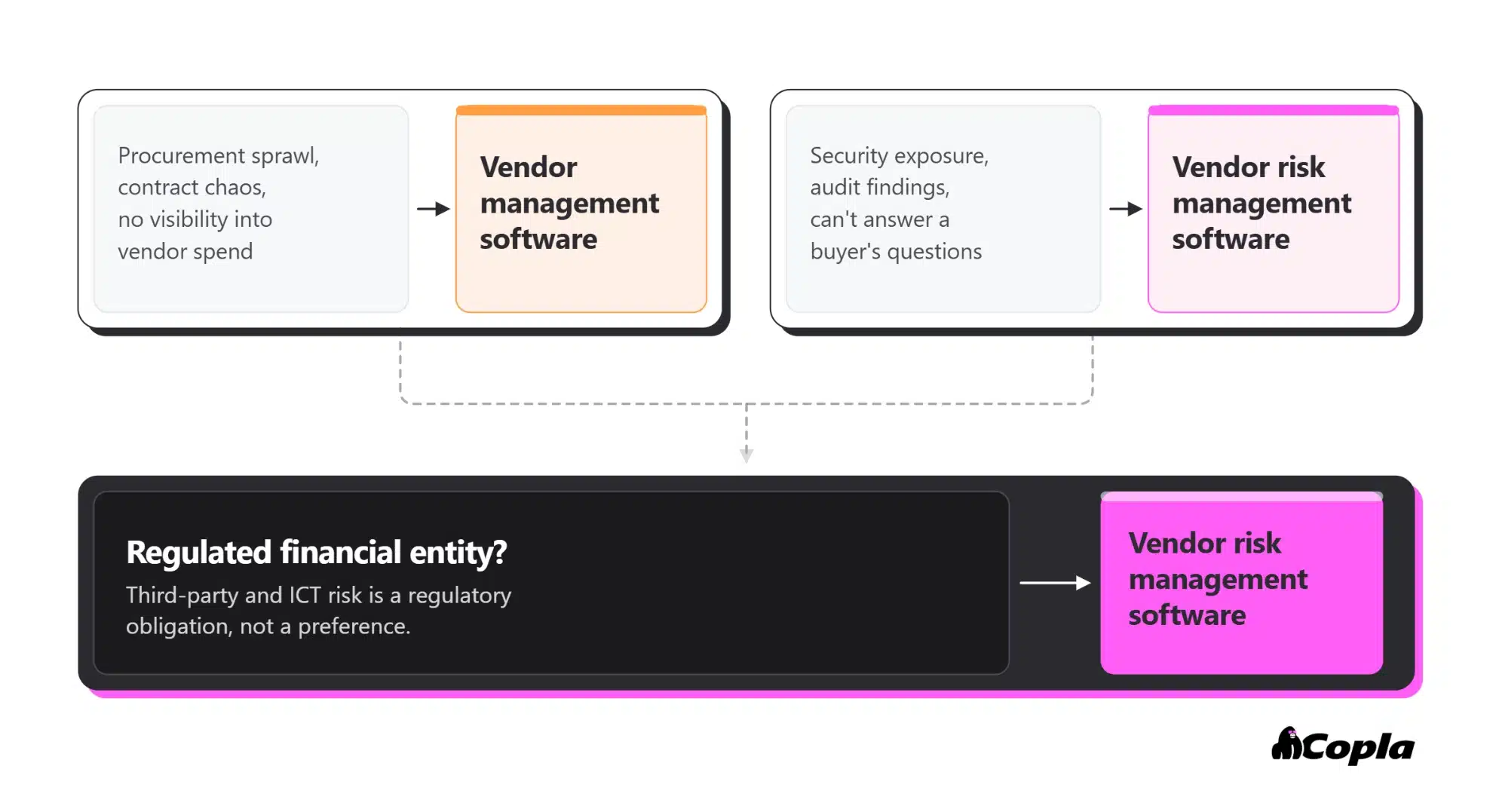
- Procurement sprawl, contract chaos, no visibility into vendor spend: that pulls toward vendor management software.
- Security exposure, audit findings, a regulator or an enterprise buyer asking questions you cannot answer cleanly: that pulls toward vendor risk management software.
For a regulated financial entity, the decision is largely made already.
Third-party and ICT risk is a regulatory obligation, not a preference.
Under DORA, financial entities maintain a DORA Register of Information covering their ICT third-party providers, and manage the risk of the ones classified as critical under a dedicated EU oversight regime.
That register needs structured data from a vendor risk process behind it, not a procurement tool’s contact list.
Most companies need both eventually, for complementary reasons: one for the relationship, one for the risk. But when a deal is stuck in security review or an auditor is waiting on evidence, the risk side is usually what unblocks it first.
How Vendor Risk Management Fits Into Compliance
Why does a compliance officer need risk software specifically, and not just better spreadsheets?
Every major framework in this space writes vendor and third-party risk into its requirements directly, an angle generic procurement-tool comparisons usually miss. ISO/IEC 27001 names it as a control. DORA names it as a register. GDPR names it as a due-diligence duty on processors. The vocabulary changes; the underlying expectation, that you can show your vendor risk work on demand, does not.
| Framework | What it expects on vendor and third-party risk |
|---|---|
| ISO/IEC 27001:2022 | Annex A.5.19 to A.5.22: supplier relationships, agreements, the ICT supply chain, ongoing monitoring |
| SOC 2 | Trust Services Criteria: documented vendor and subservice-organization oversight |
| DORA | Register of ICT third-party providers, added obligations for critical providers |
| GDPR | Article 28: due diligence and contractual terms for processors |
| NIS2 | Supply chain security as part of required risk-management measures |
A compliance-driven buyer needs the risk category specifically, not a procurement tool with a checkbox bolted on, because this is what an ISO 27001 compliance software evaluation or a DORA audit will actually test.
Choosing Vendor Risk Management Software, What to Look For
Feature lists mostly look the same across vendor risk management software. Automation is table stakes now: most tools claim it improves visibility and speeds up assessments. The differences show up in how the tool actually works, not in what the sales deck claims.
- Risk-first, not checklist-first: does it size questions to what a vendor actually exposes you to, or hand every vendor the same generic form?
- A living register: does the vendor list update as contracts and vendors change, or need a manual refresh before every audit?
- Evidence as you go: are certifications and monitoring alerts logged in real time, or reconstructed the week before a review?
- AI-assisted, human-confirmed: some tools now draft first-pass questionnaire answers with AI to speed up the busywork, which only helps if a person still checks what the draft actually says.
- Reusable across frameworks: can you do assessment work once and apply it to DORA, ISO 27001, and SOC 2, or re-answer the same questions each time?
- A human still decides: does someone confirm a vendor’s evidence is sufficient and a gap is acceptable, or does a score decide for you?
A program that can show its work on demand is what earns credibility with a board, an auditor, or an enterprise customer’s security team, the people who actually have to accept the answer.
Copla, for instance, is a GRC (governance, risk, and compliance) platform built around automated risk management: vendor risk sits inside one living register, sized to real exposure, with evidence captured as the work runs rather than reconstructed before a review.
Where Copla Fits
Software handles the mechanics:
- Inventories vendors and keeps the register current.
- Sends and organizes questionnaires.
- Routes evidence to the right reviewer.
- Flags renewals and expiring certifications.
What it cannot do on its own is the judgment: whether a vendor’s evidence is sufficient, whether a gap is acceptable before an auditor sees it, and how a critical vendor should be tiered.
An accountable person inside the organization confirms those calls, and the organization stays responsible for its third-party risk regardless of what the software flags.
Some teams bring that judgment in-house through Copla’s in-house CISO team instead of a consultant, giving questionnaire review, criticality calls, and remediation a senior owner inside the same system as the register and the evidence.
Copla supports that work. It does not make a company compliant or guarantee any audit outcome.
If you are deciding between the two, or trying to work out how much vendor risk work is already owed to a regulator or an enterprise buyer, book a vendor risk management consultation and get a straight answer before the next audit or security review forces one.


