IT risk management software that starts with your whole business
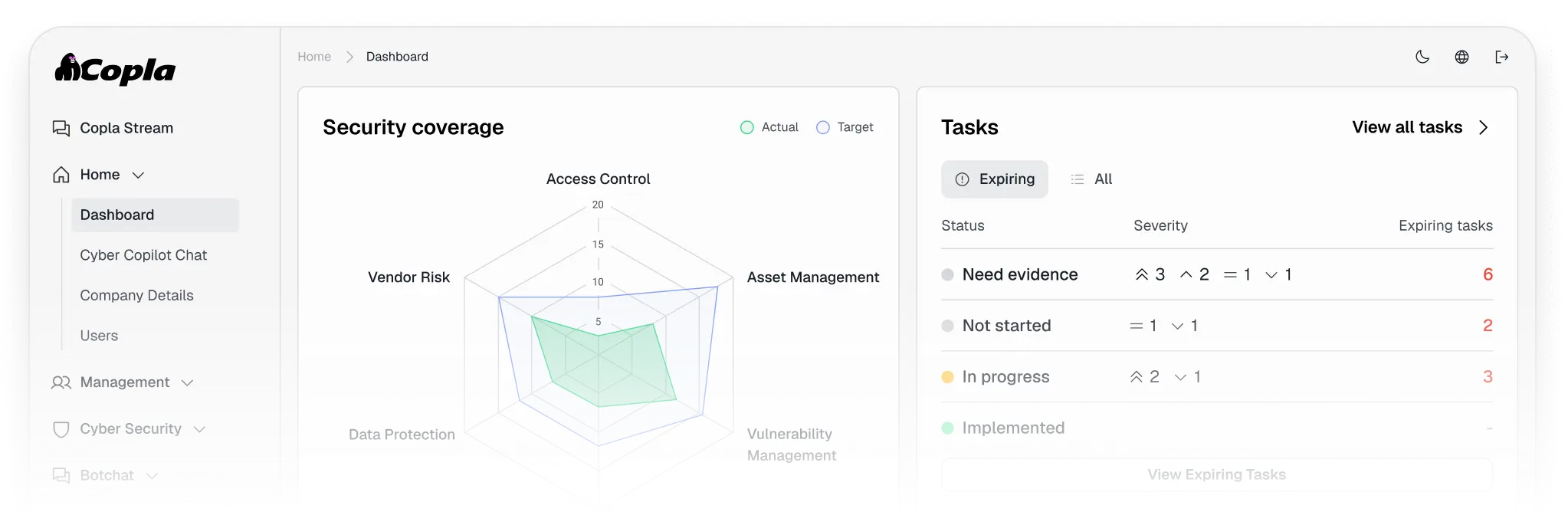
Copla is a GRC platform that runs automated risk assessment across your entire business — IT assets, third parties, and operations — and personalises every result to how you actually operate. Risks carry through to a named owner, with controls and evidence attached, and every judgement call supported by in-house CISOs. That combination is what helps companies manage risk day to day.
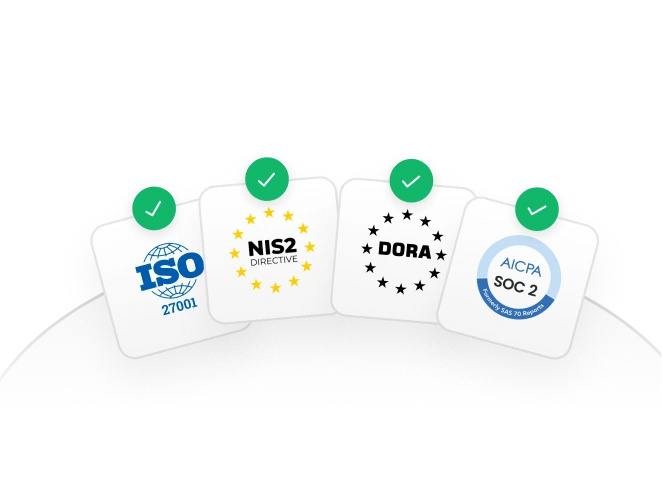
Trusted by companies of every size - from early-stage startups to established financial institutions - to manage risks across DORA, NIS2, ISO 27001 and SOC 2.
How risk assessment works in Copla
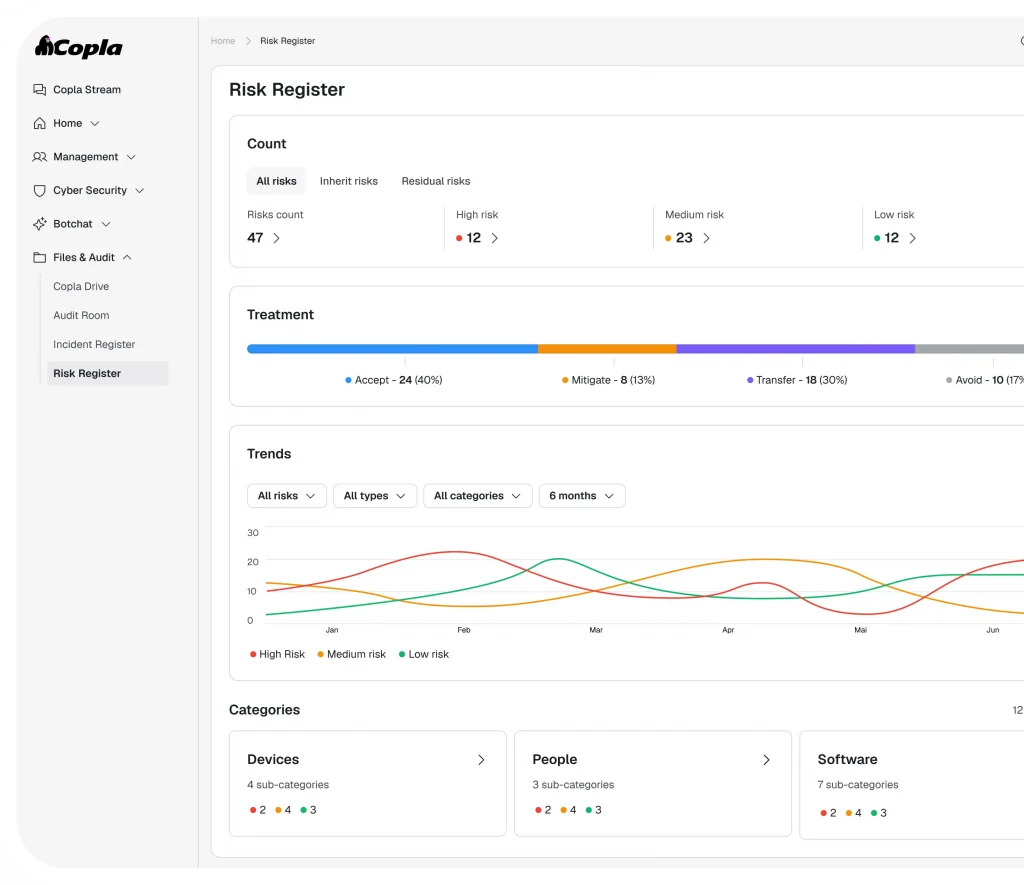
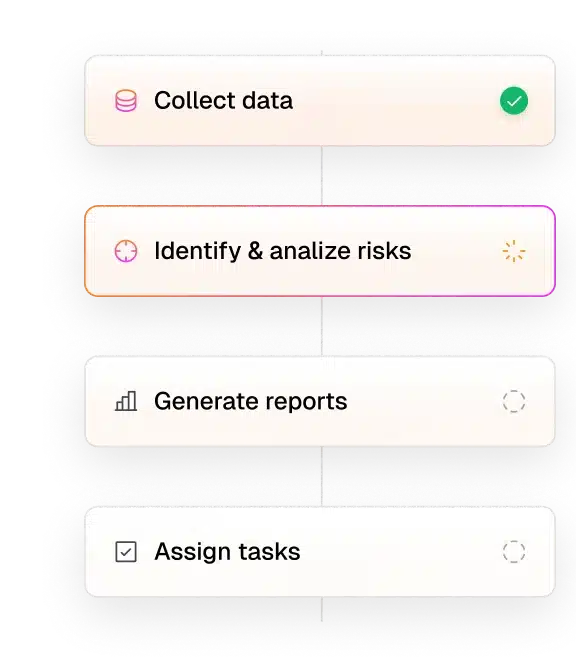
Copla starts with the assets, third parties, and operations your business depends on. It evaluates their impact, turns that into risk exposure, and maps the right controls to each risk. Owners are assigned automatically, evidence is collected against those controls, and in-house CISOs review the judgement calls before they count.
Copla is not a collection of features. It is a system that connects:
IT assets
Mapped through integrations, not inventoried by hand, so asset management stays current.
Risks
Risk identification and scoring against real business impact, structured against the regulatory requirements that ask for them.
Security controls
Sized to your risk profile and mapped to what they satisfy, not a generic checklist.
Automated workflows
Turn controls into tasks, collect evidence, and guide your team through what's left.
Hear from teams who replaced spreadsheets with Copla
"Copla saved us tens of thousands of euros and hundreds of hours. Their expert guidance made DORA compliance effortless."
Zsolt Voros
Program Director, BlockBen
"Copla's CISO-as-a-Service reduced our compliance burden and strengthened our cybersecurity posture, saving over €60K."
Roman Loban
Managing Director, FMpay
"Copla's expertise allowed us to offload 80% of compliance tasks, accelerating our certification."
Algirdas Neciunskas
COO, Axiology
Where IT risk management actually breaks down
Most teams manage risks one of three ways, and each leaves the same hole. Spreadsheets get scored by instinct and rebuilt before an audit. Security tools find problems but produce tickets, not a governed risk register. Traditional enterprise GRC platforms hold everything but need a risk function to fill them in.
Security issues get fixed and tickets get closed, but the risk register often stays the same. The work is done, yet the recorded risk no longer reflects reality.
2
Severity isn't exposure
A critical finding on a low-impact system may matter less than a moderate issue on a business-critical one. Without business context, teams end up prioritising technical severity instead of actual exposure.
3
The risk picture goes stale
Registers get reviewed annually while business operations change monthly. New third parties, systems and controls arrive faster than anyone updates the risk data.
4
The audit trail is missing
When an auditor asks how a risk was scored, treated, and approved, the answer is scattered across tickets, inboxes, and people’s memory.
How we compare
Copla compared to security tools, spreadsheets and traditional enterprise platform
Four realistic ways to manage risks, judged on whether each produces a record a supervisor can read.
Capability
Business impact analysis before prioritisation
Risk register structured for regulatory requirements
Security controls surfaced per risk
Evidence linked to risks and controls
Expert CISO review included
Fit for companies with no security team
Security tooling alone
Spreadsheet register
Free text
Folder links
Traditional enterprise GRC
Separate module
Configuration project
Do the risk work once. Reuse it across every framework.
The same risks, security controls and evidence answer to more than one regulation. Copla ships with DORA, NIS2, ISO 27001, SOC 2, PCI DSS and MiCA built in, and maps each control to every regulatory requirement it satisfies. Need an industry framework that isn't listed? Copla builds it.
80–90%
less compliance work
24/7
Audit-ready at any point in time
100%
Success rate in audits & certifications
How Copla's IT risk management software works, personalised to you
Six steps, built around your environment instead of a generic checklist.
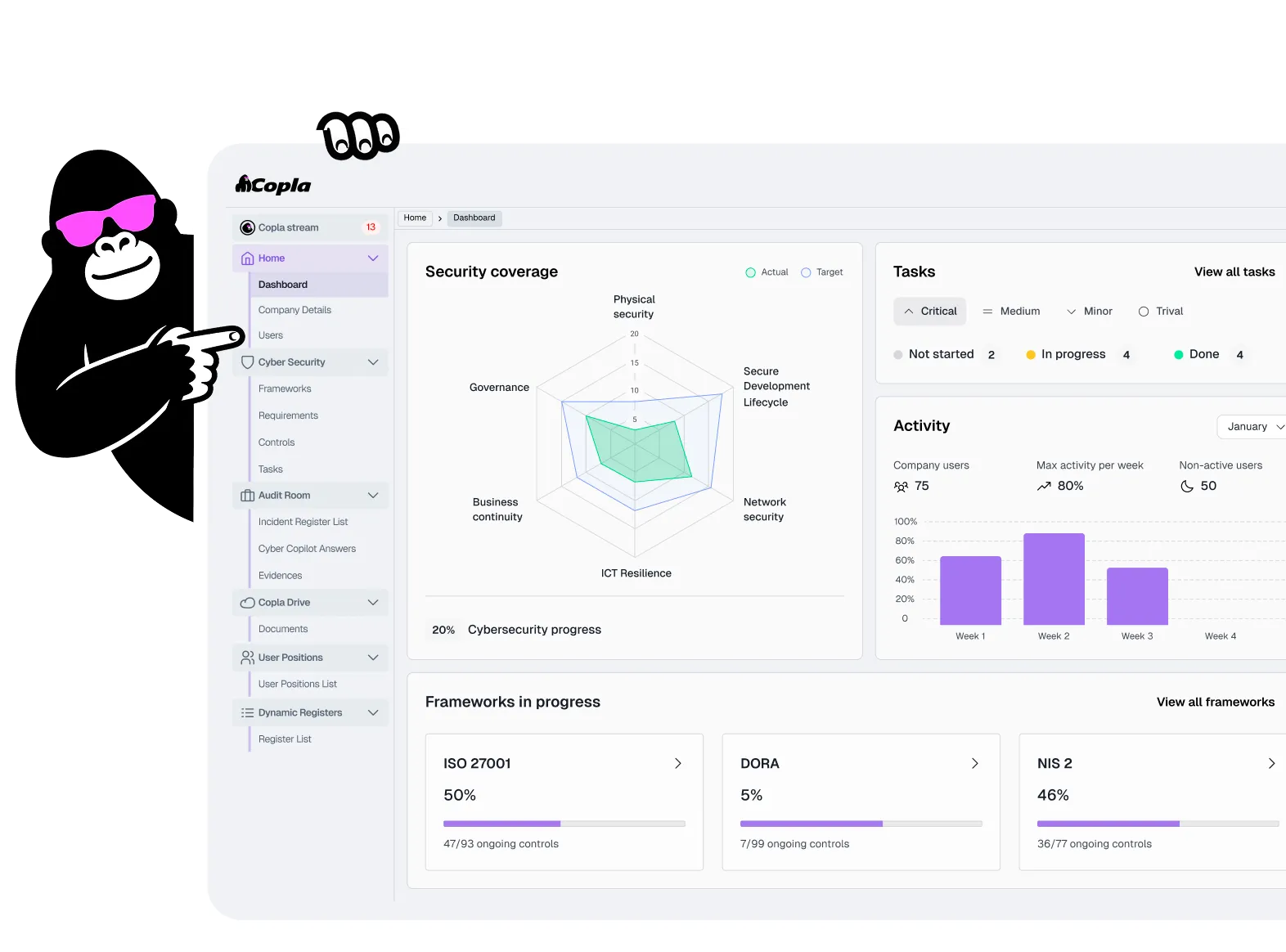
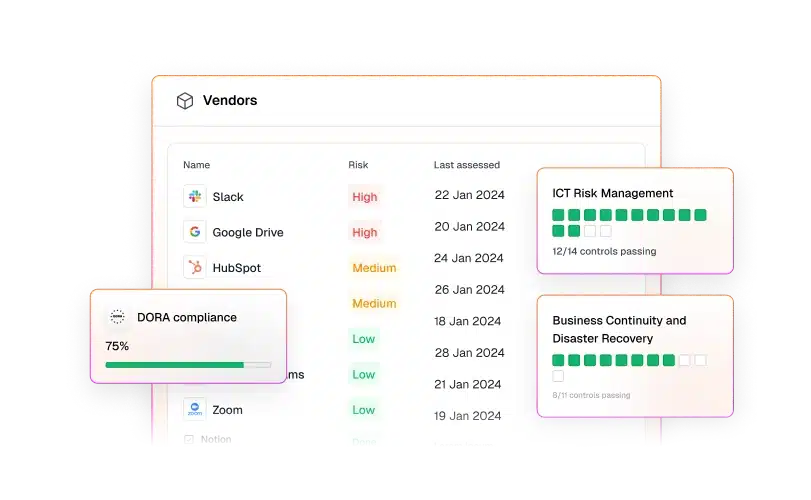
Most risk management solutions hand you every task in a framework and let you work out which ones apply. Copla starts from your IT assets, third parties and business impact, and builds only the work your risk profile requires.
Asset register
A centralized repository of the systems, third parties and processes you depend on, populated through integrations and topped up manually.
Business Impact Analysis
BIA sets which business operations are critical and the recovery objectives behind your operational resilience obligations. Copla drafts it; you or a Copla CISO confirm every row.
Risk management
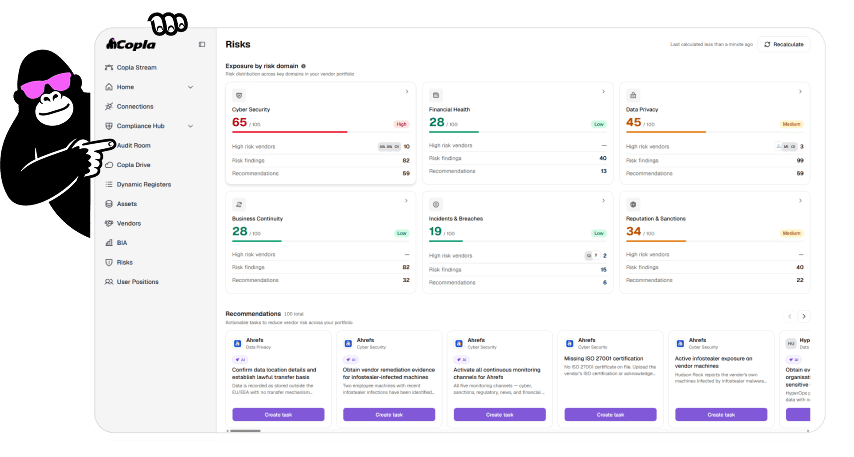
Risk scoring runs consistently on likelihood and impact. Each risk gets a named owner and the security controls that mitigate it, carried through treatment to a residual score, with financial impact quantified in monetary value.
Gap analysis
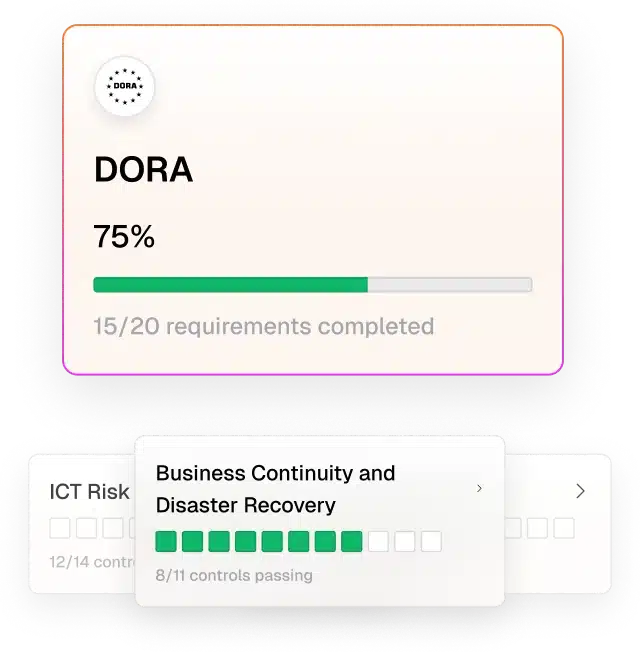
Copla identifies what's missing against DORA, NIS2 and ISO 27001 and turns each gap into a task with an owner and a deadline - one fix, credited across every framework it touches.
AI policy & doc generation
Where a gap needs a document, Copla drafts it from your real inputs rather than pre built templates, then runs it through review, approval and version control.
Evidence management
Evidence attaches to the control and risk it proves, expiring records trigger reminders, and CISOs check control effectiveness before it counts. Auditors get a structured evidence pack from the audit room.
Teams cut the manual side of risk work by up to 80% and reach audit readiness in a fraction of the usual time.
Security services that feed the risk picture
Most risk management software leaves scanning and testing to you, then expects the findings moved into your risk register by hand. Copla runs that work as a service, and the results land in the same system as the risk they affect.
Managed Vulnerability Scanning
Scheduled scans across your cloud environments and external surface, delivered as a prioritised technical report plus an audit-ready summary mapped to ISO 27001, DORA, NIS2 and SOC 2.
Penetration Testing
Expert-led testing of your applications, networks and cloud infrastructure, with vulnerabilities ranked by impact and tracked through remediation efforts and re-testing - a closed loop, not a PDF in a folder "Proof we tried".
CISO as a Service
Copla's in-house CISOs review your risk assessment, validate gaps and sit with you through the audit - available when a decision needs judgement, without a standing consulting contract.
Built for the teams that own IT risk
For CISOs and security teams
Security work mapped to what it satisfies
Security controls ranked by exposure reduced
Gaps converted into owned, dated tasks
For IT teams and engineering owners
Which vulnerabilities matter, and why
One owner, one deadline per task
Technical work tied to a real regulatory requirement
Every risk traces back to a real IT asset and an analysed business impact, not a guess.
Prioritise by what failure
Business impact analysis sets criticality, so effort goes to what carries business operations.
Findings become provable
Gaps turn into owned, dated tasks, and closing them leaves evidence behind.
One risk, every framework
Overlapping regulatory requirements share security controls and evidence, so the work counts more than once.
Scanning, testing and support included
Fewer vendors, and no evidence handoff between them.
Expert judgement where it counts
Copla's CISOs review the risk data so no team is left alone with the hardest calls.
Get started
Ready to see your real IT risk exposure?
Copla connects your IT assets and business impact to scored risks, security controls and evidence - with CISO review included. Book a demo and see the risk register it builds for your environment.
IT risk management software identifies IT and cyber risks, ties them to the assets and third parties behind them, scores exposure, assigns security controls and owners, and produces evidence for auditors. Copla builds that from a business impact analysis, not a template risk register.
What types of risks does it cover?
Cybersecurity risks and emerging threats, operational risk from system failures and outages, compliance risk against regulatory standards, third party risk from vendors, and the exposure carried by cloud environments. Copla holds all of them in one risk register rather than a tool per category, including the security incidents and data breaches that follow when controls fail.
What is the difference between IT risk management and cyber risk management?
Cyber risk management covers the security controls that stop an attack. IT risk management is the governance, risk and compliance layer above it: which risks exist across the entire organization, how likely and how costly they are, whether controls work, and what gets reported. Copla is that layer, and your security tools feed it.
Does Copla replace our security tools?
No. Copla sits above your security tools and turns their findings into a governed risk register with owners, treatment and evidence - what a supervisor asks for.
How does Copla decide which risks matter most?
Through business impact analysis. It sets which business operations are critical, so prioritisation follows real exposure rather than technical severity alone.
How does Copla handle risk scoring?
Consistently, on likelihood and impact, with a named owner and a residual score once treatment is applied. Each risk carries a named owner from identification through to closure.
Can Copla quantify risk in financial terms?
Yes. Cyber risk quantification attaches a monetary value to each risk, so decision making at board level starts from what failure costs rather than a colour on a heat map.
How often should risk and control assessments run?
Continuously rather than annually. Copla re-evaluates risks when IT assets, third parties or controls change, and surfaces new risk events and emerging threats as they arrive, so the risk posture reflects the business now.
How does IT risk connect to enterprise risk management?
A ransomware incident is an IT risk, an operational risk and a financial one at the same time. Copla scores technology exposure so it can sit inside the enterprise risk register the board already reads, instead of arriving as a separate technical report.
Which regulatory standards and industry frameworks does Copla support?
DORA, NIS2, ISO 27001, SOC 2, PCI DSS, MiCA and about 50 others are built in, with security controls mapped across all of them so one piece of work counts more than once.
Can it replace a spreadsheet risk register?
Yes. Risks link to live IT assets, risk scoring follows one method, owners are named, and evidence attaches where it belongs - current by default.
Does Copla cover third party risk management?
Yes. Third parties sit in the same asset register as your systems, carry their own risks and controls, and appear in the same risk posture your board sees.
Does Copla handle vulnerability scanning and penetration testing?
Yes, as scheduled services from Copla's team. Findings and remediation efforts land in the same system as your risk register.
Do we need a security team, and is expert support included?
No security team is required. Copla can be managed by an internal owner, while Copla’s CISOs review your risk posture, validate gaps, and check control effectiveness as part of the platform.