



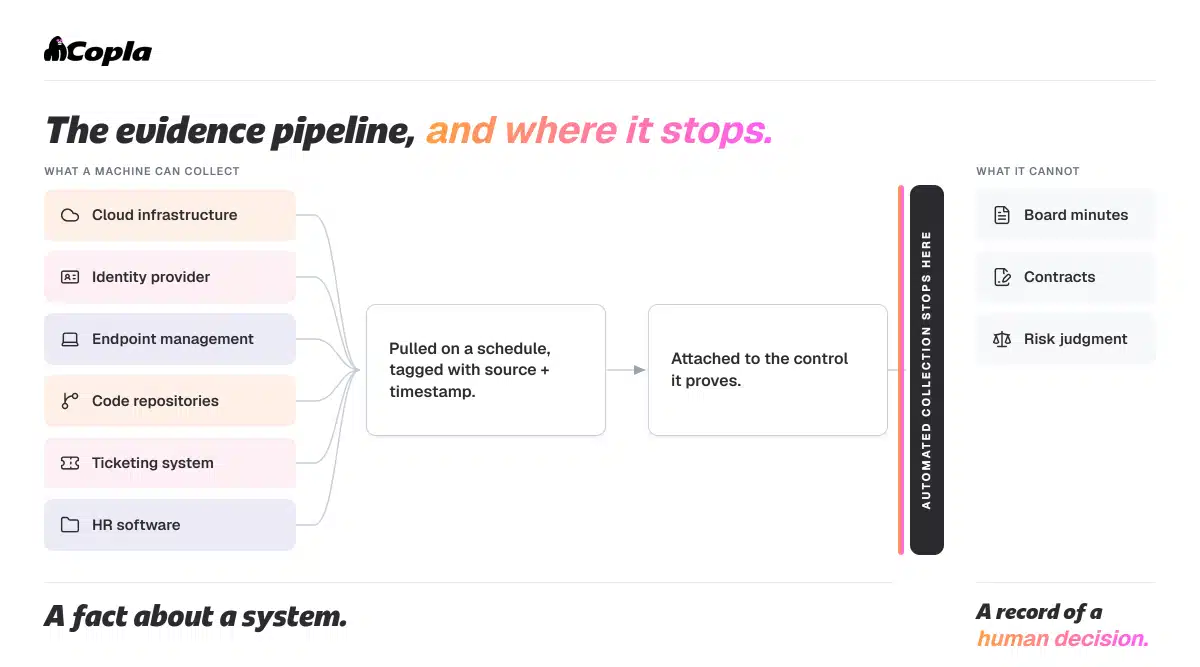
Automated evidence collection connects to the systems that already hold proof of your controls, cloud consoles, identity providers, endpoint tools, code repositories, and pulls what is there on a schedule, tagged with a source and a timestamp. Nobody is manually taking screenshots the week before an audit.
It also has a ceiling.
Configuration evidence, who has access, whether encryption is on, automates cleanly. Board minutes, contracts, exit strategies and the reasoning behind a risk acceptance do not, and no integration count changes that.
What follows: what actually comes back from an integration, why the ceiling moves with your framework, why collected evidence is not automatically valid, and what to ask a compliance and risk management platform before trusting its automation claims.
What automated evidence collection is
Most teams did not arrive here by choice. Compliance requirements now span multiple frameworks at once, evidence sits scattered across disparate systems, and pulling it together by hand invites manual intervention and human error at exactly the point where consistency matters most.
Continuous monitoring, and the automated workflows underneath it, exist to reduce manual effort and take a more proactive approach: catching a misconfiguration, detecting anomalies, or surfacing compliance gaps before an auditor does, instead of reconstructing what happened after the fact. Maintaining audit readiness and a defensible risk posture between audits, rather than rebuilding them under pressure before one, is what continuous compliance is supposed to buy you: the ability to maintain compliance as a standing state, not reconstruct it twice a year.
Organisations that automate this layer lower the operational cost of compliance in one specific place – the hours a team spends re-gathering the same screenshots every quarter, and automating it allows for greater scalability than adding headcount to a manual process ever does.
The layer connects to the systems compliance work actually depends on: cloud infrastructure, the identity provider, endpoint management, code repositories, the ticketing system, sometimes HR software. It captures evidence of the current state from each one on a schedule and attaches what it finds to the control that state is supposed to prove. MFA enforcement gets attached to the access control it satisfies.
Two things separate this from a shared drive full of screenshots, or manual data entry into a spreadsheet:
- First, provenance: every artefact carries where it came from, when it was pulled, and by what;
- Second, repetition: it runs again next week without anyone remembering to ask.
Provenance is the part that matters most to an auditor. Their job is to confirm evidence is complete, unaltered, and actually tests what it claims to test. A screenshot answers none of that on its own; someone has to vouch for it. A machine-collected artefact with a source and a timestamp answers most of it before a person even opens the file, which is the shape of defensible compliance evidence.
That is most of what audit automation software is built to produce. Copla’s asset register works the same way: populated from integrations, with AI-assisted discovery in beta for what those miss.
What actually comes out of an integration
This stays abstract until you look at what actually lands in a control file. An integration returns machine-readable facts about a system: MFA enforcement across the user base, encryption at rest per storage bucket, which accounts still have access after someone has left, whether last night’s backup completed, which pull requests were merged and by whom, patch levels across a fleet of laptops. Six categories cover most of what comes back.
| Control area | What the integration returns |
|---|---|
| Identity and access | MFA enforcement status per user; accounts still active after offboarding; when a privileged role was granted and by whom |
| Infrastructure configuration | Encryption-at-rest status per storage resource; public-facing assets and open ports; logging enabled on critical systems |
| Endpoint | Patch level per device; disk encryption status; whether the EDR or antivirus agent is running |
| Change management | Merge approvals on pull requests, who reviewed them, and whether test results passed before deployment |
| Vulnerability scanning | Open findings by severity and age, whether a corrective action or mitigation plan exists for each, and whether a fix was deployed or only scheduled |
| Personnel / HR | Training completion certificates, policy acceptance records, onboarding documentation tied to a start date |
Every row in that table is a fact about a system, current at the moment it was read. That is the boundary of what automates: a condition a machine can check by querying an API. Security teams gather evidence from the same integrations to confirm implemented controls operate day to day, not just that they were switched on once during setup, and the control evidence that satisfies an auditor often doubles as the first signal of security incidents. That overlap is exactly why the underlying security controls are worth automating in the first place. The moment evidence needs a person to say what happened, or why, the integration has nothing left to read.
What does not automate, and never will
The moment evidence stops being a fact about a system and becomes a record of a human decision, the integration has nothing to read.
That line runs through most compliance programmes, and it is worth walking category by category.
- Board and management oversight. Minutes, approvals, sign-offs on risk appetite. No system holds a record of what a board actually decided in a meeting; someone has to write it down and someone has to file it.
- Contractual evidence. Vendor agreements, exit clauses, service-level terms. These live in contracts, not in APIs.
- Judgment artefacts. Risk assessments, risk acceptance rationales, scoping decisions, exception approvals. An integration can confirm compliance controls exist. It cannot confirm someone weighed the risk of not having them and decided that was acceptable.
- Procedural evidence. That a process was followed, not just that the tool supporting it exists, and not just that the compliance documentation describing the process reads well. A ticketing system can show a change request was logged. It cannot show the change advisory board actually discussed it.
- Third-party attestations. A cloud provider’s SOC 2 report or penetration test summary is their artefact, produced under their process, not yours to pull.
- AI and model governance. Model change approvals, dataset governance decisions, sign-off on what a model is allowed to do before it goes near a customer. These sit in the same place as board minutes: somebody has to make the call before there is anything to log, so the newest category of evidence follows the oldest rule.
For most regulated organisations this is not a rounding error. It is a large share of the evidence file, and it is where in-house expertise still does the work: framing what a risk acceptance should say, structuring an audit room of evidence packs so a reviewer can actually follow the reasoning, representing the organisation when an auditor asks a follow-up question a dashboard cannot answer.
A platform that quietly leaves this out has not removed the work. It has moved it back onto manual processes and whoever gets asked for it next, usually with less warning than a scheduled audit gives.
Copla’s answer is an in-house CISO team that sits inside the same system, rather than a module that assumes the work away.
The ceiling moves depending on your framework
How much of a compliance programme automates has no single answer, because frameworks do not ask for the same kind of proof.
A SOC 2 Type II report for a cloud-native SaaS company sits close to the best case. The criteria map onto system configuration: access controls, encryption, change management, availability. Most of it is technical, so most of it automates, and how DORA and SOC 2 differ becomes obvious fast once you compare the evidence each one actually asks for.
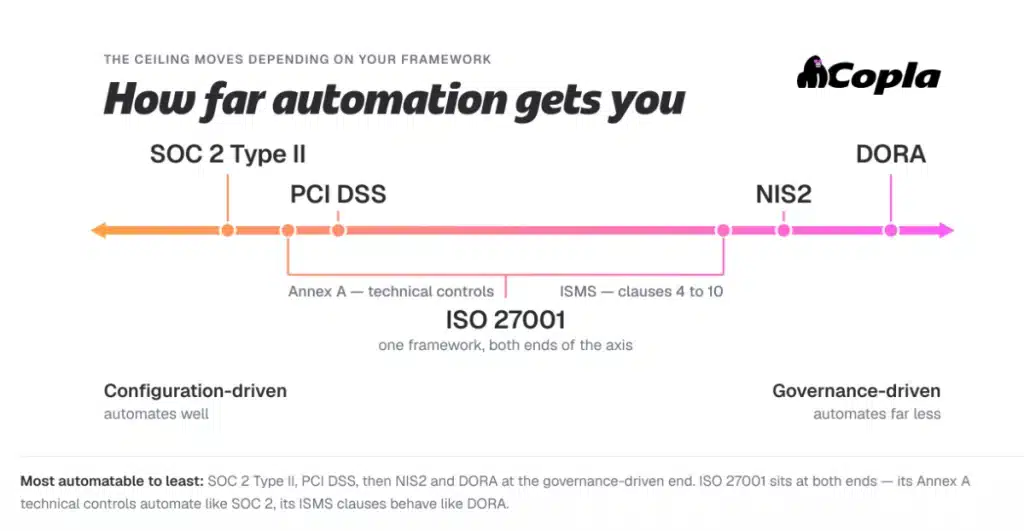
DORA sits close to the other end. Its ICT third-party risk requirements run through contractual arrangements, the DORA Register of Information, exit strategies, and board-level oversight of ICT risk. Most of that is governance, not configuration, and governance is exactly what an integration cannot read. NIS2 sits in similar territory: management-body accountability and risk-management measures are decisions and sign-offs, not settings on a console.
ISO 27001 falls in between. Its Annex A controls cover a technical layer that automates about as well as SOC 2’s. The ISMS sitting on top, risk treatment decisions, management review, internal audit records, does not. PCI DSS leans closer to SOC 2: heavily technical, so more of its testing evidence automates too.
Modern compliance frameworks increasingly talk about continuous controls monitoring instead of a single annual check, and tools that support continuous monitoring can genuinely deliver real-time visibility into the parts of your compliance posture that are technical. Regulatory pressure from multiple frameworks landing on the same organisation, and the multiple audits that come with them, are part of why ongoing assurance sounds so appealing. It still only reaches as far as the configuration layer goes.
| Framework | Where it sits |
|---|---|
| SOC 2 Type II | Closest to fully automatable; criteria map onto system configuration |
| PCI DSS | Close to SOC 2; heavily technical testing evidence |
| ISO 27001 | Split down the middle; Annex A automates, the ISMS layer does not |
| NIS2 | Close to the governance end; management-body sign-off, not configuration |
| DORA | Furthest from automatable; contractual, register-based, board-level |
A platform demoing 90 percent automation on a SOC 2 estate is telling the truth. It is telling you nothing about your compliance posture under DORA.
Collected is not the same as valid
A dashboard counts evidence collected. An auditor assesses whether each one still proves what it claims to prove. Those two things diverge quietly, and the gap is where a lot of automation claims stop holding up.
Three things cause it: evidence expires, a passing test is not always a working control, and even the evidence that is both current and correctly configured still needs someone to read it.
Evidence expires
A policy reviewed fourteen months ago. A penetration test from last year. A training record for someone who left in March. An access review completed before the last reorg. All four are sitting in the repository right now, and none of them are current.
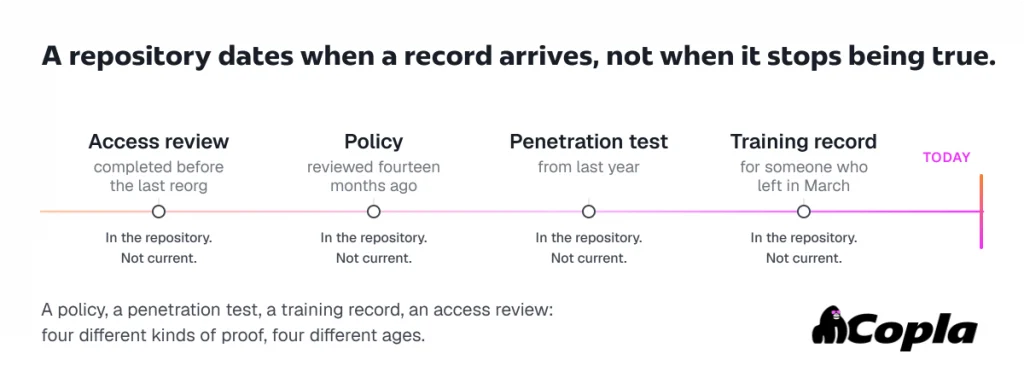
That is the difference between storage and evidence management. A system that only stores files does not know or care that any of this happened. A system that tracks expiry, and prompts the refresh before an auditor finds the gap, is doing something categorically different: it is treating evidence as something that decays, not something that gets uploaded once and left alone. Data retention policies tell you how long to keep a record. They say nothing about whether it is still true.
A passing test is not a working control
An integration confirms the condition it was configured to check. It does not confirm that condition is the right one. MFA enabled on the tenant is not the same as MFA enforced on the one account that actually matters, the admin login nobody rotated after an acquisition, the service account with standing access nobody remembers granting.
That gap is a control design question, and a person answered it once, back when the integration was set up. Automation carries that answer forward every day afterward without ever questioning it again. A test can run correctly and still be testing the wrong thing: confirming a setting is not the same as confirming control effectiveness. None of this is unique to compliance. Automated checks produce false positives and false negatives the same way manual testing does, flagging a misconfiguration that was never actually a risk, or missing one because nobody scoped the check to catch it. Automated tests are only as good as the scope somebody defined for them, and audit scope is a judgment call, not a setting that gets discovered by scanning a system.
Somebody still has to read it
Evidence needs a human to confirm it is sufficient, relevant, and defensible before an auditor ever sees it. That step does not disappear because collection got automated; it just moves later in the process.
Some platforms now use AI to sift through compliance-related data, identify gaps, and flag compliance issues: evidence that looks stale, thin, or mismatched to the control it is meant to support. That is drafting, not deciding: it narrows what a person has to review, it does not remove the person from the loop. Copla’s evidence management works the same way. AI validity review flags what looks wrong or aging out; a person still confirms before anything counts as reviewed. Compliance Copilot is built on that division: automate the flagging, keep the confirming human.
How to tell what a tool actually collects
Every compliance automation tool on the market claims to offer automated solutions built to streamline evidence collection, speed up the collection process, and help you demonstrate compliance, or demonstrate adherence, faster than the last one. Automation capabilities are rarely the real differentiator. The point is not ensuring compliance in the abstract. It is satisfying compliance requirements as your framework and your auditor actually define them, using whichever mix of automated tools and manual steps actually gets you there. Audit fatigue makes it tempting to believe whichever vendor makes the biggest claim. A short list of questions, asked in a demo rather than read off a spec sheet, does more work than any integration count.
- What does each integration you actually care about pull? Many return a list of user names and email addresses and stop there. Ask to see the real output: what it actually collects, not the marketing description of how it claims to pull evidence.
- What is the specific list of tests a given integration runs, and which controls does each one affect? Breadth is the easy number to quote. It is also the least useful one.
- What percentage of your control set can be evidenced automatically, for your framework? Not for their best-case customer on SOC 2. For the framework you are actually being assessed against.
- What happens to the evidence that cannot be automated? Is there a workflow with an owner and a deadline, or does it become your problem the week before the audit?
- How is expiry tracked, and what triggers the refresh?
- How does evidence reach the auditor? A structured pack, or a folder link nobody organised?
- Who fixes the integration when the vendor changes their API?
A vendor who answers these plainly, including where the honest answer is “not much, for that one,” is worth more than one who tells you everything is automated.
For a wider view of how platforms stack up on exactly these points, compliance audit software compared is the place to start.
How much of this applies to your own control set depends on your framework, not on a vendor’s slide. Book a demo to see what Copla’s evidence layer pulls automatically for yours, and what it honestly leaves for your team.