



Information security compliance — infosec compliance — is the process by which an organisation demonstrates that it has implemented the security controls, policies, and procedures required by the frameworks, standards, and regulations that apply to it. It is distinct from security itself: an organisation can have strong technical controls and weak compliance documentation, or vice versa. The goal of a mature infosec compliance programme is to align both — building security measures that genuinely protect information assets and documenting them in a way that satisfies auditors, regulators, and customers. This guide explains what infosec compliance requires, which frameworks apply to financial institutions, how to build a programme that covers multiple requirements efficiently, and what common failure modes look like in practice.
What Information Security Compliance Means
At its core, infosec compliance means being able to demonstrate — to an auditor, a regulator, or a customer — that your organisation manages information security in a structured, risk-based, and documented way. The demonstration requirement is as important as the underlying security practice. Controls that exist but are not documented, tested, or evidenced do not satisfy compliance requirements, regardless of how technically sound they are.
Compliance operates against a defined standard or regulatory requirement. The three most common types of compliance obligation for financial institutions are:
Regulatory compliance: Legally mandated requirements imposed by regulators — DORA for EU financial institutions, NIS2 for operators of essential services, GDPR for any organisation processing personal data of EU residents. The General Data Protection Regulation is a core example of how applicable laws turn data protection and data privacy expectations into enforceable obligations. Non-compliance with regulatory requirements carries the risk of enforcement action, fines, and supervisory sanctions.
Standards-based compliance: Voluntary (but commercially necessary) frameworks such as ISO/IEC 27001, SOC 2, and PCI DSS. These are not legally mandated for most organisations, but they are required by customers, procurement processes, or contractual commitments. ISO 27001 certification has become a de facto requirement for financial services vendors operating in European markets.
Contractual compliance: Security requirements embedded in customer or partner contracts — data processing agreements under GDPR, Business Associate Agreements under HIPAA, and supply chain security clauses under DORA. These create binding security obligations at the contract level, enforceable regardless of broader regulatory applicability.
The Key Infosec Compliance Frameworks for Financial Institutions
ISO/IEC 27001:2022 is the international standard for an information security management system (ISMS). It is the broadest and most globally recognised infosec compliance framework, covering the full lifecycle of information security governance: risk assessment, control selection, policy development, operational security, monitoring, internal audit, and continual improvement. It provides a structured security program for managing security risks, preserving operational integrity, and protecting customer data in a consistent, documented way. Unlike IT security alone, compliance is about aligning security practices with specific legal, regulatory, and contractual obligations to protect digital assets. Certification is awarded by accredited certification bodies and is recognised by regulators and enterprise buyers in most markets. For EU financial institutions, ISO 27001 certification provides the evidence base that satisfies a significant proportion of DORA’s ICT risk management requirements.
DORA — Regulation (EU) 2022/2554 — the Digital Operational Resilience Act — imposes binding requirements on financial institutions and their ICT service providers across five pillars: ICT risk management, ICT-related incident reporting, digital operational resilience testing, ICT third-party risk management, and information sharing. DORA became applicable in January 2025. It is not a voluntary standard — it is a regulation with supervisory enforcement, and non-compliance can result in regulatory sanctions.
NIS2 — Directive (EU) 2022/2555 — the Network and Information Security Directive — extends cyber resilience requirements to a broader range of sectors and organisations than its predecessor. For financial institutions, NIS2 and DORA overlap significantly in their security and incident reporting requirements. The primary distinction is that DORA applies specifically to the financial sector and is more prescriptive; NIS2 applies across critical sectors and allows more Member State discretion in implementation.
SOC 2 is the AICPA’s attestation framework for service organisations. A SOC 2 Type 2 report — covering the design and operating effectiveness of controls over a twelve-month period — is the standard expectation for technology vendors selling into enterprise US markets. For financial institutions and fintechs with US customers, a SOC 2 report is often a procurement requirement before contracts can be signed.
PCI DSS — the Payment Card Industry Data Security Standard — applies to any organisation that stores, processes, or transmits payment card data. For financial institutions handling card transactions, PCI DSS compliance is enforced contractually through the acquiring bank relationship. The current version is PCI DSS v4.0, which became the sole active standard in March 2024.
GDPR — Regulation (EU) 2016/679 — applies to any organisation processing personal data of individuals in the EU. Compliance operates against a defined standard or regulatory requirement, including data privacy rules, evolving data protection requirements, and ongoing obligations under applicable laws. Article 32 requires appropriate technical measures and organisational security measures calibrated to the risk of the processing. GDPR’s security requirements are principle-based rather than prescriptive, but they are most effectively demonstrated through alignment with an established framework such as ISO 27001. In regulatory compliance contexts, that includes the General Data Protection Regulation, under which severe infringements can trigger fines of up to €20 million or 4% of global annual revenue. In contractual compliance contexts, obligations may also reference HIPAA, the Health Insurance Portability and Accountability Act, to protect sensitive information and digital assets. Organisations achieve compliance by documenting and evidencing security practices that support data protection and help defend sensitive data from data breaches.
The Core Components of an Infosec Compliance Programme
Regardless of which frameworks apply, a functional infosec compliance programme requires the same foundational elements.
Governance and accountability. Infosec compliance requires defined ownership at the senior level. The information security function needs sponsorship from the board or executive leadership, a named owner for the compliance programme (typically a CISO or Head of Information Security), and clear accountability for each control area. Under DORA, management body accountability for ICT risk is an explicit requirement. Under ISO 27001, top management commitment is a Clause 5 requirement that auditors test directly.
Asset inventory and classification. Before controls can be applied, the assets that need protection must be identified and classified. An asset inventory covering information assets, systems, people, and third parties — with each asset classified by the sensitivity of the information it holds — is the prerequisite for everything that follows, including information such as customer data, financial data, and intellectual property. Without it, risk assessments are incomplete, scope decisions are unreliable, and access control policies cannot be calibrated to the sensitivity of what is being protected.
Risk assessment and treatment. Infosec compliance frameworks are risk-based: they require you to assess the risks relevant to your environment and select controls that mitigate those risks. The risk assessment must be documented, repeatable, and kept current to identify potential threats and wider security risks. The risk treatment plan must connect each identified risk to the specific controls implemented to address it. Under ISO 27001, the Statement of Applicability connects the risk treatment decisions to the Annex A control set and is one of the most scrutinised documents in a certification audit.
Policies and procedures. Every control area requires documented policies and procedures that tell staff what is required of them. Security policies define the governance framework, while access controls and access management ensure only authorised users can reach systems and data. Access control policy, incident response procedure, change management process, acceptable use policy, data classification policy — these documents are the evidence that controls are intentional and communicated, not improvised. They must be approved by management, communicated to relevant staff, and reviewed at defined intervals as part of a broader security program.
Control implementation and evidence. Policies without implementation are not compliance. Access reviews must be conducted, logged, and evidenced. Patch management must run on schedule with records. Incident response must be tested. Vendor assessments must be completed and documented. Compliance with frameworks such as HIPAA, PCI-DSS, and ISO 27001 is essential to safeguard sensitive data and mitigate legal and financial risks tied to breaches and non-compliance penalties. The evidence of controls operating — not just being designed — is what auditors examine during fieldwork, what regulators request during supervisory reviews, and what customers scrutinise in due diligence.
Monitoring and metrics. A compliance programme that only activates at audit time is not a programme — it is a periodic documentation exercise. Effective infosec compliance requires continuous monitoring: logging and alerting across in-scope systems, access review schedules that run throughout the year, vulnerability management that tracks remediation against defined SLAs, regular vulnerability assessments, and vulnerability assessments that help detect potential security threats between audit cycles. Metrics should show whether controls continue to protect sensitive data and whether technical measures remain effective in practice.
Internal audit. Regular internal audits test whether the compliance programme is operating as designed. They identify gaps before external auditors do, verify that controls are not drifting, and produce the management review inputs that ISO 27001 Clause 9 requires. Teams should also conduct internal audits to confirm controls still work as intended and to surface control gaps early. Internal audit findings, tracked to remediation, are evidence that the compliance programme is self-correcting — which is what continual improvement means in practice.
Common Infosec Compliance Failure Modes
Understanding where compliance programmes typically fail is as useful as understanding what they require.
Compliance as a project, not a programme. The most common failure mode is treating infosec compliance as a project with a defined end point — certification obtained, audit passed — rather than a continuous programme that must be maintained. It should be run as a formal security programme guided by documented policies and recognised best-practice baselines. Controls implemented for an audit drift within months if there is no operational discipline to sustain them. The next audit cycle reveals the same gaps, compounded by the time elapsed.
Evidence collected at audit time, not continuously. Auditors testing operating effectiveness over a twelve-month period will ask for evidence from throughout that period — not just the month before the audit. Organisations that collect evidence retrospectively at audit time frequently cannot produce it for the periods when collection was not a priority. Continuous monitoring means tracking network activity and audit logs in real time to spot anomalies, alongside regular vulnerability assessments. Access review logs that were not timestamped, change tickets that were not linked to approvers, incident records that were not created until after the audit request — these are the artefacts of a programme that runs reactively.
Controls that exist on paper but not in practice. A gap between documented policy and operational reality is one of the most common and most damaging compliance findings. The incident response procedure says incidents are logged within four hours; in practice, they are logged when someone finds time. An actionable response plan should cover detection, containment, and reporting when incidents occur. The access control policy requires quarterly reviews and stronger access management, with multi-factor authentication and least-privilege enforcement defined in documented procedures; in practice, the last review was eight months ago. Regular awareness training also reduces human error, a leading cause of data breaches. Auditors close this gap by testing whether controls operate as described, not just whether the documentation says they should.
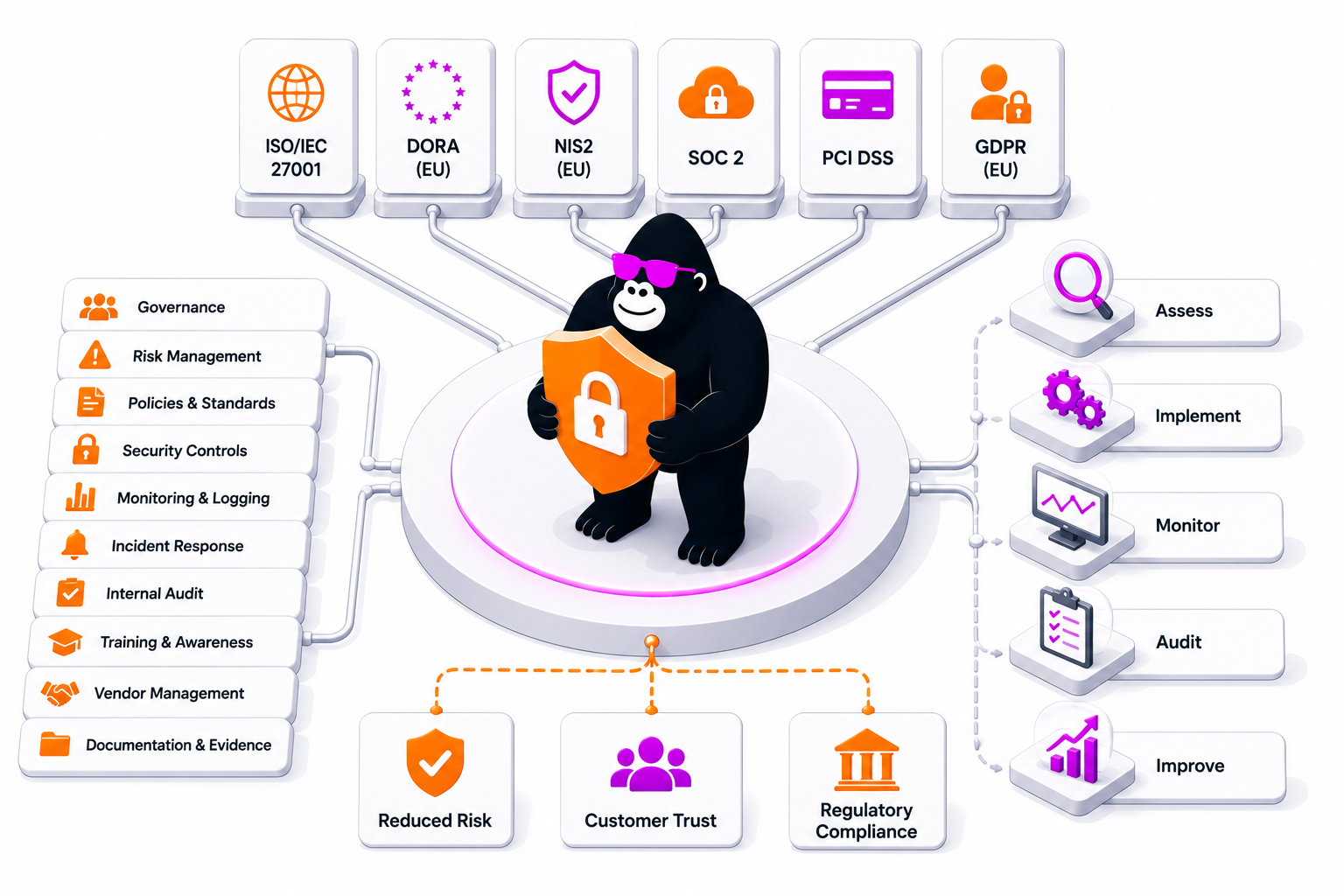
Siloed compliance workstreams. Organisations that run ISO 27001, DORA, NIS2, and SOC 2 as four separate programmes — each with its own policies, risk registers, control frameworks, and evidence repositories — duplicate effort significantly and create inconsistencies between frameworks. The more efficient approach is a single underlying compliance programme, built around a common control set, that maps outward to each framework’s requirements. These compliance frameworks provide a baseline for measuring sound security practices across teams. Controls that satisfy ISO 27001 Annex A frequently satisfy overlapping DORA and NIS2 requirements. Evidence collected for one framework can often be reused for another.
Scope that is too broad or too narrow. Infosec compliance scope defines which systems, processes, and people are covered. Over-scoping creates unnecessary compliance burden on systems that carry no meaningful risk. Under-scoping creates audit findings and potential regulatory liability when material systems are excluded, especially where customer data is involved. Scoping decisions must be defensible — documented with the rationale — and reviewed whenever the organisation’s technology environment changes significantly to maintain ongoing compliance.
How to Build an Efficient Multi-Framework Programme
For financial institutions subject to multiple infosec compliance frameworks simultaneously — the typical situation for EU-based regulated entities — the most efficient programme design starts with the most demanding framework and extends outward.
ISO 27001 is the natural foundation. Its Clause structure (context, leadership, planning, support, operation, evaluation, improvement) provides the governance skeleton that every other framework builds on. Its Annex A control set covers the majority of controls that DORA, NIS2, SOC 2, and GDPR require. Building ISO 27001 first — or refreshing an existing certification — and then mapping outward to identify the incremental requirements of each additional framework and surface any regulatory gaps, is more efficient than building each framework’s compliance programme independently, and treating compliance as an ongoing programme is what helps avoid operational disruptions and legal repercussions.
The incremental requirements above ISO 27001 are typically: DORA’s specific ICT incident classification tiers and reporting timelines, the DORA Register of Information format, DORA’s third-party contract mandatory provisions, NIS2’s national implementation specifics, SOC 2’s Trust Services Criteria for non-security categories (Availability, Confidentiality), and GDPR’s lawful basis documentation and data subject rights infrastructure. Controls that only exist on paper leave organisations exposed to security threats and data breaches. Strong execution also builds trust with customers, partners, and stakeholders, while weak compliance can erode credibility: 87% of consumers say they would not do business with a company if they had concerns about its security practices.
Frequently Asked Questions
What is the difference between information security and infosec compliance?
Information security is the practice of protecting information assets from unauthorised access, disclosure, modification, and destruction. By contrast, it compliance is about demonstrating that controls and processes align with defined requirements, while it security is the operational discipline of implementing and maintaining the technical and organisational safeguards themselves. Strong security without compliance documentation does not satisfy audit or regulatory requirements. Compliance documentation without underlying security controls does not provide genuine protection. A mature programme requires both.
Which infosec compliance framework should a financial institution implement first?
ISO/IEC 27001 is the most appropriate starting point for most financial institutions. It provides the broadest recognised coverage, satisfies the majority of DORA and NIS2 requirements when implemented thoroughly, and is the framework that enterprise customers and supervisory authorities most frequently reference. Compliance frameworks establish a strong baseline for measuring security best practices and protecting sensitive data. Organisations subject to DORA should ensure their ISO 27001 programme addresses the DORA-specific requirements that go beyond the standard’s baseline.
How long does it take to build an infosec compliance programme?
A first-time ISO 27001 certification programme typically takes 12 to 18 months from scoping to certification. Adding DORA compliance to an existing ISO 27001 programme typically requires an additional three to six months of gap assessment and remediation work. SOC 2 Type 2 requires a minimum six-month observation period after controls are implemented. The timelines overlap significantly for organisations running an integrated multi-framework programme, especially where access controls and other shared controls can be evidenced across standards.
What is the role of a CISO in infosec compliance?
The CISO (Chief Information Security Officer) is typically the programme owner for infosec compliance — responsible for the risk assessment methodology, the control framework, the evidence programme, and the relationship with auditors and regulators. In smaller organisations that do not have a full-time CISO, a virtual or fractional CISO model provides the senior security expertise required to own the compliance programme without the cost of a full-time hire.
Infosec compliance is not a destination. Every framework that matters — ISO 27001, DORA, NIS2, SOC 2 — requires continual improvement, ongoing monitoring, and evidence that controls are operating consistently over time to maintain ongoing compliance. The organisations that sustain compliance most effectively are those that build it into their operational rhythm rather than treating it as an annual event: running access reviews on schedule, logging incidents as they happen, tracking vendor assessments in a live register, and maintaining the evidence base continuously rather than assembling it retrospectively at audit time to identify the incremental requirements and the regulatory gaps created by each framework’s additional obligations.
How Copla Supports Infosec Compliance Programmes
We work with financial institutions and regulated organisations to build infosec compliance programmes that are structured for efficiency and maintained continuously as part of a broader security program. The engagement starts with a scoping workshop and gap assessment — establishing which frameworks apply, where the organisation currently stands against each, and what the priority remediation items are before the first audit cycle.
From there, we generate the policy and procedure documentation your auditors will expect, build the risk register and treatment plan in the Copla platform, implement the evidence collection processes that support ongoing compliance between audit cycles, and help teams conduct internal audits to verify controls before external review. Regular auditing helps maintain adherence to frameworks such as ISO/IEC 27001 or PCI-DSS, and data encryption protects sensitive data both at rest and in transit to maintain confidentiality. For organisations subject to multiple frameworks, we structure the programme around shared controls — building once against ISO 27001 and mapping outward to DORA, NIS2, and SOC 2 — so that cybersecurity compliance effort is not duplicated across frameworks.
Schedule a call with Copla to walk through how this would look for your organisation.