




A compliance audit is the moment an outside expert checks whether your company really follows the rules it claims to follow. In most companies it triggers the same painful routine: weeks of digging through folders and inboxes for proof, followed by a long email exchange as the auditor asks for one more file, then another. Compliance audit software ends that cycle. It keeps your security measures, your proof, and your documents connected and current all year, so the audit becomes a review of what is already there. This guide compares the top 10 best compliance audit software tools for 2026 in plain terms, so you can match a platform to the rules you face, the auditors you work with, and the team you have.
- Copla
- Vanta
- Drata
- Secureframe
- Optro
- Hyperproof
- ZenGRC
- Workiva
- TeamMate+
- Diligent
Compliance Audit Software at a Glance
| Platform | Focus | Key frameworks | Expert support | User rating (July 2026) |
| Copla | Compliance platform where the auditor works inside it | ISO 27001, DORA, NIS2, SOC 2, PCI DSS | Yes, security experts included | 4.9 / 5 |
| Vanta | Automatic proof gathering | SOC 2, ISO 27001, HIPAA, GDPR | Auditor and partner network | 4.6 / 5 |
| Drata | Automatic proof gathering | SOC 2, ISO 27001, HIPAA, GDPR, NIST | Auditor and partner network | 4.7 / 5 |
| Secureframe | Automatic proof gathering | SOC 2, ISO 27001, HIPAA, PCI DSS | Templates plus support team | 4.7 / 5 |
| Optro | Audit and risk for large companies | 40+ incl. ISO 27001, SOC 2, DORA | Paid services and partners | 4.6 / 5 |
| Hyperproof | Tracking security measures across several standards | SOC 2, ISO 27001, NIST CSF, HIPAA | Standard vendor support | 4.5 / 5 |
| ZenGRC | Audit and compliance for mid-sized companies | SOC 2, ISO 27001, HIPAA, GDPR | Named contact plus partners | 4.5 / 5 |
| Workiva | Audits and financial reporting | SOX, ESG, financial reporting | Partner network | 4.5 / 5 |
| TeamMate+ | Tools for a company’s own audit team | Works with any standard | Paid vendor services | 4.2 / 5 |
| Diligent | Audits plus board reporting | Internal audit, risk, compliance | Paid services and partners | 4.3 / 5 |
Every rating in this comparison comes from verified user reviews on platforms such as G2, checked in July 2026. Review scores move as new reviews land, so confirm the current listing before you commit.
How We Picked These Tools
We compared each platform on the things that decide a real audit: how the proof gets to the auditor, what happens to the problems the auditor finds, how much human help is included, and what it costs over a full audit cycle. Every rating comes from verified user reviews on G2 and Capterra, checked in July 2026, and every entry includes the complaints reviewers actually make, not just the strengths. No vendor paid to be included.
Get ISO 27001 certified
Getting the certificate typically takes 800+ hours and 4 – 6 months of internal effort, but with the right platform and an experienced CISO, you can move much faster.
What to Look For Before You Choose a Tool
Six questions that show whether a platform will hold up when the auditor arrives, not just look good in a demo.
Does It Cover the Rules You Are Audited Against?
Start with the standards your company actually gets checked against. A US software company usually needs SOC 2, a security report that big customers ask for before they buy. A European company is more likely to face ISO 27001, the international standard for information security, or EU rules such as DORA and NIS2. Many popular tools were built for the US market first, so their support for European rules can be newer and thinner. Ask the vendor to show your standards working today, not promised for later. And if your program covers more than audits, our comparison of the best compliance management software covers the wider category these tools belong to.
How the Auditor Gets to Your Proof
Storing proof is one thing. Letting the auditor work with it is another. In the old model the audit runs over email: the auditor asks for files, your team hunts them down, and the follow-up questions drag on for weeks. The best platforms instead give the auditor a limited login of their own, where the proof is already sorted under the rule it answers. Ask every vendor to show you exactly what the auditor sees.
Audit Readiness and Reusable Proof
Audit readiness simply means being ready when the auditor arrives, instead of starting a panic project two weeks before. Good platforms gather proof quietly in the background all year, which gives you continuous compliance readiness instead of a yearly scramble. If you face more than one standard, also check that the same proof counts toward all of them, so nobody collects the same file three times for three audits.
Automatic Checks Plus Human Help
Audits are decided by judgment calls, not by piles of files. Software can gather the proof, but someone still has to decide whether a security measure truly answers what the rule asks for, and even companies with an in-house expert find that person swamped when audit season arrives. Prefer a platform that pairs the automation with real experts, so those judgment calls are not left to whoever has spare time that week.
What Happens After the Audit
An audit does not end when the auditor logs off. The platform should keep a dated record of exactly what was reviewed and what the auditor decided, and it should turn every problem found into a task with an owner, instead of leaving your team to work through a PDF report by hand. That history pays off: each audit starts from the last one rather than from zero. Problems found in audits also feed your picture of company risks; the tools built to keep that picture current are compared in our risk monitoring software guide.
What It Really Costs
The audit cycle has more line items than the software license: extra fees for additional standards, the audit fee itself, and any consultants you bring in to interpret the rules. Almost no vendor in this category publishes prices, and price increases at renewal are a recurring complaint in reviews, so negotiate multi-year terms early and compare the cost of a whole cycle, not the first quote. Copla sits at the affordable end of this list, with flexible pricing and the expert help included in the engagement rather than billed separately.
The 10 Best Compliance Audit Software Solutions in 2026
1. Copla
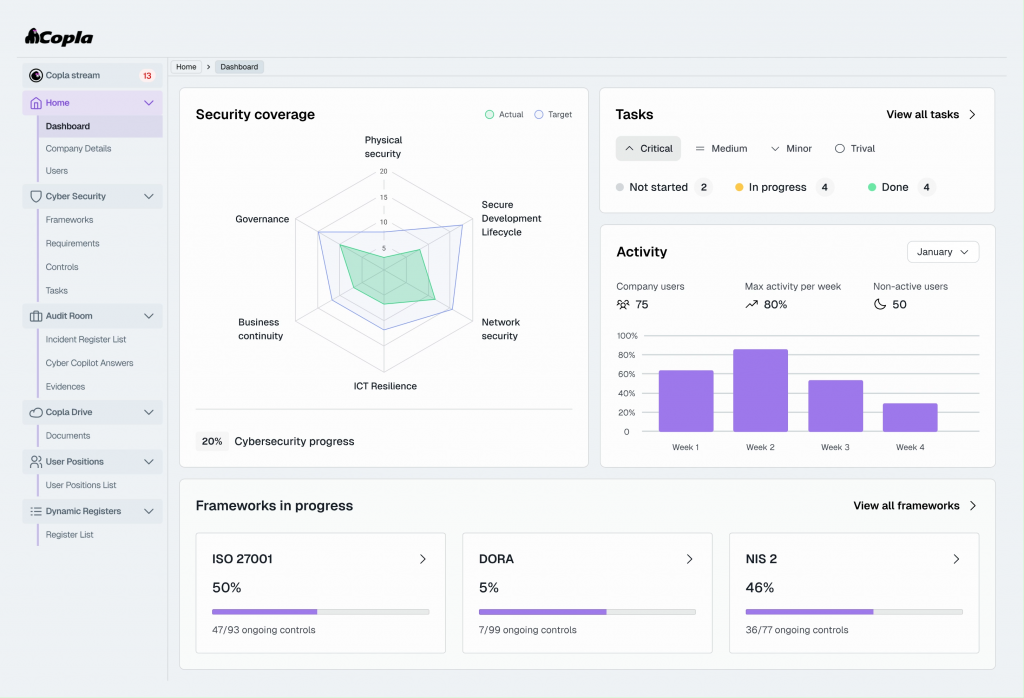
Copla is a compliance platform built in Europe for businesses in regulated industries, pairing AI-driven automation with hands-on help from experienced CISOs (chief information security officers, the people who run security at a company). Fintechs, payment firms, healthcare providers, and software companies use it to run their compliance work end to end, and it holds a 4.9 out of 5 across verified user reviews as of July 2026, with every published review rating it five stars.
The outcome Copla is built for is simple: no more audit scramble. Your proof stays matched to your security measures and current all year, and when the audit arrives, the auditor works directly inside the platform, in the Audit Room, instead of over email. The auditor reviews everything there and gives verdicts, and anything that falls short automatically becomes a task for your team, so problems turn into fixes in minutes rather than weeks. When the audit closes, a dated snapshot saves exactly what was reviewed, and because that history carries forward, every following audit gets faster. Work done for one standard counts again toward others, such as DORA or NIS2, instead of being repeated.
What closes the loop is the people. Copla’s in-house CISOs answer the hard judgment questions and manage the relationship with the auditor through each stage, users report 80 to 90 percent less manual work than running audits in spreadsheets, and pricing stays affordable and flexible, with the guidance included. Copla’s customer case studies show how this works in practice.
- User Rating: 4.9/5 as of July 2026, with 100% of reviews rating it five stars.
- Customer Satisfaction: Praised for a clean interface, guided compliance journeys, responsive support, and proof that stays audit-ready.
- Key Features: The Audit Room where the auditor works inside the platform, automatic tasks from audit findings, dated audit snapshots, risk and asset registers built for you, and proof reused across standards.
- Key Strengths: Auditors work in the platform instead of over email, in-house security experts included in the price, real depth on EU rules, and affordable, flexible pricing.
- Frameworks: ISO 27001, DORA, NIS2, SOC 2, PCI DSS, Cyber Essentials, and MiCA.
2. Vanta
Vanta is an automation platform for software companies that run on cloud tools, aimed first at the US market and SOC 2. It connects to more than 400 tools such as AWS, Google Cloud, and Azure, gathers proof automatically, and gives the audit firm its own view inside the platform to review that proof.
Reviewers note it works best when at least one person in the company owns compliance, because the platform mostly expects you to drive. ISO 27001 costs extra as an add-on and still needs manual proof for offices and people processes, and buyers mention price increases at renewal once the introductory rate ends.
- User Rating: 4.6/5 across roughly 2,350 reviews as of July 2026.
- Customer Satisfaction: Users cite the speed to a first SOC 2 and the breadth of connections.
- Key Features: 400+ connections, hourly automatic checks, automatic proof gathering, auditor access, and a customer-facing trust page.
- Key Strengths: A fast path to a first SOC 2 for US-focused software companies.
- Frameworks: SOC 2, ISO 27001 (add-on), HIPAA, GDPR, PCI DSS, and 35+ in total.
3. Drata
Drata is built for compliance programs that grow more complicated over time. It checks your security measures automatically every day, and its Audit Hub gives auditors a dedicated space to ask for, review, and track proof inside the platform. Its support score in verified reviews stands at 9.6 out of 10.
Reviewers describe the screens as less intuitive than some rivals, the first setup as taking real effort, and the pricing as premium, which can be steep for the smallest teams.
- User Rating: 4.7/5 across roughly 1,100 reviews as of July 2026.
- Customer Satisfaction: Users cite responsive, in-platform support.
- Key Features: 300+ connections, daily automatic checks, the Audit Hub auditor space, and adjustable risk and vendor workflows.
- Key Strengths: Depth that grows along with your compliance program.
- Frameworks: SOC 2, ISO 27001, HIPAA, GDPR, PCI DSS, NIST, and more.
4. Secureframe
Secureframe is built around handling several standards in one place. Its expert-written templates mean a new standard starts roughly 80 percent complete, and its dashboards show how ready you are for each audit, which suits a company juggling SOC 2, ISO 27001, and a privacy rule at once.
The most common complaint is that Secureframe does not publish its prices. Reviewers also note missing connections to niche tools, which creates manual proof work, limited room to adjust workflows for complex processes, and slower screens as the amount of proof grows.
- User Rating: 4.7/5 across roughly 800 reviews as of July 2026.
- Customer Satisfaction: Users cite fast support and ease of use.
- Key Features: Automatic proof gathering, expert-written templates, broad cloud connections, and readiness dashboards.
- Key Strengths: Quick, templated setup across several standards.
- Frameworks: SOC 2, ISO 27001, HIPAA, PCI DSS, GDPR, and a growing list.
5. Optro
Optro is the big-company option, known as AuditBoard until it rebranded in 2026. Large organizations use it to run many audit and compliance programs side by side: the internal audit team, compliance, information security, and risk all share one system, more than 40 standards are supported, and one security measure can count toward several standards while being tested once.
The scale is also the catch. Reviewers say the price makes no sense for teams that do not need the full breadth, and a mid-sized company will find it more than it needs. Getting it running goes through Optro’s services team and large consulting firms, paid separately. If you are weighing this class of platform, our comparison of GRC solution providers covers this enterprise tier in depth (GRC stands for governance, risk, and compliance, the umbrella term for these large all-in-one tools).
- User Rating: 4.6/5 across roughly 1,585 reviews as of July 2026.
- Customer Satisfaction: Users cite audit coordination across large teams.
- Key Features: One system for internal audit, risk, and compliance, AI-driven workflows, supplier risk, and analytics.
- Key Strengths: One audit view for large companies with their own audit departments.
- Frameworks: 40+, including SOC 2, ISO 27001, NIST, DORA, and SOX.
6. Hyperproof
Hyperproof fits organizations where several overlapping standards have turned tracking into a coordination problem: who owns which security measure, what proof is due, and what still needs fixing. It links risks to measures to fixes and keeps audit proof organized by standard and owner.
It is not designed for a first audit: reviewers note gaps in connections and customization, limited built-in reporting, and no built-in approval step, which forces manual workarounds. Prices sit at a premium that scales with company size, and it assumes a compliance program is already running.
- User Rating: 4.5/5 across roughly 213 reviews as of July 2026.
- Customer Satisfaction: Users cite support quality and how it keeps security measures and proof organized.
- Key Features: Central tracking of security measures, work reused across standards, proof gathering, and links from problems to fixes.
- Key Strengths: Clear oversight for established programs juggling several standards.
- Frameworks: SOC 2, ISO 27001, NIST CSF, PCI DSS, HIPAA, GDPR, and a large library.
7. ZenGRC
ZenGRC is a mid-market platform focused on straightforward compliance and audit management across several standards. It keeps security measures, proof, and auditor requests in one place, and each customer gets a named customer success manager with expert advice during onboarding.
Reviewers point to limited built-in reports and dashboards, weak sorting and filtering in the screens, and setup that can get complicated without skilled staff. Connecting older in-house systems often needs custom technical work.
- User Rating: 4.5/5 across roughly 104 reviews as of July 2026.
- Customer Satisfaction: Users cite ease of use and responsive support.
- Key Features: Security measures and proof in one place, tracking of auditor requests, and support for several standards.
- Key Strengths: Approachable audit management for mid-sized teams.
- Frameworks: SOC 2, ISO 27001, HIPAA, GDPR, and more.
8. Workiva
Workiva is a cloud platform for audits, SOX (a US financial reporting law for public companies), sustainability reporting, and financial reporting, used heavily by public companies. Its idea is one source of data feeding many reports and audit documents, with live collaboration, a record of who changed what and when, and built-in checks.
Reviewers describe it as expensive, with the advanced automation costing extra, and note slow performance on large documents and a steep learning curve. It is a reporting tool first, so buyers who mainly need audit help should check their own use case closely.
- User Rating: 4.5/5 across roughly 1,800 reviews as of July 2026.
- Customer Satisfaction: Users cite the live collaboration and connected reporting.
- Key Features: One set of data behind reports and audit documents, multi-user collaboration, a record of every change, and access controls.
- Key Strengths: Audit work tied directly to financial reporting data.
- Frameworks: SOX, sustainability (ESG), and financial reporting, plus audit workflows.
9. TeamMate+
TeamMate+ by Wolters Kluwer is built for the auditors themselves, with three decades of history in the audit profession. It handles the auditor’s side of the job: planning audits, managing the files and notes an audit produces, coordinating audit teams, and organizing what was found.
Reviewers consistently criticize its reporting, saying custom reports and workflows are hard to build, along with slow performance on large audits and occasional glitches. It also manages only the audit process itself: your company’s compliance proof lives elsewhere, so files still get exchanged outside the platform.
- User Rating: 4.2/5 across roughly 341 reviews as of July 2026.
- Customer Satisfaction: Users cite centralized audit organization and document management.
- Key Features: Audit planning, document management, team coordination, and adjustable workflows.
- Key Strengths: Purpose-built for internal audit teams.
- Frameworks: Works with any standard; supports internal audit methods across industries.
10. Diligent
Diligent, through its Diligent One Platform, is a long-established name in audit and governance. Its specialty is connecting audit, risk, and compliance work with reporting to the board of directors, which suits organizations where the board and its audit committee follow audit results closely.
The criticisms are a steep learning curve, weak onboarding for beginners, and occasional stability problems around frequent updates. Like the other large platforms here, it rewards companies with the time and people to adopt it properly.
- User Rating: 4.3/5 across roughly 150 reviews as of July 2026.
- Customer Satisfaction: Users cite feature depth and support.
- Key Features: Audit, risk, and compliance in one place, board reporting, and analytics.
- Key Strengths: Audit results connected to board-level reporting.
- Frameworks: Internal audit, company-wide risk management, IT and supplier risk, compliance, board governance, and sustainability reporting.
Honorable Mentions
Sprinto is a compliance automation tool for startups going for a first SOC 2 or ISO 27001, rated 4.8 across roughly 1,650 reviews as of July 2026. Reviewers mention occasional bugs, delays in the automatic proof gathering, and a setup first-timers can find overwhelming.
Scrut supports more than 60 standards with help from dedicated compliance experts, rated 4.9 across roughly 1,312 reviews as of July 2026. Reviews repeatedly mention sync problems with the small program it installs on laptops, and prices are available only on request.
Thoropass combines compliance software with its own in-house audit firm, rated 4.7 across roughly 570 reviews as of July 2026. The trade-offs are more manual proof gathering than reviewers expect, fewer connections, and no option to bring your own auditor.
How Copla Supports Compliance Audits
We work with regulated businesses across Europe that need to pass audits without turning each one into a weeks-long project. The platform keeps your security measures and proof current all year, your auditor works directly in the Audit Room when the audit arrives, problems become tasks automatically, and a dated snapshot saves each audit so the next one starts from history instead of from zero. Your dedicated CISO handles the judgment calls in-house, and we manage the relationship with the auditor through every stage.
Schedule a call with Copla to walk through how this would look for your next audit.


