



Most companies evaluating compliance management software are not simply trying to “do compliance”, they are seeking a comprehensive compliance management platform that centralizes and automates compliance processes to efficiently manage the entire compliance lifecycle. In today’s evolving regulatory landscape, organizations must adapt to changing regulatory requirements across multiple frameworks and jurisdictions. Selecting the best compliance management tools and compliance monitoring software is essential for ongoing compliance, streamlining audit readiness, and reducing manual work that fills spreadsheets and shared drives. This guide compares the top 10 best compliance management software platforms for 2026 in plain terms, so you can match a tool to your industry, your rules, and your team size.
- Copla
- Vanta
- Drata
- Sprinto
- Secureframe
- Formalize
- Optro
- OneTrust
- Hyperproof
- Scrut
Compliance Management Software at a Glance
The table below shows how the ten platforms compare on the points that decide most purchases: the frameworks they support, whether they start from your risks or from a ready-made checklist, whether expert help is included, and how their users rate them.
| Platform | Key frameworks | Where it starts | Expert help included | User rating (July 2026) |
| Copla | ISO 27001, DORA, NIS2, SOC 2, PCI DSS, Cyber Essentials | Your risks | Yes (own security experts) | 4.9 / 5 |
| Vanta | SOC 2, ISO 27001, HIPAA, GDPR, Cyber Essentials | A checklist | No | 4.6 / 5 |
| Drata | SOC 2, ISO 27001, HIPAA, GDPR, NIST, Cyber Essentials | A checklist | No | 4.7 / 5 |
| Sprinto | SOC 2, ISO 27001, HIPAA, GDPR, Cyber Essentials | A checklist | No | 4.8 / 5 |
| Secureframe | SOC 2, ISO 27001, HIPAA, PCI DSS, GDPR, Cyber Essentials | A checklist | Partial | 4.7 / 5 |
| Formalize | GDPR, NIS2, DORA, ISO 27001, Cyber Essentials | A checklist | No | 4.9 / 5 |
| Optro | 40+ including ISO 27001, SOC 2, NIST, DORA, Cyber Essentials | A checklist | No | 4.6 / 5 |
| OneTrust | GDPR, CCPA, ISO 27001 (partial), Cyber Essentials | A checklist | No | 4.3 to 4.6 / 5 |
| Hyperproof | SOC 2, ISO 27001, NIST CSF, HIPAA, GDPR, Cyber Essentials | A checklist | No | 4.5 / 5 |
| Scrut | SOC 2, ISO 27001, GDPR, PCI DSS, 60+, Cyber Essentials | A checklist | Partial | 4.9 / 5 |
Ratings are based on verified user reviews on platforms such as G2, as of July 2026, and are subject to change.
How We Picked These Platforms
We compared the things a buyer actually feels: which frameworks each platform covers, how much of the work it does for you, how much human help is included, and what it costs over time. Every rating comes from verified user reviews on G2 and Capterra, checked in July 2026, and every entry includes the complaints reviewers actually make, not just the strengths. No vendor paid to be included.
What to Look For Before You Choose a Tool
Does It Cover the Rules You Actually Face?
Start with the obvious question: does the tool support the frameworks you need, and who will be checking your work? A European bank or fintech needs ISO 27001 (the international standard for information security) and DORA (the EU’s rulebook for keeping technology at financial firms reliable). An energy, healthcare, or digital provider may fall under NIS2 (an EU cybersecurity law for essential sectors). Many popular tools were built for the US market first, so their support for European rules like DORA and NIS2 can be newer and thinner. DORA in particular expects detailed proof of how you manage technology risk and keep an eye on suppliers, the kind of proof many automation tools were not designed to produce. If DORA applies to you, it is worth running a DORA gap analysis early to see where you stand, and checking that a tool can meet the specific DORA audit requirements you will face.
Does It Start From Your Risks?
Some tools hand you a long list of security measures and say: do all of these. The better ones first ask what could actually go wrong in your business, then recommend only the measures that address those risks.
How Much Human Help Is Included?
Some platforms are pure software: they automate the busywork and leave the thinking to you. That works when you have a capable compliance expert on staff with time to spare. In practice, even companies that do have an internal expert find that person pulled onto more urgent work, and the judgment questions, like what a DORA or NIS2 requirement actually means for your business, still need answering. If you do not have that expertise in-house, or your expert’s time is already spoken for, the strongest setup is software plus people: a tool that handles the mechanical work, paired with experienced experts who make sure the results fit your business and hold up in front of an auditor. A platform that generates a policy from a template is helpful. A platform, or a partner, that makes sure the policy will survive an audit is more helpful still.
Can It Get You Through an Audit Without a Panic?
The real test of any compliance tool comes a few weeks before an audit. Can your team pull together complete, up-to-date proof without a scramble? Good platforms collect proof quietly in the background so it is always ready, giving you continuous compliance readiness rather than a yearly panic. Just as important: if you follow more than one framework, the same piece of proof should count toward all of them. A platform that connects its measures across frameworks, so an access record gathered for ISO 27001 also satisfies DORA or SOC 2, saves enormous amounts of time compared with collecting the same proof twice. Look for live records of who did what and when, results of security checks, and a note of who approved which policy, all available the moment you need them. If the audit itself is your biggest pain point, we compare the tools built specifically for that in our compliance audit software guide.
Is It Easy to Use, and Is the Support Good?
A compliance platform only helps if your team actually uses it, and reviews show this is where tools differ most. Some are praised for fast, expert support, with Copla, Drata, Scrut, and Secureframe scoring especially well. Others can feel overwhelming to a small team that has nobody dedicated to compliance. If you do not have an in-house expert, weigh onboarding help and support quality heavily, or choose a platform that builds expert guidance into the service.
What It Really Costs
Price is the factor buyers check last and regret first. Most vendors in this category publish no pricing at all, quotes vary widely with company size and framework count, and reviewers across several platforms report significant increases at renewal once an introductory rate ends. Budget not just for year one but for the full picture: the license, framework add-ons, the audit itself, and any consultants you need to fill gaps in expertise. Platforms differ meaningfully here. Copla, for example, is one of the more affordable options on this list and is flexible on pricing, with the expert guidance included in the price instead of billed as separate consultancy, which makes the total easier to predict for small and mid-sized teams.
The 10 Best Compliance Management Software Tools in 2026
1. Copla
Copla is a European compliance platform that pairs AI-driven software with hands-on help from experienced CISOs (chief information security officers), built for regulated industries in Europe. It works with a wide range of fintech and payment firms, but also healthcare providers, software companies, and other businesses that operate under strict rules. It is one of the highest-rated platforms here, holding a 4.9 out of 5 across verified user reviews as of July 2026, with every published review rating it five stars.
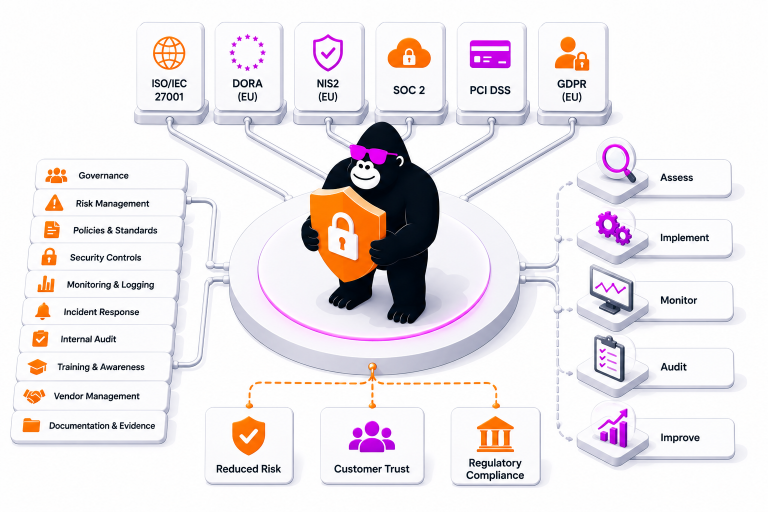
What sets Copla apart is that it starts from your risks, not from a checklist. Most platforms hand you every security measure in a framework and ask you to work through the list. Copla instead asks what your business actually looks like: your systems, your data, and your suppliers. From those real answers it builds a risk register (a list of what could go wrong in your business) and a list of your assets, then recommends only the measures that fit your actual situation, with a clear reason for each. The same work counts toward several frameworks at once, so proof gathered for ISO 27001 can be reused for DORA or NIS2 instead of collected twice. Focusing on the measures that genuinely apply, rather than all 93 in the ISO 27001 standard, is exactly the documented reasoning auditors look for.
Because Copla was built for European regulation rather than adapted to it, it goes deep where US-first tools stay shallow. For companies under DORA, it covers the harder duties: managing technology risk, tracking third-party suppliers, reporting incidents, and keeping the detailed supplier register regulators expect. Its AI assistant, Copla Stream, guides teams through tasks in real time, and users report 80 to 90 percent less manual work than running everything in spreadsheets.
The blend of software and people is the real draw. Instead of buying a tool and then hiring separately to make sense of it, you get both in one engagement: the platform generates the documents and tracks the measures, and Copla’s in-house CISOs handle the judgment calls and the relationship with the auditor through each stage of assessment. Proof stays current in the platform, so audit preparation becomes ongoing upkeep rather than a one-off scramble. Pricing works in Copla’s favor too: it is one of the more affordable platforms in this comparison and flexible on pricing, with the expert guidance included rather than billed as a separate consultancy line. Copla’s customer case studies show how this works in practice.
- User Rating: 4.9/5 as of July 2026, one of the highest on this list, with 100% of its roughly 80 verified reviews rating it five stars.
- Customer Satisfaction: Praised for a clean interface, guided compliance journeys, responsive support, and proof that stays audit-ready.
- Key Features: Risk and asset registers built from your answers, work that counts toward several frameworks at once, automatic policy and document generation, supplier risk management, the Copla Stream AI assistant, and bundled CISO consultancy.
- Key Strengths: In-house security experts included in the engagement (not routed to a third party), a risk-based method auditors trust, genuine depth on EU rules, affordable and flexible pricing compared with the large US incumbents, and up to 80 to 90 percent less manual work than spreadsheets.
- Frameworks: ISO 27001, DORA, NIS2, SOC 2, PCI DSS, Cyber Essentials, and MiCA.
2. Vanta
Vanta is a compliance automation platform for companies that run mostly on cloud tools. It connects to more than 400 of them, including AWS, Google Cloud, Azure, and GitHub, and collects proof automatically, so your compliance status stays current without anyone taking screenshots by hand.
Vanta’s core use case is SOC 2, the US security report many enterprise customers ask for, which makes it primarily aimed at the US market. It supports ISO 27001 and dozens of other frameworks as well, but ISO 27001 costs extra as an add-on, and because its checks work through software connections, the physical and people-related parts of ISO 27001, such as office security, still need manual proof.
Vanta is largely self-service. Reviewers note that it works best when at least one person in the company owns compliance, and buyers mention price increases at renewal once the introductory startup rate ends.
- User Rating: 4.6/5 across roughly 2,350 verified reviews as of July 2026.
- Customer Satisfaction: Users cite the speed to a first SOC 2 and the breadth of connections.
- Key Features: 400+ connections, automatic checks every hour, around 90% of proof collected automatically, a customer-facing trust page, and an AI agent.
- Key Strengths: A large connection library and a fast path to a first SOC 2 for US-focused software companies.
- Frameworks: SOC 2, ISO 27001 (add-on), HIPAA, GDPR, PCI DSS, and 35+ in total.
3. Drata
Drata is a compliance automation platform built for programs that grow more complex over time. It checks your security measures automatically every day and lets you adjust how risk, supplier checks, and audit coordination work. Its support is among the best rated in the category, scoring 9.6 out of 10 in verified reviews.
Compared with Vanta, Drata checks daily rather than hourly and connects to roughly 100 fewer tools, but its audit workflows and adjustable setup are aimed at teams that expect to add frameworks and people as they grow. Its 2025 purchase of SafeBase added a public trust page for customers.
Reviewers describe the interface as less intuitive than some alternatives, the first setup as taking real effort, and the pricing as at the premium end of the market.
- User Rating: 4.7/5 across roughly 1,100 verified reviews as of July 2026.
- Customer Satisfaction: Users cite responsive, in-platform support (9.6/10 quality of support).
- Key Features: 300+ connections, daily automatic checks, adjustable risk, supplier, and audit workflows, and a SafeBase trust page.
- Key Strengths: Adjustable depth for compliance programs that keep growing.
- Frameworks: SOC 2, ISO 27001, HIPAA, GDPR, PCI DSS, NIST, and more.
4. Sprinto
Sprinto is a compliance automation tool aimed at startups and small businesses going for a first SOC 2 or ISO 27001. It collects proof automatically, connects to your cloud tools, and walks you through getting audit-ready; a number of customers report being ready for SOC 2 in under a month.
The most common themes in reviews are its automation and responsive support, which make it approachable for teams with no dedicated compliance person. The company reports more than 3,000 customers, largely fast-moving global software companies.
Reviewers also mention occasional bugs and delays in proof syncing, support that can become less consistent as accounts grow, and a first setup that newcomers can find overwhelming. Some companies report friction as their requirements get heavier.
- User Rating: 4.8/5 across roughly 1,650 verified reviews as of July 2026.
- Customer Satisfaction: Users cite fast SOC 2 readiness, often under 30 days, and helpful support.
- Key Features: Automatic proof collection, audit-readiness workflows, continuous checks, and a large small-business customer base.
- Key Strengths: Speed to certification for teams without a compliance specialist.
- Frameworks: SOC 2, ISO 27001, GDPR, HIPAA, PCI DSS, and more.
5. Secureframe
Secureframe is built around handling several frameworks in one place. Its expert-written templates let teams start a framework roughly 80 percent complete, and reviewers report email support that typically answers in under an hour.
It supports a wide range of standards and gives you dashboards showing where you stand on each one, which matters when you are juggling SOC 2, ISO 27001, and a privacy framework at the same time.
The most common complaint is that Secureframe does not publish its prices, which makes early budgeting harder. Reviewers also note gaps in connections to less common tools, limited flexibility for complex company processes, and the platform slowing down as the amount of proof grows.
- User Rating: 4.7/5 across roughly 800 verified reviews as of July 2026.
- Customer Satisfaction: Users cite fast support and ease of use (4.8 on Capterra).
- Key Features: Automatic proof collection, expert-written framework templates, broad cloud connections, and AI features.
- Key Strengths: Ready-made templates that speed up setup across several frameworks on modern cloud systems.
- Frameworks: SOC 2, ISO 27001, HIPAA, PCI DSS, GDPR, and a growing list.
6. Formalize
Formalize is a European platform that brings governance, risk, and compliance work together, with particular focus on data privacy and whistleblowing, the systems that let employees report wrongdoing safely. Its whistleblowing product holds a 4.9 user rating and was chosen as Spain’s national whistleblowing system, and the company raised EUR 30 million to expand across Europe.
Because Formalize was built in and for the EU, rules like NIS2, DORA, and GDPR are core to the product rather than an add-on. Its hosting is ISO 27001 certified, and it serves more than 8,000 organizations along with hundreds of law and consultancy firms.
The main caveat is about the numbers: the 4.9 rating and the large review base belong to the whistleblowing product, while the broader compliance suite is reviewed separately and far more lightly. As a younger vendor, Formalize also connects to fewer outside tools, and it works from ready-made checklists rather than starting from your risks, so it stays broad rather than deep on the technical security measures an ISO 27001 or DORA program needs to hold up in an audit. Expert guidance is not included.
- User Rating: 4.9/5 across 157 verified reviews as of July 2026 for its whistleblowing product (the broader compliance suite is reviewed separately and more lightly).
- Customer Satisfaction: Users cite ease of use, anonymity and security, and responsive support.
- Key Features: EU Whistleblower Directive compliance, 80+ languages, GDPR-compliant and ISO 27001-certified hosting, and modules covering privacy record-keeping, data requests, impact assessments, and related compliance documents.
- Key Strengths: EU whistleblowing case management with NIS2, DORA, and GDPR built in from the start.
- Frameworks: EU Whistleblower Directive, GDPR, NIS2, DORA, ISO 27001.
7. Optro
Optro, the platform formerly known as AuditBoard until its rebrand in March 2026, is built for large organizations running many compliance and audit programs at once. It brings compliance, internal audit, information security, and risk into one connected system and supports more than 40 frameworks, including DORA, ISO 27001, and NIST (a set of US government security guidelines). One security measure can count toward ISO 27001, SOC 2, and NIST at the same time, tested once.
As AuditBoard, it ranked as a category leader in user-review rankings across audit management, GRC, and supplier risk for more than 20 quarters in a row, and reviewers describe it as a workable way to coordinate audits across large teams that have a dedicated audit or GRC (governance, risk, and compliance) function.
Reviewers note that it is not sensibly priced or sized for teams that do not need the full enterprise breadth, and some mention limits in features and reporting and a need for more in-product guidance and training. A 50-person company will almost certainly find it more than it needs.
- User Rating: 4.6/5 across roughly 1,585 verified reviews as of July 2026, under the new Optro listing.
- Customer Satisfaction: Users cite audit coordination across large teams.
- Key Features: Audit, risk, information security, and compliance in one place, AI-driven GRC, supplier risk management, and reporting.
- Key Strengths: One combined view of governance, risk, and compliance for enterprises with dedicated audit teams.
- Frameworks: 40+, including SOC 2, ISO 27001, NIST, DORA, and SOX.
8. OneTrust
OneTrust is a privacy-focused platform: it handles requests from people who want to see or delete their data (a right under GDPR), manages consent and cookies, maps where data lives across your systems, and tracks supplier risk. It is aimed at organizations whose main obligation is data privacy rather than security, and most of its reviewers sit in large, regulated enterprises.
For an organization whose compliance program is led by privacy law, that privacy tooling is the core reason enterprises choose it.
The criticisms in reviews are consistent. OneTrust has a steep learning curve, with reviewers describing weeks spent setting up workflows rather than a quick start. It is widely seen as expensive, support tends to scale with how much you spend, and mid-sized buyers frequently say they end up paying for enterprise complexity they do not need.
- User Rating: No single overall score; OneTrust splits into several separately rated products, with Privacy Automation at 4.3/5 and Tech Risk and Compliance at 4.6/5 as of July 2026.
- Customer Satisfaction: Reviewed mainly by enterprise and regulated-industry teams for its privacy and GRC breadth.
- Key Features: Privacy automation (data requests, consent, cookies), data mapping, supplier risk, and tech risk and compliance.
- Key Strengths: Extensive privacy-specific tooling.
- Frameworks: GDPR, CCPA/CPRA, global privacy laws, SOC 2, ISO 27001, NIST, SOX.
9. Hyperproof
Hyperproof is made for organizations running several overlapping frameworks, where keeping track of who owns which security measure, what proof is due, and what still needs fixing becomes a real coordination problem. It links risks to measures to fixes across the whole compliance cycle.
Its focus is visibility for a maturing program: one place where a mid-sized or enterprise team can see the state of every framework and every owner at once.
It is not designed for a first audit. Reviewers note gaps in connections and customization, limited built-in reporting, and no built-in approval flow, which forces manual workarounds, along with some fixed fields that cannot be edited. It is priced at a premium that scales with company size and assumes you already have a compliance program up and running.
- User Rating: 4.5/5 across roughly 213 verified reviews as of July 2026.
- Customer Satisfaction: Users cite support quality and the handling of security measures and proof.
- Key Features: Central tracking of security measures, framework mapping, proof collection, and links from risks to measures to fixes.
- Key Strengths: Full program visibility for teams with an established compliance program.
- Frameworks: SOC 2, ISO 27001, NIST CSF, PCI DSS, HIPAA, GDPR, and a large library.
10. Scrut
Scrut is a compliance and risk platform aimed at mid-sized companies running several frameworks together. It offers more than 60 frameworks out of the box, collects proof automatically to cut manual work by around 80 percent, and pairs that with continuous checks and a flexible risk register, plus support from dedicated compliance experts.
That mix of framework coverage and hands-on help at a mid-market price is the main reason teams choose it, particularly when they want guidance rather than a purely self-service tool.
Reviews across several years repeatedly mention syncing issues with Scrut’s device-monitoring agent, where laptop or cloud status can lag, along with occasional bugs and slowness. Users also ask for clearer dashboards, better in-product help, and a gentler learning curve on advanced settings. Pricing is quote-only, with nothing published upfront.
- User Rating: 4.9/5 across roughly 1,312 verified reviews as of July 2026.
- Customer Satisfaction: Users cite the support from dedicated compliance experts.
- Key Features: 60+ ready-made frameworks, automatic proof collection, continuous checks, risk management, and a device-monitoring agent.
- Key Strengths: Broad framework coverage with hands-on support at a mid-market price.
- Frameworks: SOC 2, ISO 27001, GDPR, HIPAA, PCI DSS, and 60+ in total.
Honorable Mentions
A few more platforms deserve a place on your shortlist, depending on your situation.
Thoropass combines compliance software with its own in-house, peer-reviewed audit firm, so the software and the audit come from one vendor, an uncommon model that suits mid-sized companies wanting a guided path from start to finish. It holds a 4.7 user rating across roughly 570 verified reviews as of July 2026. The trade-offs: proof collection is more manual than reviewers expect, it connects to fewer tools than the larger automation platforms, and by design you cannot bring your own auditor.
Cynomi works as a virtual security chief and compliance hub for IT service providers and consultancies that deliver compliance to many small and mid-sized clients at once. It uses AI to automate risk assessments and produce executive-ready reports at scale. It is not a self-service compliance tool like the others here, and its verified review base is very small (around 22 reviews as of July 2026), with reviewers noting limited options for putting their own branding on reports.
Tugboat Logic, now part of OneTrust, remains a familiar name for straightforward audit preparation in smaller security teams.
How Copla Supports Compliance Management Programmes
We work with EU financial institutions — fintechs, payment institutions, banks, and regulated SaaS businesses — that need to get compliant and stay compliant without building a large in-house team to manage it.
The engagement starts with a scoping workshop: we map your assets, identify the applicable frameworks, and run a gap analysis against your current posture. From there, the platform generates your risk register and asset register from real business inputs, and a structured intake process produces your full policy and procedure pack. Controls are implemented in order of risk priority, not alphabetically through a list — so the work focuses on what actually matters for your organisation’s exposure.
For ISO 27001 and DORA programmes, we manage the auditor relationship and support the team through Stage 1 and Stage 2 assessments, or the equivalent supervisory review. Evidence is maintained continuously in the platform, so audit preparation is not a separate event.
Schedule a call with Copla to walk through how this would look for your team.
Get compliant without complexity
Spreadsheets, disconnected tools, last-minute audits – that’s what makes compliance hard. Find out how Copla can help.
FAQ
-
What should compliance software include? +
Core features to evaluate include a risk register connected to controls, automated or guided documentation generation, continuous evidence collection, audit trail management, and cross-framework control mapping. For EU financial institutions specifically, look for DORA-specific workflows, ICT third-party register support, and evidence formats that meet supervisory expectations.
-
What is the difference between GRC software and compliance management software? +
Governance, risk, and compliance (GRC) software is a broader enterprise category that adds board-level governance reporting, audit management, and enterprise risk modelling on top of compliance tracking. Compliance management software focuses specifically on framework implementation, control evidence, and audit readiness. For most EU fintechs and regulated SMEs, a focused compliance management system is sufficient and considerably easier to implement than a full enterprise GRC platform.
-
How much does compliance management software cost? +
Software-only platforms typically start between 7,500 EUR and 15,000 EUR per year for a single framework, scaling up with additional frameworks and user numbers. Enterprise GRC platforms are priced on request. Platforms that combine software with consultancy support price the programme holistically — for most mid-sized regulated businesses, that compares favourably to the cost of an in-house compliance hire and produces more defensible outcomes.