




NIST compliance software helps companies organize security work around guidelines from the National Institute of Standards and Technology. For most buyers, the main question is simple: which NIST framework do you need to show alignment with, and who are you proving it to?
For many commercial businesses, that means NIST CSF 2.0: a practical cybersecurity framework used by customers, insurers, boards, and partners as a common security benchmark. For US government agencies and contractors, the need is usually more specific, such as NIST 800-53, NIST 800-171, or CMMC-related work.
This guide compares the best NIST compliance software tools for 2026. Copla is the strongest fit for European businesses that need credible NIST CSF alignment alongside ISO 27001, DORA, NIS2, and other EU compliance requirements. The other tools may suit teams with different needs, especially US federal or defense-focused programs.
- Copla
- Sprinto
- Vanta
- Drata
- Secureframe
- Hyperproof
- CyberSaint
- Apptega
- Ostendio
- SimpleRisk
NIST Compliance Software at a Glance
| Platform | NIST coverage | Best for | Expert support | User rating |
| Copla | NIST CSF alignment through ISO 27001 mapping | European businesses that need NIST CSF plus EU compliance | Yes, security experts included | 4.9 / 5 |
| Sprinto | CSF, 800-53, 800-171 | Cloud-based teams adding NIST to existing compliance work | Support manager and auditor network | 4.8 / 5 |
| Vanta | CSF, 800-171, AI RMF | Companies with many cloud tools and automated evidence needs | Auditor and partner network | 4.6 / 5 |
| Drata | CSF, 800-53, 800-171, AI RMF | Teams that want broad NIST coverage in an automation platform | Former auditors and auditor network | 4.7 / 5 |
| Secureframe | CSF, 800-53, 800-171, federal-focused options | Teams moving toward US government requirements | Former auditors on staff | 4.7 / 5 |
| Hyperproof | CSF, 800-53, 800-171 | Mature programs managing many standards | Account-manager led | 4.5 / 5 |
| CyberSaint | CSF-focused, with NIST mappings | Large NIST-focused enterprises | Enterprise account manager | 4.5 / 5 |
| Apptega | CSF and 800-171 modules | Security firms managing programs for clients | Partner-led | 4.8 / 5 |
| Ostendio | CSF and 800-171 via framework mapping | Young security programs on a budget | Hands-on onboarding help | 4.8 / 5 |
| SimpleRisk | CSF, 800-53, 800-171 content | Tight budgets and open-source users | Mostly self-serve | 4.5 / 5 |
Ratings are from verified user reviews checked in July 2026 and are subject to change.
How We Picked These Platforms
We compared each tool on the factors that matter in a real NIST project: which NIST frameworks it supports, whether it connects NIST work to other compliance requirements, how much evidence collection is automated, how much expert help is included, and what users say after using the platform.
We also looked at fit. A tool built for US federal compliance is not automatically the right choice for a European company that needs NIST CSF alignment for a customer request. Likewise, a broad compliance platform may not be the right choice for a defense contractor that needs deep 800-171 or CMMC support. No vendor paid to be included.
Which NIST Framework Do You Need?
Before comparing tools, identify the NIST requirement you actually need.
NIST CSF 2.0 is the most common fit for commercial companies. It is a flexible cybersecurity framework used to show that an organization has a structured approach to security. There is no formal CSF certificate, but customers, insurers, and boards often use it as a benchmark.
NIST 800-53 is more detailed and is mainly relevant to US federal systems and organizations that sell into that environment.
NIST 800-171 applies to organizations that handle certain types of sensitive US government information, especially contractors. It is closely connected to CMMC.
For European businesses, the most practical route is often not to run a separate NIST project from scratch. NIST provides a way to map ISO 27001 work to CSF 2.0, which means the same security measures can support ISO 27001 certification, EU compliance obligations, and NIST CSF alignment. This is where Copla is strongest.
What to Look For in NIST Compliance Software
Fit for Your Actual NIST Requirement
Do not choose a tool because it lists “NIST” on a long framework page. Choose it because it supports the specific NIST outcome you need. If you need NIST CSF alignment for customers or partners, a platform that connects CSF to ISO 27001 and your wider compliance program may be enough. If you need US federal authorization or contractor assessment support, you will need a more specialized tool.
Reuse Across Frameworks
Most companies are not dealing with NIST alone. They may also need ISO 27001, SOC 2, DORA, NIS2, PCI DSS, or other requirements. Good compliance management software should let one control, one policy, or one piece of evidence support multiple frameworks. Otherwise, the team ends up repeating the same work under different labels.
Evidence and Reporting
The tool should help you show progress clearly. That may mean customer-ready reports, audit-ready evidence, board-level summaries, or framework-specific exports. The right report depends on your audience. A customer asking for NIST CSF alignment does not need the same output as a US federal assessor.
Human Support
NIST language can become abstract quickly. For many teams, expert interpretation matters as much as the software itself. This is especially important when NIST is part of a wider compliance program. A platform that includes expert guidance can help teams avoid overbuilding, duplicating work, or misunderstanding what a customer actually expects.
The 10 Best NIST Compliance Software Tools in 2026
1. Copla
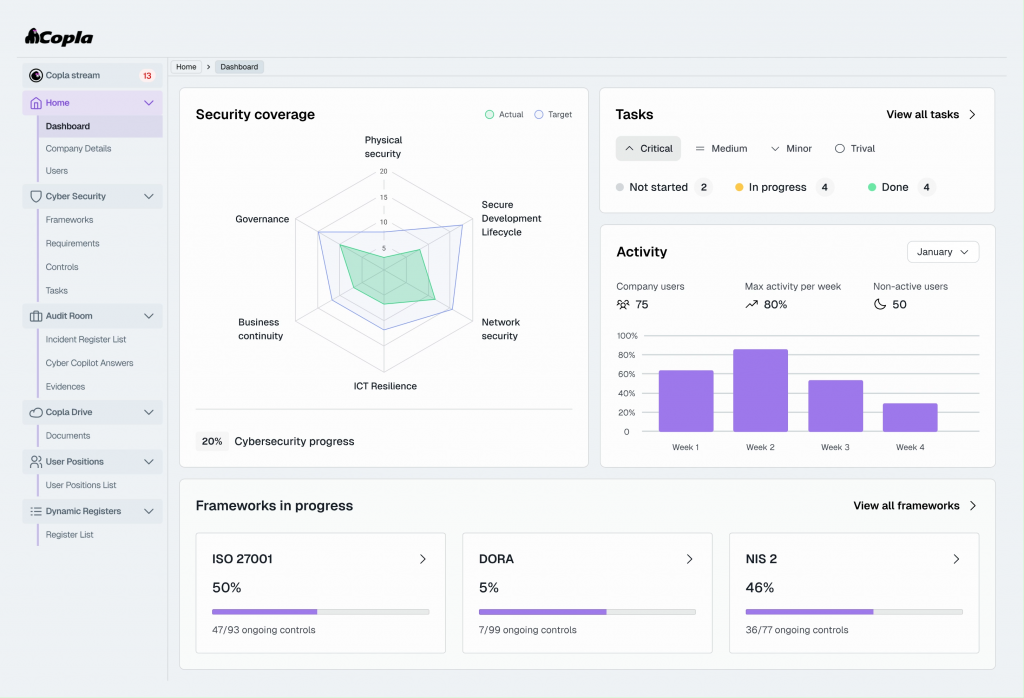
Copla is the best fit for European businesses that need NIST CSF alignment as part of a broader compliance program.
Many companies do not start with NIST as their main project. They start with ISO 27001, DORA, NIS2, SOC 2, or customer security requirements, and then a US customer, partner, insurer, or parent company asks for NIST CSF alignment too.
Copla handles that scenario directly. The platform builds your compliance program around real information about your business: your risks, systems, assets, suppliers, safeguards, and evidence. That work can then support ISO 27001 and EU requirements while also showing alignment with NIST CSF through the ISO 27001-to-CSF mapping.
This matters because it avoids the common problem of running NIST as a separate spreadsheet or side project. With Copla, the same security measures and evidence can support several obligations at once.
Copla also includes dedicated security experts. That is a major difference from tools that mostly provide software and leave interpretation to the customer. Your expert helps decide what matters, explains how NIST CSF applies to your business, and keeps the work practical rather than theoretical.
Copla is not the right tool for every NIST use case. If you need US federal system authorization under NIST 800-53, or a contractor-focused 800-171 and CMMC program, a US federal specialist may be a better fit. But for European companies that need credible CSF alignment alongside ISO 27001, DORA, NIS2, and other compliance work, Copla is the strongest choice. See Copla customer stories for examples of how the platform supports compliance work in practice.
- User Rating: 4.9 / 5 as of July 2026, with 100% of published reviews rating it five stars.
- Best For: European businesses that need NIST CSF alignment alongside EU compliance.
- Key Features: ISO 27001 work reused for NIST CSF alignment, risk and asset registers, evidence collection, control mapping, and bundled expert support.
- Main Strength: One compliance program that can support NIST CSF, ISO 27001, DORA, NIS2, and related requirements.
- Frameworks: ISO 27001, DORA, NIS2, SOC 2, PCI DSS, Cyber Essentials, MiCA, and NIST CSF alignment through ISO 27001 mapping.
2. Sprinto

Sprinto is a compliance automation platform that supports NIST CSF, NIST 800-53, and NIST 800-171. It is mainly suited to cloud-based teams that already use compliance automation and want to add NIST alongside SOC 2 or ISO 27001.
The platform includes templates, integrations, automated evidence collection, and framework mapping. For teams with standard cloud environments, it can reduce manual compliance work.
The main limitations are around cost and flexibility. Reviewers often mention renewal increases, limited customization, and setup complexity for teams that are new to compliance automation.
- User Rating: 4.8 / 5 across roughly 1,500 reviews as of July 2026.
- Best For: Cloud-based teams adding NIST to SOC 2 or ISO 27001 work.
- Key Features: NIST templates, integrations, automated evidence collection, and cross-framework mapping.
- Main Limitation: Pricing and customization may become issues as programs grow.
- Frameworks: NIST CSF, NIST 800-53, NIST 800-171, SOC 2, ISO 27001, and others.
3. Vanta
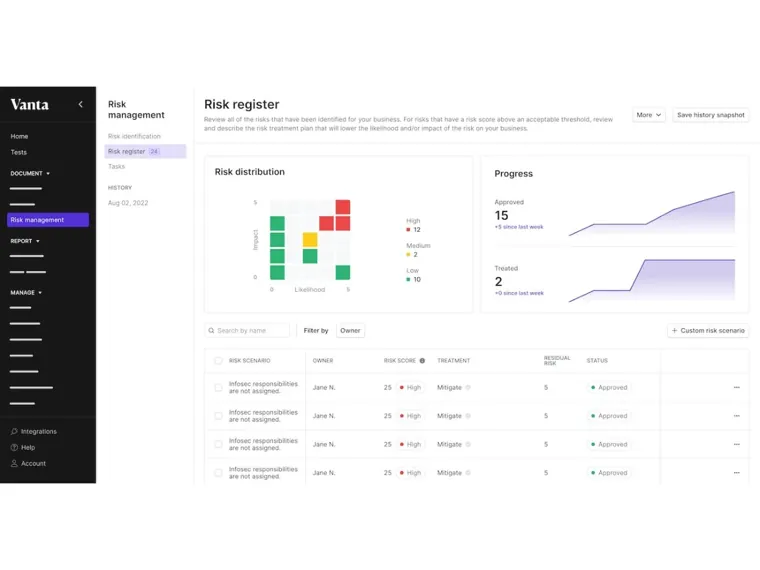
Vanta supports NIST CSF, NIST 800-171, and NIST AI RMF. It is best known for automated evidence collection through a large integration library.
For companies already using Vanta for SOC 2 or ISO 27001, adding NIST may be a practical extension. Its strength is collecting evidence from cloud tools and showing compliance status continuously.
The trade-off is that Vanta is less focused on expert-led interpretation. Reviewers also mention renewal increases, added costs after purchase, and support levels that can vary by account size.
- User Rating: 4.6 / 5 across roughly 2,400 reviews as of July 2026.
- Best For: Cloud-based companies that want automated evidence collection.
- Key Features: NIST CSF and 800-171 support, AI RMF support, integrations, and automated checks.
- Main Limitation: Better suited to standard automation use cases than complex interpretation-heavy programs.
- Frameworks: SOC 2, ISO 27001, NIST CSF, NIST 800-171, AI RMF, and others.
4. Drata

Drata offers broad NIST coverage, including CSF, 800-53, 800-171, and AI RMF. It is a fit for companies that want NIST inside a wider compliance automation platform.
The platform can map work across several frameworks, reducing duplicate tasks. It also has a large integration library and is often used by companies managing SOC 2, ISO 27001, and other security requirements at the same time.
The main drawbacks are similar to other automation platforms: renewal pricing, setup effort, and occasional uncertainty over which tasks are truly required.
- User Rating: 4.7 / 5 across roughly 1,150 reviews as of July 2026.
- Best For: Teams that want broad NIST coverage within compliance automation.
- Key Features: NIST framework support, automated checks, integrations, and cross-framework mapping.
- Main Limitation: Setup and scoping can still require significant internal effort.
- Frameworks: NIST CSF, 800-53, 800-171, AI RMF, SOC 2, ISO 27001, and others.
5. Secureframe
Secureframe supports NIST CSF, NIST 800-53, and NIST 800-171. It also has a federal-focused product for teams moving toward US government requirements.
This makes it a relevant option for commercial companies that expect to work with US government customers or need a clearer path toward federal compliance.
The platform includes templates, evidence collection, expert-written policies, and support from people with audit experience. Reviewers also mention some workflow rigidity, renewal increases, and manual work around certain integrations.
- User Rating: 4.7 / 5 across roughly 800 reviews as of July 2026.
- Best For: Teams moving toward US government or contractor requirements.
- Key Features: NIST support, federal-focused options, policy templates, and automated evidence collection.
- Main Limitation: Some workflows may feel prescriptive.
- Frameworks: SOC 2, ISO 27001, NIST CSF, NIST 800-53, NIST 800-171, CMMC, FedRAMP-related work, and others.
6. Hyperproof
Hyperproof is designed for mature compliance teams managing many frameworks at once. It supports NIST CSF, NIST 800-53, and NIST 800-171, and helps map work across different standards.
Its strength is centralizing evidence, controls, and compliance collaboration across a larger program. It can suit organizations that already have compliance owners, internal processes, and several frameworks to manage.
It is less suited to teams that want a simple, guided path. Reviewers mention a steeper learning curve, longer setup, and limited reporting customization.
- User Rating: 4.5 / 5 across roughly 213 reviews as of July 2026.
- Best For: Mature compliance programs managing several frameworks.
- Key Features: NIST templates, evidence management, cross-framework mapping, and collaboration workflows.
- Main Limitation: More complex than smaller teams may need.
- Frameworks: NIST, SOC 2, ISO 27001, PCI DSS, HIPAA, and others.
7. CyberSaint
CyberSaint is a NIST-focused enterprise platform. It is built around cyber risk management and is often positioned for larger organizations that need structured NIST reporting.
The platform supports NIST CSF and mappings to other NIST requirements. It also offers board-level reporting and risk quantification features.
CyberSaint is more specialized than general compliance automation tools, but it is also more enterprise-oriented. It may be excessive for smaller teams or companies that only need customer-facing CSF alignment. Its independent review base is also smaller than some larger automation platforms.
- User Rating: Limited G2 presence as of July 2026; small review base on Gartner Peer Insights.
- Best For: Large enterprises with NIST-focused risk programs.
- Key Features: NIST-first structure, CSF reporting, framework mapping, and risk reporting.
- Main Limitation: Enterprise fit and smaller public review base.
- Frameworks: NIST CSF, NIST 800-53, NIST 800-171, and related mappings.
8. Apptega
Apptega supports NIST CSF and NIST 800-171 modules. It is commonly used by security service providers, consultants, and teams managing programs for multiple clients.
Its framework mapping can help connect NIST work to other standards such as ISO 27001 and SOC 2. The platform is relatively accessible for teams that need repeatable program management rather than a highly customized enterprise setup.
Reviewers note that some features can be slow to arrive, integrations are more limited than larger automation platforms, and performance can vary.
- User Rating: 4.8 / 5 across roughly 155 reviews as of July 2026.
- Best For: Security firms and consultants managing NIST work for clients.
- Key Features: NIST CSF and 800-171 modules, framework mapping, and client program management.
- Main Limitation: More limited integrations than larger automation platforms.
- Frameworks: NIST CSF, NIST 800-171, ISO 27001, SOC 2, CMMC, and others.
9. Ostendio
Ostendio takes a program-first approach. Instead of only tracking framework tasks, it helps organizations build a security program and then map that work to standards, including NIST CSF and NIST 800-171.
It can be a practical option for smaller or earlier-stage teams that need structure and onboarding help. Its CrossWalk-style assessments allow teams to connect work across several regulations and frameworks.
The limitations are mainly around polish and scale. Reviewers mention that some screens take time to learn, some policy support may require upgrades, and the auditor-facing experience is less refined.
- User Rating: 4.8 / 5 across roughly 40 G2 reviews as of July 2026.
- Best For: Young security programs that need structure and onboarding help.
- Key Features: Cross-framework assessments, onboarding support, and program management.
- Main Limitation: Smaller review base and less polished experience in some areas.
- Frameworks: NIST CSF, NIST 800-171, SOC 2, HIPAA, and others.
10. SimpleRisk
SimpleRisk is the lowest-cost option on this list. It has a free open-source core and supports a large library of frameworks, including NIST CSF, NIST 800-53, and NIST 800-171.
It can work for teams that need structure but do not have budget for a larger platform. It is especially relevant for users who are comfortable with a more self-managed approach.
The trade-offs are clear. The interface is dated, automation is limited, evidence collection is mostly manual, and the platform may become harder to manage as the compliance program grows.
- User Rating: Sparse review presence as of July 2026; 4.5 / 5 across platforms.
- Best For: Teams with tight budgets and self-serve compliance needs.
- Key Features: Open-source core, broad framework library, risk scoring, and low cost.
- Main Limitation: Limited automation and a dated user experience.
- Frameworks: NIST CSF, NIST 800-53, NIST 800-171, and many others.
Honorable Mentions
Archer is a long-standing enterprise GRC platform with NIST support, especially for large organizations and federal-style programs. It can be powerful, but it comes with enterprise cost, heavy implementation, and a dated user experience.
MetricStream also supports NIST inside a broader enterprise risk and compliance suite. It is better suited to large organizations than smaller teams looking for straightforward CSF alignment.
Onspring can be used to build NIST tracking workflows without code, but buyers should verify the exact NIST content and reporting they need before shortlisting it.
How Copla Supports NIST CSF Alignment
Copla works with European businesses that need to show NIST CSF alignment without creating a separate compliance program just for NIST.
The platform builds your risk and asset picture from real information about your business, connects safeguards to evidence, and shows how the same work supports ISO 27001, DORA, NIS2, and NIST CSF alignment.
Your dedicated security expert helps interpret what matters, explains the work in plain language, and keeps the program focused on what customers, partners, and auditors actually need to see.
Schedule a call with Copla to see how one compliance program can support both European requirements and NIST CSF alignment.


