




Every company runs on other companies: the software you subscribe to, the data center that hosts you, the firm that handles your payroll. When one of them gets hacked, the problem lands on you. That is what third-party risk management (TPRM) means: keeping an eye on the risk that comes from your suppliers and service providers. Vendor risk management software does the record keeping for you: one list of every supplier, checks on how each one handles security, and reports that show a regulator or your leadership that someone is watching. In Europe this is now the law for many businesses, because DORA and NIS2, two EU rules covering financial firms and other important sectors, require an up-to-date supplier register and real proof that suppliers get checked. This guide compares the top 10 best risk management software vendors for 2026 in plain terms, so you can match one to your suppliers, your rules, and your budget.
- Copla
- Vanta
- OneTrust
- UpGuard
- Whistic
- Prevalent
- Panorays
- Hyperproof
- Drata
- SecurityScorecard
Vendor Risk Management Software at a Glance
| Platform | Type | Vendor-risk strengths | Expert support | User rating (July 2026) |
| Copla | Compliance platform + consultancy | Supplier register built for EU rules (DORA, NIS2) | Yes, security experts bundled | 4.9 / 5 |
| Vanta | Compliance platform + vendor risk | Vendor reviews inside the compliance workflow | Auditor and partner network | 4.6 / 5 |
| OneTrust | Enterprise vendor risk + privacy | Deep supplier workflows for large enterprises | Tiered vendor support | 4.3 to 4.6 / 5* |
| UpGuard | Ratings + management in one | Constant outside watching with clear reports | Vendor support (9.0/10) | 4.5 / 5 |
| Whistic | Shared assessment network | One completed check serves many customers | Vendor support | 4.5 / 5 |
| Prevalent (Mitratech) | Dedicated vendor risk platform | Automated check workflows | Hands-on onboarding | 4.3 / 5 |
| Panorays | Dedicated vendor risk platform | Automated checks + outside security view | Vendor support | 4.3 / 5* |
| Hyperproof | Compliance platform, many frameworks | Vendor risk inside the compliance program | Customer success team | 4.5 / 5 |
| Drata | Compliance platform + vendor risk | Adjustable vendor workflows | Customer success team + auditor network | 4.7 / 5 |
| SecurityScorecard | Security ratings | Constant outside scoring of vendors | Vendor support | 4.3 / 5 |
Ratings come from verified G2 reviews checked in July 2026 and are subject to change. *OneTrust has no single overall G2 score (its separately rated products range 4.3 to 4.6); Panorays’ 4.3 rests on a small review base (~37).
How We Picked These Platforms
We compared each platform on what a real supplier risk program needs: the supplier list, the security checks, the ongoing watching, and the reports a regulator would ask for. Every rating comes from verified user reviews on G2, checked in July 2026, and every entry includes the complaints reviewers actually make, not just the strengths. Where a rating could not be verified, the table says so. No vendor paid to be included.
Automate Vendor Risk Management
Copla simplifies third-party risk assessments, automating the process to reduce your workload
The EU Rules That Set the Bar: DORA and NIS2
If your company operates in the EU, two rules likely decide what your vendor risk software must produce, and most US-focused comparison pages cover neither.
DORA’s register of information. DORA is an EU rule for financial firms and their technology suppliers (Regulation (EU) 2022/2554). It says financial firms stay fully responsible for the technology services they buy: a written plan for supplier risk, checks on suppliers before signing, and an exit plan for critical services. Above all, Article 28(3) requires an up-to-date list of every technology service contract, called the register of information, which must be reported to the regulator. Keeping that list current as contracts change is exactly the kind of job software should do.
NIS2’s supply chain rule. NIS2 is an EU cybersecurity rule covering thousands of companies in important sectors (Directive (EU) 2022/2555). Article 21(2)(d) requires them to manage the security of their supply chain, including each direct supplier and service provider relationship, and Article 21(3) expects them to weigh each supplier’s weaknesses and overall security quality.
If either rule applies to you, judge every tool below on one question: can it produce that supplier list and that proof of oversight, up to date, whenever someone asks?
What to Look For Before You Choose a Tool
One thing to know up front: some of these tools manage the work on your side (the supplier list, the questionnaires, the follow-up), ratings tools watch your vendors from the outside and score their security like a credit score, and compliance platforms such as Copla, Vanta, Drata, and Hyperproof build vendor risk into a wider compliance program. Many companies end up pairing one manager with one watcher, so check the Type column in the table before comparing prices. Beyond that, four questions matter more than any feature list.
Questionnaires That Do Not Exhaust Everyone
Supplier security checks usually happen through long questionnaires, and they are where programs stall, on both sides of the relationship. Look for tools that fill in answers automatically, reuse past checks, and share completed ones (Whistic’s model), so every buyer stops asking every vendor the same 300 questions. Ask each vendor how much of a typical questionnaire their tool actually pre-fills.
One Up-to-Date Supplier Register
For financial firms under DORA, the register of information is a report the regulator can demand, not a nice-to-have export. Check whether the tool records each contract with the details supervisors expect, keeps a history as arrangements change, and produces the report without a week of spreadsheet cleanup first. If you need a general list of company risks beyond suppliers, we compare those in our risk register tool guide.
Alerts Someone Will Act On
Watching your vendors only helps if the alerts reach a person who fixes things. Ratings tools get criticized for noisy alerts; management platforms get criticized for reviews that happen once a year and go stale. Whichever way you lean, test what happens after an alert fires, not how the dashboard looks. The wider category of tools that watch risk continuously is covered in our risk monitoring software comparison.
What It Really Costs
Prices grow with the number of vendors you watch, and dedicated platforms and ratings services usually run to tens of thousands per year, with almost nothing published. Compliance platforms fold vendor risk into the wider subscription, which is often the cheaper route when supplier oversight is one duty among several. Count your real supplier list before asking for quotes, including the small suppliers nobody ever checked.
The 10 Best Vendor Risk Management Platforms in 2026
1. Copla
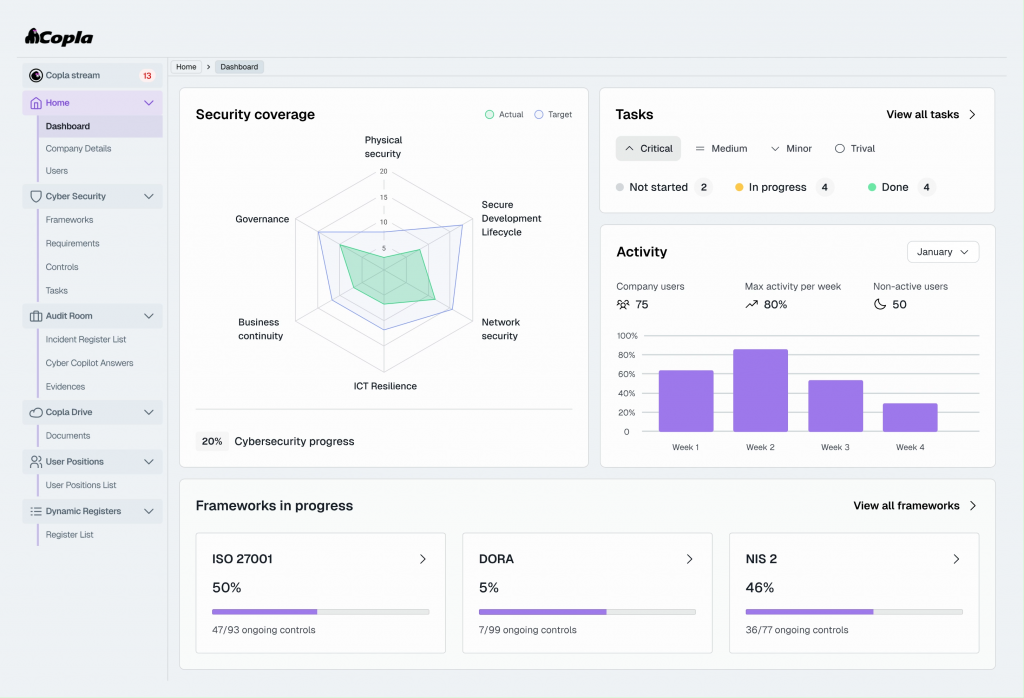
Copla treats supplier risk the way European regulators do: as a legal duty with specific rules attached. The platform builds a supplier register alongside your risk and asset registers from real information about your business, tracks the checks and follow-up for each vendor, and is built for the DORA third-party requirements specifically: the register of information, the records of checking suppliers before signing, and the proof of oversight regulators ask financial firms to produce. It holds a 4.9 out of 5 across verified user reviews as of July 2026, with every published review rating it five stars.
Because supplier risk lives inside the same program as ISO 27001 (the international information security standard), DORA, and NIS2, no work happens twice: supplier records feed the register of information, the proof of oversight counts toward certifications, and a change in a vendor relationship shows up in your overall risk picture instead of a separate tool. Your dedicated security expert helps decide how closely each supplier needs watching, and users report 80 to 90 percent less manual work than running a vendor program in spreadsheets.
The honest boundary: Copla does not watch your vendors from the outside or score them. Companies that want that ongoing external score pair it with a ratings tool such as SecurityScorecard or UpGuard below. Copla’s customer case studies show what this looks like in practice.
- User Rating: 4.9/5 as of July 2026, with 100% of reviews rating it five stars.
- Customer Satisfaction: Praised for a clean interface, guided compliance journeys, responsive support, and proof that stays audit-ready.
- Key Features: Supplier register built for DORA’s register of information, vendor checks and oversight tracking, connection to your risk and asset registers, and bundled expert consultancy.
- Key Strengths: Supplier risk handled inside one compliance program, with the documents regulators ask for produced automatically.
- Frameworks: DORA, NIS2, ISO 27001, SOC 2, PCI DSS, Cyber Essentials, and MiCA.
2. Vanta
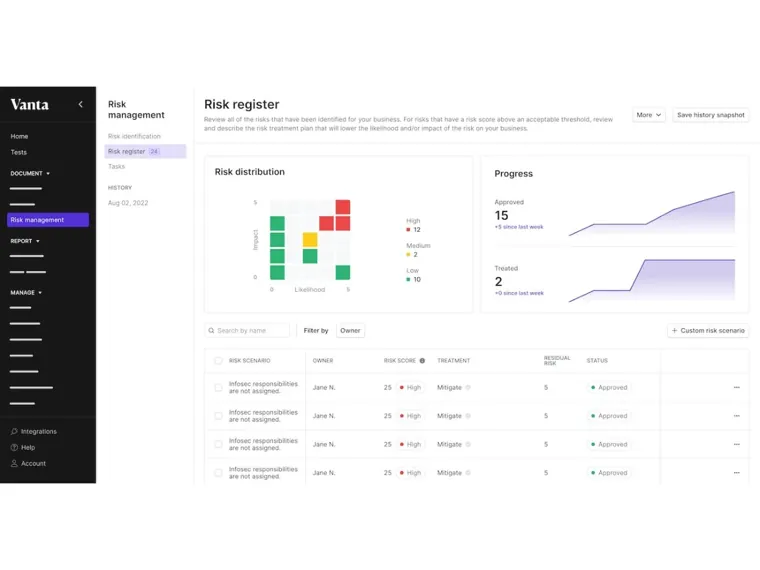
Vanta’s vendor risk feature lives inside its wider compliance platform. It finds vendors automatically from the tools your company connects, runs security reviews with AI help reading vendor documents, and shows vendor status on the same dashboard as your own compliance work. That suits teams whose supplier duties come from SOC 2 (a security report US customers often ask for) and ISO 27001.
The complaints that follow Vanta everywhere apply here too: renewal prices jumping 30 to 50 percent and support that depends on your plan. Its vendor risk depth is fine for a company with dozens of vendors, but thin for a financial firm running hundreds with reports due to a regulator.
- User Rating: 4.6/5 across roughly 2,400 reviews as of July 2026.
- Customer Satisfaction: Users cite how it finds vendors automatically from connected tools.
- Key Features: Automatic vendor discovery, AI-assisted security reviews, and one dashboard for all compliance work.
- Key Strengths: Vendor risk without leaving the compliance platform.
- Frameworks: SOC 2, ISO 27001, and 35+ in total; vendor risk included as a feature.
3. OneTrust
OneTrust is the big-company option: deep supplier risk workflows, vendor inventories, automated checks, and connections to its privacy tools. Its reviewers are mostly large regulated enterprises that run vendor risk as a full-time function.
The criticisms match the size: a steep learning curve with weeks of setup before it works your way, prices that mid-sized buyers call enterprise-sized, and support that improves the more you spend. Its products are rated separately on G2 (4.3 to 4.6), with no single overall score.
- User Rating: No single overall score; its separately rated products range from 4.3 to 4.6/5 as of July 2026.
- Customer Satisfaction: Cited for breadth by enterprise privacy and risk teams.
- Key Features: Vendor inventories, automated checks, privacy integration, and enterprise workflows.
- Key Strengths: Supplier risk at large-company scale, next to privacy operations.
- Frameworks: GDPR, global privacy laws, ISO 27001, SOC 2, NIST; full vendor risk suite.
4. UpGuard
UpGuard does two jobs in one product: it constantly watches your vendors’ security from the outside, and it runs questionnaire checks. Its reports are the clearest in the category, and reviewers keep citing its ease of use (9.1 out of 10).
The limits: it spots problems but does not manage the fixing for you, setup can get technical, and questionnaires and reports allow little customization. It watches and checks; your program still needs a home.
- User Rating: 4.5/5 across roughly 694 reviews as of July 2026.
- Customer Satisfaction: Users cite ease of use and clear reports they can hand to their board.
- Key Features: Constant outside monitoring, security questionnaires, vendor scoring, and data leak detection.
- Key Strengths: Watching and checking in one purchase.
- Frameworks: Works with any framework; supports vendor check programs.
5. Whistic
Whistic attacks questionnaire overload from both ends. Buyers use it to check their vendors, and vendors use it to publish a reusable security profile, so one completed check can serve many customers instead of one. Reviewers credit it with cutting check time substantially.
The trade-offs: it does not watch vendors from the outside, and gathering documents for its AI features is manual and has to happen in the right order, which reviewers call error-prone. It pairs naturally with a ratings tool rather than replacing one.
- User Rating: 4.5/5 across roughly 383 reviews as of July 2026.
- Customer Satisfaction: Users cite how easy it is to share and complete security profiles.
- Key Features: Shared vendor checks, reusable trust profiles, questionnaire automation, and AI assistance.
- Key Strengths: The security check done once and used everywhere.
- Frameworks: Supports standard questionnaire formats (SIG, CAIQ, custom).
6. Prevalent (Mitratech)
Prevalent, bought by Mitratech in October 2024, is a dedicated vendor risk platform with automated check workflows, easy navigation, and hands-on onboarding that reviewers single out. It covers the whole vendor relationship, from bringing a supplier on to parting ways.
Buyers should check two things before committing: where the product is headed under its new owner, and the reviews themselves, since the current listing has roughly 21 reviews and its star rating could not be reliably verified for this comparison. Reviewers also mention building questionnaires one at a time, risk scores that are hard to see into, and a dated look.
- User Rating: Rating unverified on a small base (~21 reviews on the Mitratech Prevalent listing) as of July 2026.
- Customer Satisfaction: Users cite automated workflows and supportive onboarding.
- Key Features: Vendor checks across the whole relationship, workflow automation, risk scoring, and optional managed services.
- Key Strengths: Dedicated vendor risk discipline with hands-on delivery.
- Frameworks: Covers the full vendor lifecycle; works with common check standards.
7. Panorays
Panorays checks vendors two ways at once: questionnaire answers plus an outside scan of the vendor’s security, combined into one rating per vendor. Reviewers find the interface genuinely easy to use.
The caveats: limited options for customizing reports, real onboarding effort, cost concerns from smaller buyers, few options for controlling who can see what, and a small review base (roughly 37) behind its 4.3.
- User Rating: 4.3/5 across roughly 37 reviews as of July 2026 (small base).
- Customer Satisfaction: Users cite the single view of each vendor’s security.
- Key Features: Automated checks, outside security scanning, combined vendor ratings, and fix tracking.
- Key Strengths: Questionnaire answers and outside scanning fused into one score per vendor.
- Frameworks: Supports SIG, CAIQ, and custom questionnaires.
8. Hyperproof
Hyperproof treats vendor risk the way it treats everything: as part of a wider compliance program covering many standards, with each vendor check linked to the compliance requirement it satisfies. That suits teams handling supplier oversight as part of ISO 27001 or SOC 2 rather than as a separate job.
Its usual trade-offs apply: a learning curve, limited report customization, and prices that assume a serious program (roughly $12,000 to start, $40,000 median).
- User Rating: 4.5/5 across roughly 213 reviews as of July 2026.
- Customer Satisfaction: Users cite keeping all their compliance work and proof in one place.
- Key Features: Vendor checks tied to compliance requirements, proof workflows, and mapping across standards.
- Key Strengths: Vendor risk that feeds the compliance program directly.
- Frameworks: SOC 2, ISO 27001, NIST, PCI DSS, and a large library.
9. Drata
Drata’s vendor workflows cover finding vendors, running security reviews, and reminding you before renewals, all inside its compliance platform, with the most praised customer success team in the category behind it. It is a natural add-on for teams already using Drata for SOC 2 or ISO 27001.
The familiar caveats: renewal increases of 20 to 40 percent, automation that weakens outside common cloud setups, and vendor risk depth that is solid but not specialist.
- User Rating: 4.7/5 across roughly 1,150 reviews as of July 2026.
- Customer Satisfaction: Users cite responsive, expert customer success.
- Key Features: Adjustable vendor workflows, security review tracking, renewal reminders, and compliance integration.
- Key Strengths: Supplier oversight inside a growing compliance program.
- Frameworks: SOC 2, ISO 27001, HIPAA, GDPR, NIST, and more; vendor risk included.
10. SecurityScorecard
SecurityScorecard is the outside watcher: it constantly scores your vendors’ public security with letter grades, like a credit score for security. That gives you an always-on signal between formal checks, and proof that your oversight really is continuous.
It complements a management platform rather than replacing one: reviewers note the scores are broad rather than deep, and they need interpretation before they turn into a conversation with a vendor. It is the signal, not the program.
- User Rating: 4.3/5 across roughly 91 reviews as of July 2026.
- Customer Satisfaction: Users cite the at-a-glance vendor scoring.
- Key Features: Constant outside scoring, breakdowns by risk area, alerts, and portfolio views.
- Key Strengths: The always-on outside signal regulators increasingly expect.
- Frameworks: Works with any framework; feeds vendor risk programs.
Honorable Mentions
Bitsight invented the security ratings category and remains the big-company ratings choice (4.5 to 4.6 across roughly 75 reviews as of July 2026, depending on the listing); reviewers praise the credit-score clarity and criticize noisy alerts and scoring that is hard to see into. ProcessUnity, named a leader in Forrester’s 2026 ranking of third-party risk platforms (4.5 across roughly 54 reviews), offers deeply customizable workflows for large enterprises behind a steep learning curve for administrators, boosted by its CyberGRX network of shared vendor checks. Venminder (4.7 across roughly 115 reviews) is a favorite of US banks and credit unions for managing vendor contracts and documents, with reporting its main criticism.
How Copla Supports Vendor Risk Programs
We work with financial firms and NIS2-covered businesses across Europe whose supplier oversight has to satisfy specific legal rules, not just internal policy. The platform builds your supplier register alongside your risk and asset registers, tracks the checks and follow-up for each vendor, and produces the DORA register of information from data that stays current as contracts change. Your dedicated security expert helps decide how closely each supplier needs watching, and the same proof counts toward ISO 27001 and NIS2 instead of living in a separate tool.
Schedule a call with Copla to see the register of information built from your real supplier list.


