




Most companies keep a list of the things that could hurt them: a key supplier failing, a hacked system, a rule they might break without noticing. The problem is that the list usually lives in a spreadsheet someone updates twice a year, so it shows last quarter’s dangers, not today’s. Risk monitoring software fixes that. It keeps a risk register, the central list of what could go wrong and what you are doing about it, connected to your real systems and suppliers, and it updates the picture as your business changes. That matters to anyone who answers to a regulator, an auditor, or a security-minded customer: banks and payment firms under DORA (the EU rule for how financial firms handle technology risk), healthcare and energy providers under NIS2 (the EU rule for critical services), and software companies working toward ISO 27001 or SOC 2. This guide compares the top 10 risk monitoring software solutions for 2026 in plain terms, so you can match a platform to your size, your rules, and your team.
- Copla
- Vanta
- Drata
- Scrut
- LogicGate
- Hyperproof
- Optro
- ServiceNow IRM
- Riskonnect
- MetricStream
Risk Monitoring Software at a Glance
| Platform | Focus | What it does best | Human help included | User rating (July 2026) |
| Copla | Risk-first compliance and GRC | A risk register that stays current, deep on EU rules | Yes, CISO consultancy bundled | 4.9 / 5 |
| Vanta | Automated compliance checks | Checks security settings every hour | Auditor and partner network | 4.6 / 5 |
| Drata | Automated compliance checks | Daily automatic checks | Auditor and partner network | 4.7 / 5 |
| Scrut | Mid-sized companies with several standards | Many standards with hands-on help | Dedicated compliance experts | 4.9 / 5 |
| LogicGate | Build-your-own risk processes | Workflows you design without code | Paid services and partners | 4.6 / 5 |
| Hyperproof | Tracking many standards at once | One view of measures and proof | Vendor support | 4.5 / 5 |
| Optro | Enterprise audit and GRC | Risk run from the audit side | Paid services and consultants | 4.6 / 5 |
| ServiceNow IRM | Risk on the ServiceNow platform | Links risks to specific IT systems | Through consulting partners | 4.4 / 5 |
| Riskonnect | Enterprise-wide risk | Insurance risk and keeping business running | Vendor services and partners | 4.3 / 5 |
| MetricStream | Large enterprise risk suite | Day-to-day risk at global scale | Through consulting partners | 3.9 / 5 |
Ratings reflect verified user reviews on platforms such as G2 and Gartner Peer Insights, checked in July 2026. New reviews shift these scores over time, so recheck the live listings before you shortlist.
How We Picked These Tools
We compared each platform on the things that decide a real purchase: how current the risk picture stays, how much of the watching happens automatically, how much human help is included, and what users say after living with the tool. Every rating comes from verified user reviews on platforms such as G2 and Gartner Peer Insights, checked in July 2026, and every entry includes the complaints reviewers actually make. No vendor paid to be included.
What to Look For Before You Choose a Tool
Continuous Monitoring, Not Annual Reviews
The core question: does the tool show you your risks as they are now, or as they were at the last review? Look for automatic checks on your security measures, alerts when something slips, and a risk register that updates when the business changes. European rules such as DORA and NIS2 increasingly expect this continuous readiness rather than a once-a-year snapshot. If your most urgent problem is an upcoming audit rather than day-to-day tracking, our compliance audit software comparison covers that side directly.
A Living Risk Register
A risk register only helps if it is connected to reality: your systems link to risks, risks link to the security measures that reduce them, and those measures link to proof that they work. When a new supplier or system arrives, the register should show it, instead of waiting for the next quarterly meeting. A register that lives in a spreadsheet nobody updates records history, not your current situation. Risk monitoring is also just one part of a bigger job; the platforms that handle the whole compliance side are compared in our compliance management software comparison.
Third-Party and Vendor Risk Monitoring
A lot of what can hurt you sits outside your own walls, with the suppliers and service providers you depend on (regulators call them third parties). Check that the platform keeps a list of your suppliers, helps you assess them, and keeps supplier oversight up to date. For financial firms under DORA that is a legal requirement; for everyone else it is simply where many of today’s problems start.
Automation Plus Expert Help
The best risk programs combine both. Automation keeps the register and the checks current, but deciding what a risk actually means for your business, and how much effort it deserves, takes judgment. Even companies with an in-house expert find that person pulled toward more urgent work. Look for a platform that pairs automatic monitoring with experts you can ask, so the thinking is not left to your team alone.
Reporting That Leadership Actually Uses
Risk monitoring only changes decisions if the results reach the people who decide, in a form they will read. Look for clear dashboards, trends over time, and reports that turn technical findings into plain business language. Several otherwise strong platforms draw consistent criticism for weak built-in reporting, so test this with your own data before you buy.
What It Really Costs
The price gap in this category is wide: enterprise risk suites often reach six figures a year before setup fees, while modern platforms are running in weeks at a fraction of that. Most vendors publish no prices, and price increases at renewal are a recurring theme in reviews, so add up the full cost: the license, the setup, and any consultants you need to fill gaps. Copla is among the more affordable platforms here, with flexible terms and the expert guidance included in the price rather than sold as an extra.
The 10 Best Risk Monitoring Software Solutions in 2026
1. Copla
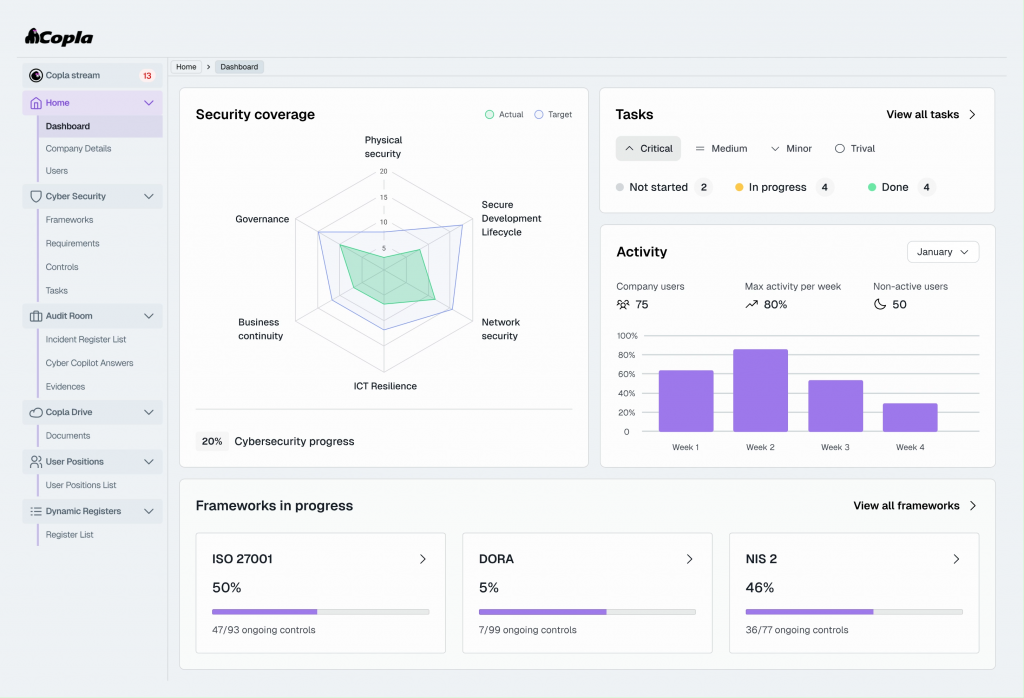
Copla is a European compliance and GRC platform (GRC is short for governance, risk, and compliance, the industry term for managing rules and risks in one place) built for companies under strict rules: fintech and payment firms, healthcare providers, software companies, and other regulated businesses. It pairs AI-driven software with hands-on help from experienced security chiefs (CISOs), and it starts with risk rather than treating it as an add-on module. It holds a 4.9 out of 5 across verified user reviews as of July 2026, with every published review rating it five stars.
You describe your business, your systems, your data, and your suppliers, and the platform builds a living risk register and asset register from those real answers. It then recommends only the security measures that fit your actual situation, with a clear reason for each. From there the picture stays current: proof is collected automatically, changes in the business flow into the register, and work done for one set of rules counts toward others such as ISO 27001, DORA, and NIS2 instead of being repeated. Users report 80 to 90 percent less manual work than running the same program in spreadsheets.
Software alone cannot decide what a risk means for your company, so Copla pairs the platform with people: your dedicated CISO explains what each risk means for your business, handles the relationship with the auditor through every stage of assessment, and keeps supplier oversight in line with what regulators expect. Pricing is affordable and flexible, with the expert help included rather than billed separately. Copla’s customer case studies show how this works in practice.
- User Rating: 4.9/5 as of July 2026, with 100% of reviews rating it five stars.
- Customer Satisfaction: Praised for a clean interface, guided compliance journeys, responsive support, and proof that stays ready for auditors.
- Key Features: Living risk and asset registers, automatic proof collection, work reused across rule sets, supplier risk monitoring, the Copla Stream AI assistant, and bundled CISO consultancy.
- Key Strengths: Risk-first by design, real depth on EU rules, expert interpretation included, and affordable, flexible pricing.
- Frameworks: ISO 27001, DORA, NIS2, SOC 2, PCI DSS, Cyber Essentials, and MiCA.
2. Vanta
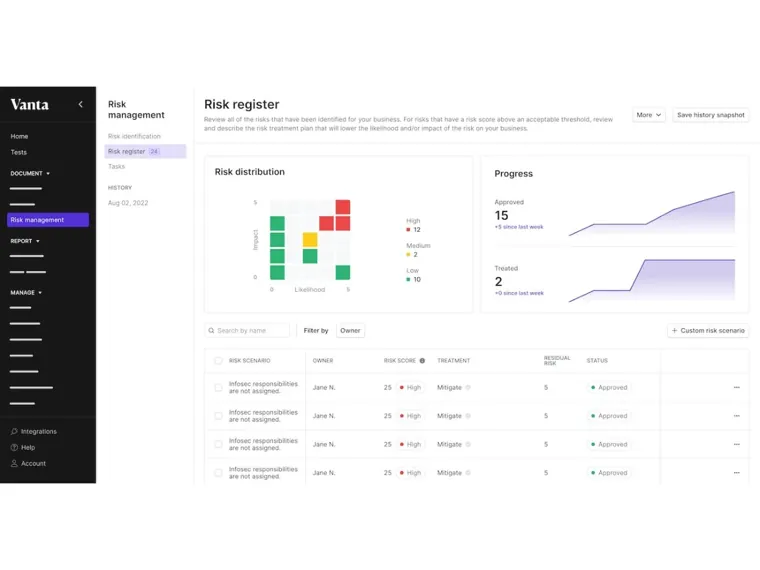
Vanta comes at risk monitoring from the compliance side. Built for companies that run mostly on cloud tools and aimed primarily at the US market, it connects to more than 400 systems such as AWS, Google Cloud, and Azure, and it checks your security settings automatically every hour, so your compliance status stays current without anyone taking screenshots. Its risk register sits alongside that monitoring as one feature of the product.
Reviewers note the platform works best when someone owns compliance internally, since you mostly drive it yourself, and its risk assessment side is lighter than in platforms built around risk. Buyers also mention price increases at renewal once the introductory rate ends.
- User Rating: 4.6/5 across roughly 2,450 reviews as of July 2026.
- Customer Satisfaction: Users cite the speed to a first SOC 2 (a security report US customers often ask for) and the breadth of connections.
- Key Features: 400+ connections, hourly automatic checks, automatic proof collection, a risk register, and a customer-facing trust page.
- Key Strengths: Highly automatic monitoring for companies running on standard cloud tools.
- Frameworks: SOC 2, ISO 27001 (add-on), HIPAA, GDPR, PCI DSS, and 35+ in total.
3. Drata

Drata runs automatic checks on your security measures every day and lets you shape its risk, supplier, and audit workflows to your own process, which suits compliance programs that expect to grow and add standards and stakeholders over time. Its support quality scores 9.6 out of 10 in verified reviews.
Reviewers describe the interface as less intuitive than some rivals, the first setup as taking real effort, and the pricing as premium, which can be steep for the smallest teams.
- User Rating: 4.7/5 across roughly 1,100 reviews as of July 2026.
- Customer Satisfaction: Users cite responsive support inside the platform.
- Key Features: 300+ connections, daily automatic checks, adjustable risk and supplier workflows, and a SafeBase trust page.
- Key Strengths: Risk and supplier monitoring you can shape as your program grows.
- Frameworks: SOC 2, ISO 27001, HIPAA, GDPR, PCI DSS, NIST, and more.
4. Scrut

Scrut pairs a flexible risk register with ongoing monitoring for mid-sized companies running several standards at once: more than 60 come ready out of the box, along with support from dedicated compliance experts, which suits teams that want guidance rather than a purely do-it-yourself tool.
Reviews across several years repeatedly mention sync problems with Scrut’s device-monitoring agent, where the status of laptops or cloud accounts can lag behind reality, along with occasional bugs and requests for clearer dashboards. Pricing is available only on request, with nothing published upfront.
- User Rating: 4.9/5 across roughly 1,300 reviews as of July 2026.
- Customer Satisfaction: Users cite the support from dedicated compliance experts.
- Key Features: Flexible risk register, ongoing monitoring, 60+ standards, automatic proof collection, and a device-monitoring agent.
- Key Strengths: Wide coverage of standards with hands-on help at a mid-market price.
- Frameworks: SOC 2, ISO 27001, GDPR, HIPAA, PCI DSS, and 60+ in total.
5. LogicGate
LogicGate Risk Cloud lets your team build its own risk monitoring processes with a drag-and-drop builder, no programming needed. A capable administrator can shape the platform to the business and bring risk monitoring, compliance, and audit work together in one place.
The flip side of that freedom is effort: building and tuning the workflows takes time, advanced reporting often needs extra setup or outside tools, and reviewers see its AI features as less mature than some rivals.
- User Rating: 4.6/5 across roughly 190 reviews as of July 2026.
- Customer Satisfaction: Consistently high satisfaction in user reviews.
- Key Features: A drag-and-drop workflow builder, one workspace for risk, compliance, and audit, plus automation and adjustable dashboards.
- Key Strengths: Freedom to design your own risk processes without writing code.
- Frameworks: Adaptable to many standards; company-wide and operational risk, compliance, audit.
6. Hyperproof
Hyperproof gives established programs one view of every standard, every security measure, who owns it, and the proof behind it, which matters once several overlapping standards have turned tracking into a coordination headache. It connects each risk to the measures that address it and to the work of fixing what gets found.
It is not built for a first program: reviewers note gaps in connections and customization, limited built-in reporting, and no built-in approval step, which forces manual workarounds. Pricing is premium and rises with company size.
- User Rating: 4.5/5 across roughly 213 reviews as of July 2026.
- Customer Satisfaction: Users cite support quality and the handling of security measures and proof.
- Key Features: Central tracking of security measures, mapping across standards, proof collection, and links from each risk to its fixes.
- Key Strengths: A clear line from each risk to its measures and fixes, for established programs.
- Frameworks: SOC 2, ISO 27001, NIST CSF, PCI DSS, HIPAA, GDPR, and a large library.
7. Optro
Optro, the 2026 rebrand of AuditBoard, comes at risk from the audit side. Large organizations run many audit, risk, and compliance programs in its one connected environment, with more than 40 standards supported and a single security measure able to count toward several of them, tested once.
Reviewers note it is not priced or sized for teams that do not need full enterprise breadth; a mid-sized company will find it more than it needs. Setup runs through Optro’s own services team and Big Four consulting partners, contracted separately.
- User Rating: 4.6/5 across roughly 1,585 reviews as of July 2026.
- Customer Satisfaction: Users cite audit and risk coordination across large teams.
- Key Features: Audit, risk, and compliance in one place, AI-assisted workflows, supplier risk, and analytics.
- Key Strengths: Audit-led risk programs at enterprise scale.
- Frameworks: 40+, including SOC 2, ISO 27001, NIST, DORA, and SOX.
8. ServiceNow IRM
ServiceNow Integrated Risk Management puts risk monitoring on the same ServiceNow platform many large organizations already use to run their IT help desk. Its standout feature is the link to ServiceNow’s master inventory of IT systems and equipment, which ties each risk to the specific systems and incidents behind it and raises automatic alerts when a security measure stops working as intended.
The value depends heavily on already being a ServiceNow customer. Reviewers note the price is hard to justify on its own, the learning curve is steep with little built-in guidance, and the first setup demands serious internal expertise and time.
- User Rating: 4.4/5 across roughly 130 reviews as of July 2026.
- Customer Satisfaction: Users cite having everything on one platform and the clear line from systems to risks.
- Key Features: Risk, compliance, and audit on the ServiceNow platform, links to the IT system inventory, heat maps, and reporting.
- Key Strengths: A live view of which risks touch which systems, for existing ServiceNow customers.
- Frameworks: Company-wide risk, operational risk, IT and cyber risk, supplier risk, audit, policy.
9. Riskonnect
Riskonnect is an enterprise platform that pulls operational, IT, supplier, and compliance risk into one central view, with particular depth in risks a company insures against and in keeping the business running after a disruption (what the industry calls business continuity). Its reports show trends over time and the numbers a company watches to spot trouble early, and the platform can be shaped to your own processes.
Reviewers describe the first setup as complex and slow, administration as needing extra training, and the interface as overwhelming until familiarity sets in. It is priced for enterprises and less suited to smaller organizations.
- User Rating: 4.3/5 across roughly 172 reviews as of July 2026.
- Customer Satisfaction: Users cite the single view across all types of risk.
- Key Features: Company-wide risk management, insurance risk and claims, business continuity and resilience, supplier risk, and analytics.
- Key Strengths: Depth in insurance-related risk and business continuity in one platform.
- Frameworks: Company-wide risk, operational risk, supplier risk, compliance, business continuity.
10. MetricStream
MetricStream is a long-standing suite built for the obligations global banks and insurers carry, covering company-wide risk, day-to-day operational risk, compliance, audit, supplier risk, and business continuity. Reporting for boards and senior leadership is a particular strength, and rollouts are usually led by big consultancies such as Deloitte, PwC, and Infosys.
The trade-offs are the classic enterprise ones: a complex, resource-heavy setup, a steep learning curve, some rigidity when you want custom changes, and support that can be slow at times. Its user ratings sit below most platforms on this list, and it is not a realistic choice for a small or mid-sized company.
- User Rating: 3.9/5 across roughly 47 reviews as of July 2026.
- Customer Satisfaction: Valued in large enterprises for adaptability and leadership-level reporting.
- Key Features: Risk management across many standards, workflow automation, risk scoring, and board reporting.
- Key Strengths: Deep coverage of day-to-day operational risk at global scale.
- Frameworks: Company-wide risk, operational risk, IT and cyber risk, supplier risk, compliance, audit.
Honorable Mentions
Archer, formerly RSA Archer, is one of the oldest names in this category, rated 4.1 across roughly 69 reviews as of July 2026, with deep adaptability for large, established enterprise programs. Reviewers cite a dated interface, heavy setup, and a long wait before the value shows compared with newer cloud rivals.
Centraleyes is a mid-market platform built around connected cyber risk, with an AI-assisted risk register mapped against more than 180 standards and a setup measured in days. Reviewers note the interface can feel slow when moving between modules.
SecurityScorecard watches your suppliers from the outside, continuously rating how secure each one looks, and is rated 4.3 across roughly 91 reviews as of July 2026. It complements a risk platform rather than replacing one; reviewers note its scores are broad rather than deeply technical.
How Copla Supports Risk Monitoring
We work with regulated businesses across Europe that need a current, defensible view of their risks without a big team to maintain it. The platform builds your risk and asset registers from real information about your business, keeps them current as things change, and reuses proof across rule sets so the same work counts toward ISO 27001, DORA, and NIS2. Your dedicated CISO explains what each risk means for your business, and we manage the relationship with the auditor through every stage, so monitoring turns into certification without a scramble.
Schedule a call with Copla to walk through how this would look for your team.


