


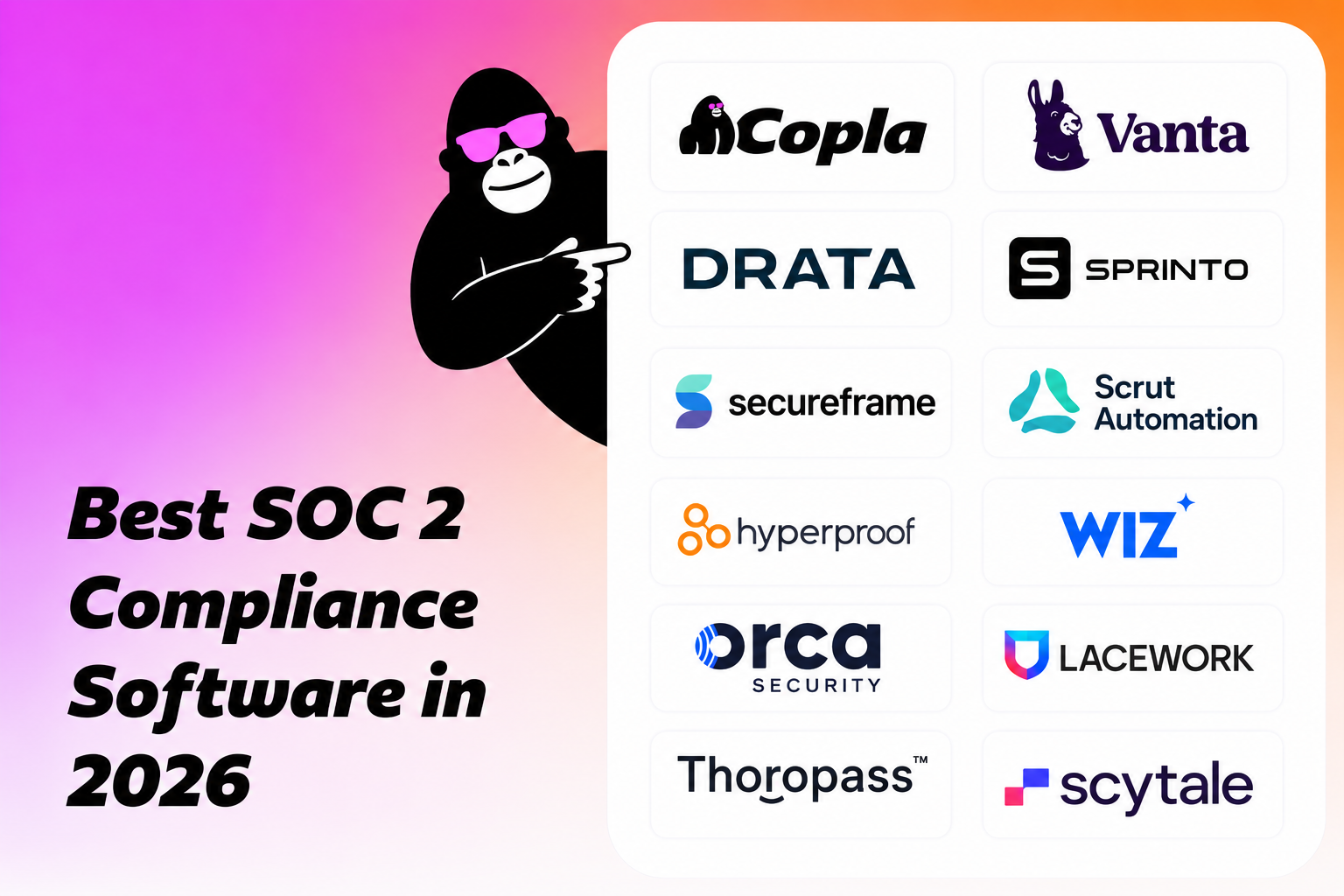


SOC 2 compliance software helps companies prepare for a SOC 2 audit by organizing controls, collecting evidence, monitoring security tasks, and giving auditors a clear place to review proof.
SOC 2 is often requested by American customers, especially larger companies, before they trust a vendor with customer data. The final SOC 2 report must be issued by a licensed CPA firm, not by software. But the right platform can make the process much easier by keeping your controls, policies, evidence, risks, and audit work organized.
This guide compares the top SOC 2 compliance software platforms for 2026.
Copla is the strongest fit for European businesses that need SOC 2 for US customers while also managing ISO 27001, DORA, NIS2, PCI DSS, or other compliance requirements. It is not positioned as the fastest standalone SOC 2 tool for a US startup. It is best when SOC 2 needs to fit into a wider compliance program.
- Copla
- Vanta
- Drata
- Scytale
- Secureframe
- Sprinto
- Hyperproof
- Thoropass
- A-LIGN
- Oneleet
Accelerate SOC 2 certification
Losing clients due to a prolonged SOC 2 certification process
is a risk your business simply can’t afford.
SOC 2 Compliance Software at a Glance
| Platform | Best for | SOC 2 strengths | Who does the audit | Expert help included | User rating (July 2026) |
| Copla | European businesses needing SOC 2 plus ISO 27001, DORA, or NIS2 | One set of controls and evidence reused across frameworks | Works with the CPA firm you choose | Yes, CISO consultancy included | 4.9 / 5 |
| Vanta | Cloud-based companies preparing for a first SOC 2 | Automated evidence collection and auditor network | Audit firm network | Auditor and partner network | 4.6 / 5 |
| Drata | Companies managing SOC 2 with other frameworks | Automated checks, auditor workspace, and cross-framework mapping | Audit firm network | Support team and former auditors | 4.7 / 5 |
| Scytale | Teams wanting guided SOC 2 preparation | Dedicated compliance expert and structured readiness process | Audit firm network | Dedicated compliance expert | 4.8 / 5 |
| Secureframe | Teams wanting templates and audit preparation workflows | Policy templates, progress dashboards, and evidence collection | Audit firm network | Former auditors on staff | 4.7 / 5 |
| Sprinto | Cloud-based startups looking for a lower-friction first SOC 2 | Automated checks, auditor dashboard, and pre-checked audit firms | Audit firm directory | Support team and in-house experts | 4.8 / 5 |
| Hyperproof | Mature teams managing many frameworks | Control ownership, evidence management, and multi-framework mapping | Bring your own auditor | Support-team led | 4.5 / 5 |
| Thoropass | Teams that want software and audit from one provider | SOC 2 preparation and examination under one vendor | In-house audit firm | In-house auditors | 4.7 / 5 |
| A-LIGN | Teams that want an audit firm with supporting software | Audit-firm-led SOC 2 engagement with A-SCEND software | In-house CPA firm | Audit-firm professionals | 4.7 / 5 |
| Oneleet | Early-stage teams wanting security tools bundled with SOC 2 | Compliance software, security tooling, and penetration testing | Audit firm network | Expert support | 4.9 / 5 |
Ratings are from verified G2 reviews checked in July 2026 and may change over time.
How We Compared These Platforms
We compared each platform on the factors that matter in a real SOC 2 project:
- How it organizes SOC 2 controls
- How much evidence it collects automatically
- How it supports Type I and Type II audits
- How the auditor reviews evidence
- Whether work can be reused across other frameworks
- Whether expert help is included
- What users say after using the platform
We gave more weight to tools that keep SOC 2 evidence current over time, because SOC 2 Type II depends on showing that controls operated over a monitoring period, not just on one audit day.
No vendor paid to be included.
What Is SOC 2 Compliance Software?
SOC 2 compliance software helps companies prepare for a SOC 2 audit.
A SOC 2 audit reviews how a company protects customer data based on the Trust Services Criteria set by the AICPA. These criteria cover areas such as security, availability, confidentiality, processing integrity, and privacy.
The software does not issue the report. A CPA firm does that. The software helps with the work around the report: controls, evidence, policies, access reviews, vendor reviews, risk assessments, and auditor collaboration.
Good SOC 2 compliance software should answer three questions:
- What controls do we need?
- What evidence proves those controls are working?
- What still needs to be fixed before the auditor reviews it?
What to Look For in SOC 2 Compliance Software
Type II Readiness
SOC 2 reports come in two main types.
A Type I report checks whether your controls are designed properly at a specific point in time.
A Type II report checks whether those controls worked over a period of time, usually three to twelve months.
Most serious customers eventually ask for Type II. That means the platform should keep evidence current throughout the monitoring period, not only help you prepare a one-time audit packet.
Evidence Collection
SOC 2 involves a lot of proof: access reviews, security settings, policies, vendor checks, incident records, risk assessments, logging, and more.
The best tools reduce manual evidence collection so teams can collect evidence with less back-and-forth, and automation reduces repetitive work in evidence collection. The strongest platforms can automatically collect evidence by connecting to cloud providers, HR tools, ticketing platforms, identity providers, and cloud infrastructure.
The right level of automation depends on your setup. Cloud-based companies usually get more value from integrations than companies with more custom or manual processes.
Auditor Workflow
SOC 2 audits are easier when the auditor can review evidence inside the platform through secure access, which improves the overall audit process instead of relying on email threads or shared folders.
Some platforms connect you to audit firms. Some let you bring your own CPA firm. Some sell the software and audit together. Each model can work, and strong audit collaboration also helps external auditors review evidence without relying on scattered email threads, but buyers should know which model their customers will accept.
Reuse Across Frameworks
Most companies do not stop at SOC 2.
A company may also need ISO 27001, GDPR, HIPAA, PCI DSS, DORA, NIS2, or customer-specific security reviews. The best compliance management software supports control mapping, so one control and one piece of evidence can satisfy multiple frameworks through mapping controls. Strong multi framework support also makes that reuse practical as requirements evolve.
This is especially important for European companies selling to US customers. SOC 2 may be needed for revenue, while ISO 27001, DORA, or NIS2 may be needed for regulators, customers, or partners at home across multiple frameworks.
Expert Support
SOC 2 language can be hard to interpret the first time without prior compliance expertise.
A platform can organize the work, but expert support, especially during the initial setup, helps decide what applies, which controls are enough, how to answer auditor questions, and how to avoid unnecessary work.
This matters most when SOC 2 is part of a broader compliance program rather than a single one-off audit.
The 10 Best SOC 2 Compliance Software Platforms in 2026
1. Copla
Copla is the best fit for European businesses that need SOC 2 alongside ISO 27001, DORA, NIS2, PCI DSS, or other compliance requirements.
Many European companies do not start with SOC 2 as their only compliance project. They may already be working toward ISO 27001, preparing for DORA, responding to NIS2, or managing supplier and customer security requests. Then a US customer asks for SOC 2.
Copla is built for that reality. The platform creates one compliance program around your actual business: risks, systems, suppliers, policies, safeguards, evidence, owners, compliance tasks, and audit tasks. With control mapping across multiple frameworks, the same controls and evidence can support SOC 2, ISO 27001, and EU compliance obligations instead of being managed in separate spreadsheets or separate tools.
This is where Copla is strongest. It is not just a SOC 2 checklist. It helps turn SOC 2 into part of a broader security and compliance operating model.
Copla also includes dedicated CISO support. Your expert helps interpret requirements, prepare evidence, work with the CPA firm you choose, and keep the audit moving through the broader compliance journey. This is useful for teams that do not want to hire a separate consultant just to understand what the auditor is asking for.
Copla is not the fastest standalone SOC 2 tool for every company. A US startup that only needs a quick first SOC 2 and already runs fully on standard cloud tools may find a dedicated SOC 2 automation platform enough. Copla is the better fit when SOC 2 needs to sit beside ISO 27001, DORA, NIS2, PCI DSS, or other compliance requirements.
See Copla customer stories for examples of the multi-framework model in practice.
- User Rating: 4.9 / 5 as of July 2026, with 100% of published reviews rating it five stars.
- Best For: European businesses that need SOC 2 plus ISO 27001, DORA, NIS2, PCI DSS, or other compliance requirements.
- Key Features: Controls and evidence mapped across frameworks, automated evidence collection, risk and asset registers, supplier tracking, audit support, and bundled CISO consultancy.
- Main Strength: One compliance program that can support SOC 2 and European compliance requirements together.
- Main Limitation: Not positioned as a standalone audit firm or the quickest one-framework SOC 2 tool for every US startup.
- Frameworks: SOC 2, ISO 27001, DORA, NIS2, PCI DSS, Cyber Essentials, and MiCA.
2. Vanta
Vanta is a SOC 2 compliance automation platform used by many cloud-based companies.
It connects to common business and cloud tools, can automatically collect evidence, monitors security settings, and gives auditors a way to review the work. It is often used by startups and SaaS companies preparing for a first SOC 2, which can help support audit readiness for first-time SOC 2 teams.
Vanta may be a practical fit when the company has a standard cloud setup and wants to automate as much evidence collection as possible.
The main limitations are cost growth and support experience. Reviewers often mention renewal increases, extra costs after purchase, and support that can vary by plan. ISO 27001 and other frameworks may also increase the total cost.
- User Rating: 4.6 / 5 across roughly 2,400 reviews as of July 2026.
- Best For: Cloud-based companies preparing for a first SOC 2.
- Key Features: Integrations, automated evidence collection, continuous checks, auditor access, trust page, and cross-framework support.
- Main Limitation: Renewal pricing and add-on costs can become issues as the program grows.
- Frameworks: SOC 2, ISO 27001, HIPAA, GDPR, PCI DSS, and others.
3. Drata
Drata supports SOC 2 preparation through automated checks, continuous control monitoring, evidence collection, auditor workflows, and cross-framework mapping.
It is often used by companies that expect their compliance work to expand beyond SOC 2. The platform can support several frameworks and gives auditors a dedicated place to review evidence.
Continuous monitoring can alert teams if a control fails during the monitoring period and help detect configuration drift instead of relying on periodic checks.
Drata’s support team is often mentioned positively in reviews, including help from people with audit experience. That can be useful for teams that need guidance but still want a software-first platform. It also helps teams track control monitoring and demonstrate operating effectiveness over time.
The main drawbacks are renewal pricing, setup effort, and weaker automation for unusual technical environments. Buyers should expect a more involved setup than a simple checklist tool.
- User Rating: 4.7 / 5 across roughly 1,150 reviews as of July 2026.
- Best For: Companies managing SOC 2 alongside several other frameworks.
- Key Features: Automated checks, auditor workspace, integrations, workflows, and cross-framework mapping.
- Main Limitation: Setup and pricing may be heavier than a simple first SOC 2 project needs.
- Frameworks: SOC 2, ISO 27001, HIPAA, GDPR, PCI DSS, NIST, and others.
4. Scytale
Scytale is a SOC 2 and compliance automation platform that includes dedicated guidance for each account.
Its main fit is teams that want a structured path through SOC 2 preparation and prefer more hands-on support than a purely self-serve tool. Guided support can simplify the initial setup for teams going through a first SOC 2, and it can help organize evidence, policies, control work, and audit preparation around a realistic audit timeline.
Scytale may be useful for companies that want a guided Type I or Type II readiness process without hiring a separate consultant.
The trade-offs are its smaller integration library compared with some larger platforms, pricing that may require a sales process, and some advanced features being available only on higher tiers.
- User Rating: 4.8 / 5 across roughly 570 reviews as of July 2026.
- Best For: Teams wanting guided SOC 2 preparation.
- Key Features: Dedicated compliance expert, automated evidence collection, framework support, and audit coordination.
- Main Limitation: Smaller integration library than some category leaders.
- Frameworks: SOC 2, ISO 27001, HIPAA, GDPR, HITRUST, and others.
5. Secureframe
Secureframe supports SOC 2 preparation with templates, policy management, evidence collection, dashboards, and access to audit partners.
It is relevant for teams that want a structured SOC 2 workflow and prefer starting from pre-built policies and controls rather than building everything themselves; those policy workflows can include employee acknowledgements for compliance procedures.
Secureframe also includes guidance from people with audit experience, which can help teams understand what auditors expect. It is also a common fit for small and mid-sized businesses that want integrated training and vendor risk management, which matters for SOC 2 compliance.
The main limitations are workflow rigidity, renewal pricing, and repetitive evidence handling in some areas. Buyers should check whether the default process fits how their team actually works.
- User Rating: 4.7 / 5 across roughly 800 reviews as of July 2026.
- Best For: Teams wanting pre-built SOC 2 templates and structured preparation.
- Key Features: Policy templates, automated evidence collection, progress dashboards, integrations, and audit partner network.
- Main Limitation: Workflows may feel restrictive for teams that need more flexibility.
- Frameworks: SOC 2, ISO 27001, HIPAA, PCI DSS, GDPR, and others.
6. Sprinto
Sprinto is a cloud-first compliance automation platform that supports SOC 2, ISO 27001, and other frameworks.
It is often used by startups and smaller cloud-based companies that want to get SOC 2 readiness moving quickly by collecting evidence automatically. The platform provides automated checks, evidence collection, dashboards, and access to audit firms.
Sprinto may be a practical option for teams with standard cloud tooling and limited internal compliance experience. That can help lean teams stay audit ready over time.
The limitations are customization and reliability of automated checks. Reviewers mention bugs, false alarms, workflow constraints, and renewal increases. Teams with more complex environments should validate fit carefully.
- User Rating: 4.8 / 5 across roughly 1,500 reviews as of July 2026.
- Best For: Cloud-based startups preparing for SOC 2 with limited internal compliance resources.
- Key Features: Automated evidence collection, auditor dashboard, integrations, support team, and cross-framework mapping.
- Main Limitation: Less flexible for non-standard compliance workflows.
- Frameworks: SOC 2, ISO 27001, GDPR, HIPAA, PCI DSS, and others.
7. Hyperproof
Hyperproof is designed for teams that need explicit multi framework support across several compliance frameworks at once.
For SOC 2, it helps track controls, owners, evidence, tasks, compliance status, and auditor-facing views. It is more suitable for mature teams that already understand their compliance process and want to centralize work across frameworks.
Its strength is organizing multi-framework compliance operations, and it is also better suited to teams managing compliance within broader governance structures, rather than guiding a first-time SOC 2 from scratch.
The trade-offs are complexity, setup time, and reporting limitations. Smaller or first-time teams may find it heavier than necessary.
- User Rating: 4.5 / 5 across roughly 213 reviews as of July 2026.
- Best For: Mature compliance teams managing SOC 2 alongside many other standards.
- Key Features: Control ownership, evidence collection, cross-framework mapping, task tracking, and auditor views.
- Main Limitation: Better suited to experienced compliance teams than first-time buyers.
- Frameworks: SOC 2, ISO 27001, NIST CSF, PCI DSS, HIPAA, GDPR, and others.
8. Thoropass
Thoropass combines SOC 2 software with an in-house audit firm.
This can simplify vendor management because the preparation platform and the audit come from the same provider, which can also make managing compliance easier for teams that want fewer handoffs. Teams that want one vendor for both preparation and examination may find that model convenient.
The limitation is choice. You generally cannot bring your own auditor, and some customers may prefer a clearer separation between the software used to prepare and the firm that issues the report.
Reviewers also mention interface clutter as programs grow and some duplicate evidence handling between preparation and audit stages.
- User Rating: 4.7 / 5 across roughly 570 reviews as of July 2026.
- Best For: Teams that want SOC 2 software and audit services from one provider.
- Key Features: Compliance platform, in-house audit firm, tasks, policies, evidence, and workflow automation.
- Main Limitation: Less flexibility if you want to choose your own CPA firm.
- Frameworks: SOC 2, ISO 27001, HITRUST, PCI DSS, and others.
9. A-LIGN
A-LIGN is an audit firm with its own compliance software, A-SCEND.
It is best understood as an audit-firm-led SOC 2 option rather than a pure software platform. The software helps manage the engagement, organize audit evidence, and reuse proof across requirements. Effective security controls, clear ownership, and auditor collaboration are essential for compliance success.
This model may work for companies that want the audit firm and supporting platform together.
The trade-off is that the software is not as deep as some standalone compliance automation platforms. Reviewers note thinner evidence collection and fewer integrations, which can leave more manual work for the team.
- User Rating: 4.7 / 5 across roughly 69 reviews as of July 2026.
- Best For: Teams that want an audit firm with supporting SOC 2 software.
- Key Features: A-SCEND platform, audit-firm-led process, evidence storage, and reuse across requirements.
- Main Limitation: Smaller review base and less automation depth than software-first platforms.
- Frameworks: SOC 2, SOC 1, ISO 27001, HITRUST, FedRAMP, and others.
10. Oneleet
Oneleet combines SOC 2 compliance software with security tooling, including penetration testing.
It is aimed at early-stage teams that need both security improvements and SOC 2 preparation. This can be useful when a company is not just documenting controls but also building parts of its security program, with more practical support for data security and protecting sensitive data.
Oneleet may fit startups that want one subscription for compliance preparation and some security work, with bundled tools that can also strengthen overall security posture.
The limitations are maturity and breadth. It is a younger platform, supports fewer niche tools than larger vendors, and covers fewer frameworks than some established compliance platforms.
- User Rating: 4.9 / 5 across roughly 138 reviews as of July 2026.
- Best For: Early-stage teams wanting SOC 2 support with security tooling included.
- Key Features: Compliance software, security tooling, penetration testing, evidence collection, and expert support.
- Main Limitation: Smaller ecosystem and narrower framework coverage than larger platforms.
- Frameworks: SOC 2, ISO 27001, HIPAA, and a growing list.
Honorable Mentions
Trustero takes an AI-first approach to SOC 2, with scans that turn findings into tasks. Its rating is high, but the review base is small, so buyers should validate fit carefully.
Anecdotes serves larger companies with experienced compliance teams. It offers a modern interface and a broad plugin library, but it is heavier than most first-time SOC 2 buyers need.
Scrut covers SOC 2 among many other standards with hands-on support at mid-market pricing. Buyers should check device monitoring and automation fit before shortlisting it.
How Copla Supports SOC 2 Programs
Copla works with European businesses that need SOC 2 for US customers while also managing European and international compliance requirements.
The platform builds one set of controls, risks, assets, suppliers, owners, and evidence from real information about your business, mapping controls across multiple frameworks. That work can support SOC 2 while also supporting ISO 27001, DORA, NIS2, PCI DSS, and other requirements.
Your dedicated CISO helps prepare evidence, prepare audit-ready evidence for the CPA firm you choose, answer difficult questions, and keep the program moving through the Type II monitoring period, supporting continuous compliance workflows and keeping compliance status visible.
Schedule a call with Copla to map SOC 2 onto the frameworks you already run.
FAQ
-
What is SOC 2 compliance software? +
SOC 2 compliance software helps companies prepare for a SOC 2 audit.
It organizes controls, policies, evidence, owners, risks, data protection, and audit tasks around the Trust Services Criteria within the AICPA service organization control framework. It also helps auditors review evidence more efficiently.
The SOC 2 report itself must be issued by a licensed CPA firm.
-
What is the difference between SOC 2 Type I and Type II? +
A SOC 2 Type I report checks whether controls are designed properly at a specific point in time.
A SOC 2 Type II report checks whether those controls operated over a period of time, usually three to twelve months, so continuous evidence collection and ongoing monitoring matter because Type II is judged across the review period, not only at audit time.
Most larger customers prefer Type II because it shows that security practices were showing operating effectiveness over time.
-
How long does SOC 2 take with compliance software? +
With software, many companies can prepare for a Type I report in several weeks, depending on their starting point.
A Type II report takes longer because it requires a monitoring period, often three to twelve months. Software can also shorten the audit process by helping teams collect evidence and keep evidence documents organized. It can speed up evidence collection and audit preparation, but it cannot remove the monitoring period.
For audit workflow specifically, see our audit and compliance software comparison. Continuous workflows also reduce the scramble during audit season.
-
Can one platform cover SOC 2 and ISO 27001? +
Yes. SOC 2 and ISO 27001 overlap in many areas, including access control, risk management, vendor management, policies, logging, and incident response.
Using one platform for both can reduce duplicate work. This is especially useful for European companies that need ISO 27001 or EU compliance requirements alongside SOC 2 for US customers.
-
How much does SOC 2 compliance software cost? +
SOC 2 compliance software often costs five figures per year, depending on company size, integrations, frameworks, and support.
The audit fee from the CPA firm is separate unless you choose a vendor that bundles software and audit services. Audit fees commonly depend on company size, audit scope, and whether the report is Type I or Type II.
Buyers should compare the full cost: software, audit, support, additional frameworks, and renewal pricing.
-
What is the best SOC 2 compliance software for regulated industries? +
It depends on the company’s situation.
Cloud-based US startups preparing for a first SOC 2 may consider Vanta, Sprinto, Drata, Secureframe, or Scytale. Teams that want software and audit services from one vendor may consider Thoropass or A-LIGN. Mature compliance teams managing many standards may consider Hyperproof.
For European businesses that need SOC 2 for US customers while also managing ISO 27001, DORA, NIS2, PCI DSS, or other compliance requirements, Copla is the strongest fit. It reuses one set of controls and evidence across frameworks and includes expert guidance.