“Copla Register of Information highlighted the mistakes in an easier way, in more human, understandable language. And if we needed more information, we instantly received support from Copla.”
Eimantas Vytuvis, Head of Compliance and MLRO, Paynt
The challenge
A report rejected over commas and spaces
Paynt helps businesses get paid. It is a payment acquirer, supplying POS terminals and acquiring services to merchants, with a strong focus on hospitality, where its card tipping solution helps waiting staff get tipped by card. It is growing across the Baltics and the rest of the EU, and competes with larger legacy players on flexible pricing, speed of delivery and customer support.
Behind that sits a six-person compliance team, led by Eimantas Vytuvis, Head of Compliance and MLRO. Among its obligations is Paynt’s DORA Register of Information, submitted to the Bank of Lithuania through the central bank’s reporting system.
In the first year, Paynt built and submitted the report in-house. A dedicated employee worked on it, and the Bank of Lithuania system rejected it over details as small as a comma where another symbol was required. Rejection meant another round of questions to the regulator and another wait for guidance.
For the second year of DORA Register of Information obligations, Paynt decided to do it differently. On the recommendation of its CISO, it came to Copla.
What changed
Errors caught before submission
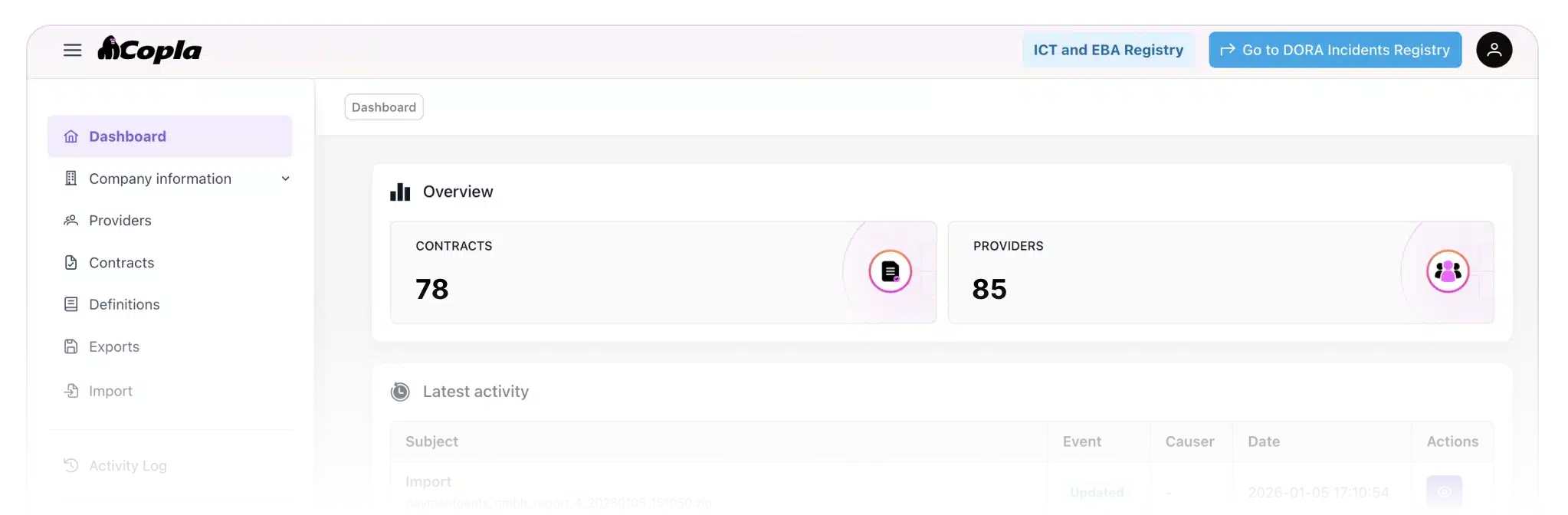
Paynt used Copla’s DORA Register of Information to check its data before it reached the Bank of Lithuania. Gabriele Survilaite, Deputy MLRO, who led the work, started by running the previous year’s report through Copla’s test environment to see what would happen.
It came back with multiple errors. Unlike the regulator’s system, Copla explained each one in plain language and pointed to what needed to change.
Copla helped by:
Tested Paynt’s report and identified every change still required
Provided guidance on what to fix
Made the final adjustments to the report themselves
Handed back a finished report that Paynt could submit
“When we escalated to the Copla team, it was almost 5 p.m. in the evening, but they still jumped in and responded. By the end of the next day, everything was fixed and done.”
— Gabriele Survilaite, Deputy MLRO, Paynt
The comparison with the year before is clear. Paynt estimates the process went from a couple of weeks of back-and-forth to a few days.
Results
The cost-benefit analysis is clear
In the first year, the report cost Paynt a couple of weeks of rework, resubmissions and waiting for guidance from the regulator. In the second, with Copla validating the data before it reached the Bank of Lithuania, it was done in a few days.
“Doing it ourselves costs significantly more than doing it with Copla, with about 50 compliance team hours saved. The difference came from when errors showed up: before submission, not after.”
— Eimantas Vytuvis, Head of Compliance and MLRO, Paynt
Instead of discovering errors one rejection at a time in the regulator’s system, the team saw them all at once, before submission, explained in plain language. When the deadline got tight, Copla’s team was on hand to finish the job.
Looking ahead
Starting from a report that has already passed
Paynt’s next reporting cycle falls at the beginning of next year. With the register now built and validated in Copla, the team starts from a report that has already passed, rather than from a blank template and a regulator’s error log, which will save them even more time in the next reporting cycle.
Weeks to days
DORA Register of Information submission time, with about 50 compliance team hours saved.
Paynt
Payment acquiring · EU
Submitted RoI successfully to the Bank of Lithuania