






An ISMS, or information security management system, is the set of policies, processes, roles, and records an organization uses to manage information security risk in a structured, repeatable way. It sits above individual security controls, deciding which risks matter and who owns them. ISO/IEC 27001 is the international standard an ISMS is measured against. This guide covers what an ISMS includes, how it compares with ISO 27001, who needs one, and how to build and keep one effective. It’s the same ground a compliance and risk management platform like Copla operates on.
What an ISMS is, in short
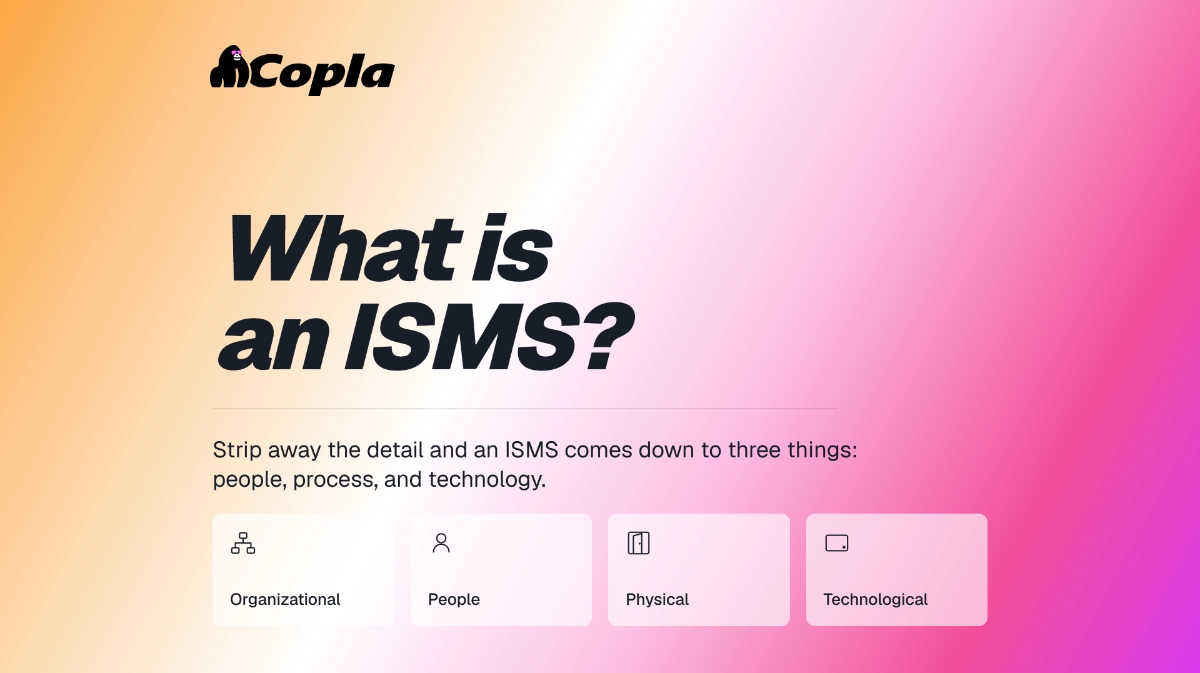
Strip away the detail and an ISMS comes down to three things: people, process, and technology.
It runs as a continuous cycle, not a one-off project:
- Risk-based: starts from what could go wrong and what that would cost, not a generic control list.
- Cyclical: plan, operate, review, improve, often called the PDCA cycle, repeated on an ongoing basis, never closed out once a year.
- Technology and vendor neutral: requires that risks get managed and reviewed, not that you buy specific products.
- Not a checklist: unread policies in a binder are not an ISMS.
Run it on ISO 27001 compliance software or across spreadsheets: certification against the standard is optional, separate from having an ISMS.
What an ISMS includes (the core components)
An ISMS is not one document. It is a set of artefacts that work together, each doing a specific job.
| Component | What it does |
|---|---|
| ISMS scope | Which parts of the business, systems, and locations the system covers |
| Information security policy | States management’s commitment, backed by topic-specific policies for access, incident management, and business continuity |
| Risk assessment and risk register | Records what could go wrong, and how likely and damaging it is |
| Risk treatment plan | How each risk gets mitigated, transferred, avoided, or accepted, and who owns it |
| Statement of Applicability (SoA) | Which Annex A controls apply, which do not, and why |
| Selected Annex A controls | Safeguards implemented because the risk assessment justified them |
| Roles and responsibilities | Who owns the ISMS, each risk, and each treatment decision |
| Internal audit and management review | Independent checks, reviewed by leadership on a set cadence |
| Evidence and records | Proof controls actually operate, beyond the policy describing them |
| Continual improvement and corrective action | Acting on what audits, incidents, and reviews turn up |
ISO/IEC 27001:2022 sets the structure behind this list (ISO.org, accessed August 2026): Clauses 4 to 10 define the management system, and Annex A supplies a reference set of ISO 27001 Annex A controls, 93 across four themes (organizational, people, physical, technological), with ISO/IEC 27002 providing implementation guidance for each one.
An organization implements only what its risk assessment justifies.
ISMS vs ISO 27001: what is the difference?
What is an ISMS next to ISO 27001, if the two are not the same thing? The ISMS is the management system an organization operates. ISO/IEC 27001 is the standard defining what a credible ISMS must include.
You can run an ISMS without certifying it, or treat ISO 27001 as guidance without seeking a certificate. Certification enters only once an accredited body assesses your ISMS against the standard. The ISMS is what gets examined. The standard is the yardstick.
One more distinction: ISO 27001 is a certifiable standard, resulting in a certificate; SOC 2 is an attestation, a different instrument entirely.
| Dimension | ISMS | ISO/IEC 27001 |
|---|---|---|
| What it is | The operational system: policies, risk process, controls, records | The standard defining a credible ISMS |
| Who owns it | The organization, continuously | A certification body, only during an audit |
| Is it mandatory | No, unless a regulation or contract requires one | No; certifying against it is a choice |
| What certification assesses | Nothing alone; it is the subject assessed | Whether the ISMS meets its requirements |
Who needs an ISMS?
An ISMS suits any organization that handles sensitive data and needs to manage information security in a structured, provable way.
Common triggers:
- Enterprise buyers and tenders. Procurement teams increasingly ask for ISO 27001 before they sign, and an ISMS is the prerequisite for that certificate.
- Sector and regulatory obligations. In the EU, frameworks like DORA and NIS2 push regulated financial entities and essential or important entities toward formal information security management, whether or not they name ISO 27001 directly. NIS2 compliance assumes a working management system behind it.
- Cyber insurance. Insurers increasingly expect evidence of a structured programme, not a one-page policy.
- Outgrowing ad hoc security. Past a certain size, security run from memory and a shared drive stops holding up.
Scale is not fixed: an SME runs a lean, narrow-scope ISMS, a larger organization runs a broader one.
How to build an ISMS (the risk-first sequence)
Building an ISMS holds up when the sequence stays in order:
1. Define the scope
Which business units, systems, and locations it covers.
2. Secure leadership commitment
Set the information security policy that states what the organization is committing to.
3. Inventory assets and run the risk assessment
Starting from real assets and business impact, so controls match actual exposure.
4. Produce the risk treatment plan
Mitigate, transfer, avoid, or accept, with an owner for each decision.
5. Build the Statement of Applicability
Select the Annex A controls the risk assessment justifies.
6. Implement the controls
Assign an owner to each.
7. Run the mandatory internal audit and management review
Independent checks that the ISMS still works, reviewed by leadership.
8. Improve continuously
Feeding audit and incident findings back into the risk register.
The more common habit runs backward: pick a checklist first, implement controls against it, then backfill the risk thinking afterward, if at all.
Controls chosen before the risk work exists are controls calibrated to nothing.
ISMS risk management done in the right order is the harder half of building an ISMS.
Evidence should be captured as controls run, not reconstructed before an audit. Copla’s version is an automated risk register generated from real assets and kept current, guided by a CISO. That’s one example of the continuous model, not a guarantee any specific ISMS will pass an audit.
How an ISMS connects to certification
Certification is optional, but common. Plenty of organizations build an ISMS specifically to certify against ISO 27001 and unlock deals that require it.
The certificate is issued by an accredited certification body after an external audit: Stage 1 reviews documentation, Stage 2 tests the controls. It runs on a three-year cycle, with lighter surveillance audits between, and a mandatory internal audit happens first. The full walkthrough lives in the ISO 27001 certification process guide.
Most of the real effort sits in preparation, scaling with scope and readiness, not a fixed timeline. ISO writes the standard; it does not certify organizations, and no software vendor can issue the certificate either.
Keeping an ISMS effective over time
An ISMS is only useful if it stays current. Risks, assets, and people all change, so the risk register, controls, and evidence have to update continuously. Management review and internal audit are recurring, not one-off events.
Two different pictures follow. An ISMS built for a certificate and then left static drifts out of date, and every surveillance or recertification audit turns into a scramble.
An ISMS maintained continuously makes those same audits closer to routine.
Copla’s version is living registers and evidence captured as it happens, with an in-house CISO team keeping the system current. Responsibility for the ISMS still sits with the organization, whichever model runs it.
Book an ISO 27001 consultation to talk through what building or maintaining one would take.
FAQ
-
Is an ISMS mandatory? +
No single law requires something called “an ISMS” by name. What regulations like DORA and NIS2 require is the substance of one: a documented risk process, controls, and records a supervisor can inspect. In practice, that substance is mandatory for many regulated organizations, even where it is never named directly.
-
Can you have an ISMS without ISO 27001 certification? +
Yes. Running an ISMS and certifying it against ISO 27001 are two separate decisions, covered in full above under ISMS vs ISO 27001. Plenty of organizations operate a functioning ISMS for years before deciding whether a certificate is worth pursuing.
-
What is the difference between an ISMS and a security policy? +
A security policy is one document inside the ISMS: a statement of rules and commitments. The ISMS is the system around it, scope, risk assessment, controls, roles, records, and the review cycle that keeps the policy accurate. A policy with nothing operating behind it is not an ISMS.
-
How long does it take to build an ISMS? +
It depends on scope, how much already exists (an asset inventory, existing policies, prior risk work), and how much dedicated ownership the project gets. A narrow scope with a named owner moves faster than a broad one run alongside someone’s other job. Treat any fixed timeframe you are quoted as an estimate, not a guarantee.
-
Does an ISMS only cover digital or IT data? +
No. Annex A’s four control themes, organizational, people, physical, and technological, exist because information security covers more than servers and software. Paper records, office access, supplier relationships, and how staff handle information all sit inside scope too.
-
Who is responsible for the ISMS? +
Top management is accountable for the ISMS under ISO 27001’s leadership requirements, even when day-to-day ownership sits with a CISO, compliance lead, or risk officer. Bringing in outside support, whether a consultant, a CISO service, or a platform, changes who does the work. It does not change where accountability sits.


