




Getting ISO 27001 certified usually starts the same way: a customer or regulator asks for it, someone looks up the requirements, and the size of the project sinks in. Policies to write, risks to document, evidence to collect, and an auditor who will check all of it. ISO compliance software exists to carry that load: it organizes the documents, tracks the security measures you put in place, and keeps the proof ready for your audit, whether this is your first certification or a renewal. One check before you buy: the standard was updated in 2022 and the old version expired in October 2025, so any tool still built around the old requirements will cost you rework. This guide compares the top 10 best ISO compliance software platforms for 2026 in plain terms, so you can match one to your team, your budget, and your audit.
- Copla
- Vanta
- Drata
- Sprinto
- Secureframe
- Scrut
- ISMS.online
- DataGuard
- Conformio
- Thoropass
Download our guide to learn how to get ISO compliant fast”
ISO Compliance Software at a Glance
| Platform | Best for | What it does for you | Human help included | User rating (July 2026) |
| Copla | EU businesses that want experts to guide them | Builds documents and registers from your answers, manages the audit | Yes, CISO consultancy bundled | 4.9 / 5 |
| Vanta | Cloud-based companies | Checks your systems automatically, hourly | Auditor network, self-serve otherwise | 4.6 / 5 |
| Drata | Growing compliance programs | Daily automated checks, best-rated support | Former auditors advise + auditor network | 4.7 / 5 |
| Sprinto | Startups on a budget | Sets up documents and checks from day one | In-house experts + auditor directory | 4.8 / 5 |
| Secureframe | Teams that want ready templates | Expert-written templates + automated proof | Former auditors on staff | 4.7 / 5 |
| Scrut | Mid-sized companies with several standards | Ready control sets, document generator | Dedicated compliance experts | 4.9 / 5 |
| ISMS.online | Teams focused on the documents | Step-by-step path with everything in one place | In-house experts + built-in coaching | 4.5 / 5 |
| DataGuard | Teams that want consultants to lead | Consultants do the work with you | Yes, consultants bundled | 4.6 / 5 (Capterra)* |
| Conformio | Small businesses, first certification | Wizards that write the documents for you | ISO experts included | 4.5 / 5* |
| Thoropass | One vendor for software and audit | Platform plus its own audit team | In-house auditors | 4.7 / 5 |
Ratings are drawn from verified user reviews checked in July 2026 and are subject to change.
How We Picked These Platforms
We compared each platform on the things that decide a real certification project: how much of the paperwork it produces for you, how much proof it collects automatically, how much human help is included, and what users say after living with it for a year. Every rating comes from verified user reviews on G2 and Capterra, checked in July 2026, and every entry includes the complaints reviewers actually make, not just the strengths. No vendor paid to be included.
What to Look For Before You Choose a Tool
Five questions that matter more than any feature list.
Does It Cover the Current Version of the Standard?
ISO 27001 was updated in 2022, and the old version expired in October 2025. The current standard lists 93 security controls, reorganized and simpler than before. Ask every vendor to confirm their templates and checklists are built for the current version, because content carried over from the old one means rework for you and awkward questions from your auditor.
How Much of the Paperwork Does It Do for You?
Certification needs a set of policies plus one central document that explains which of the 93 controls apply to your company and why (the standard calls it the Statement of Applicability, and your auditor will read it first). The best tools write these documents for you based on answers about your business. The weakest hand you blank templates and wish you luck. This single difference can be weeks of work.
How Much Proof Does It Gather Automatically?
Auditors want evidence that your security measures actually run: who has access to what, whether laptops are protected, whether backups happen. Modern tools connect to the systems you already use and collect that proof in the background. The more your company runs on standard cloud tools, the more of this can be automatic; the parts software cannot see, such as offices and people processes, always need some manual proof.
How Much Human Help Is Included?
This is the question that matters most if nobody on your team has done ISO before. The market covers the whole range: mostly self-service platforms where you do the thinking, tools with former auditors on staff who advise, consultants who lead the project for you, and, at Copla, security experts included in the engagement who also handle the auditor relationship. Be honest about your team’s experience and pick the level of help that matches. Tools judged specifically on how they handle the audit itself are compared in our audit-readiness platforms guide.
What It Really Costs
Your budget has three parts: the software, the certification body’s audit fees, and any consultants you bring in to fill gaps. The software is often the smallest line. Most vendors publish no prices, and price increases at renewal are the most common complaint in reviews across the category, so ask about multi-year terms and compare three-year totals, not the first quote. Copla folds the expert help into the platform price, which keeps the total predictable for teams without a specialist on staff.
The 10 Best ISO Compliance Software Platforms in 2026
1. Copla
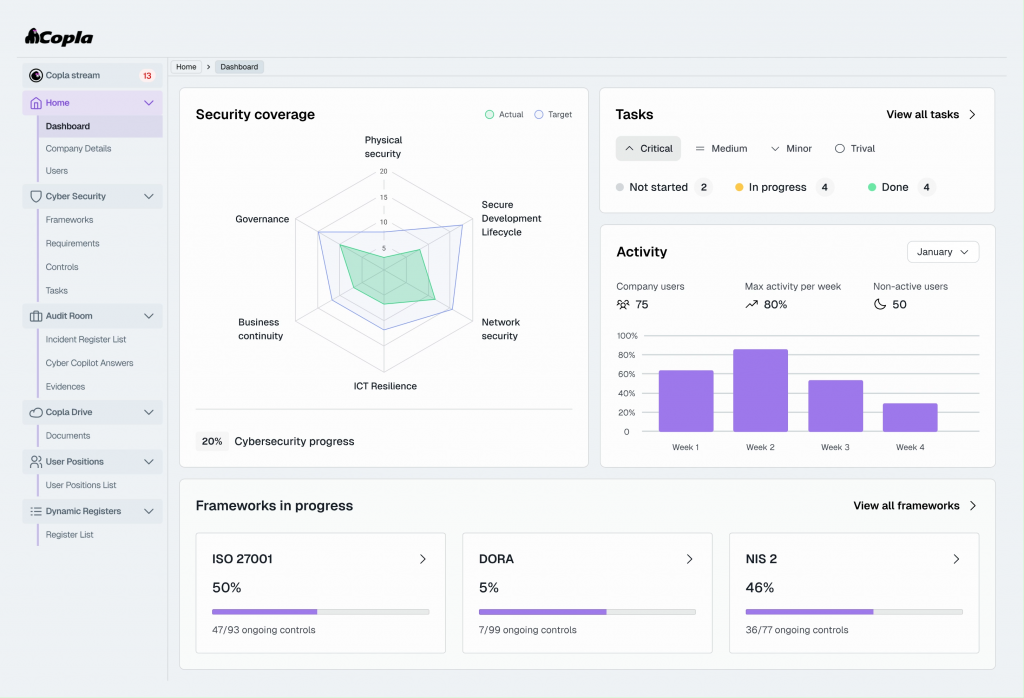
Copla is a European compliance platform that comes with its own security experts, and it is built around exactly the journey a certification follows. It starts with a workshop to understand your business. Then the platform builds your risk and asset registers from real information about your company, and a guided set of around 160 questions generates your full policy and document pack. It holds a 4.9 out of 5 across verified user reviews as of July 2026, with every published review rating it five stars.
What makes it different is that it does not hand you all 93 controls and leave you to figure them out. It recommends the ones your business actually needs, explains why, and helps you put them in place in order of importance. That reasoning is exactly what auditors want to see. The same work also counts toward EU rules such as DORA and NIS2, so nothing gets done twice.
When the audit comes, Copla manages the relationship with the certification body and supports your team through both audit stages, with your dedicated expert answering the difficult questions. Users report 80 to 90 percent less manual work than running the project in spreadsheets, and pricing stays affordable and flexible with the expert help included. Copla’s customer case studies show what the journey looks like in practice.
- User Rating: 4.9/5 as of July 2026, with 100% of reviews rating it five stars.
- Customer Satisfaction: Praised for a clean interface, guided compliance journeys, responsive support, and proof that stays audit-ready.
- Key Features: Documents and registers built from your answers, guided policy generation, controls recommended with clear reasons, automatic proof collection, and bundled expert consultancy.
- Key Strengths: The whole certification journey in one engagement, deep coverage of EU rules, and predictable pricing with the experts included.
- Frameworks: ISO 27001, DORA, NIS2, SOC 2, PCI DSS, Cyber Essentials, and MiCA.
2. Vanta
Vanta is the pick for companies that run mostly on cloud tools. It connects to more than 400 of them, from AWS to Google Workspace, and checks your security settings automatically every hour, so a big share of the proof your auditor needs collects itself. It covers the full current version of the standard and helps you produce the central applicability document.
The complaints in reviews are consistent: prices jump 30 to 50 percent at renewal, extra costs appear after purchase, and support is slower on cheaper plans. The ready-made policies still need real editing, and anything software cannot see, such as office security and people processes, still needs manual proof.
- User Rating: 4.6/5 across roughly 2,400 reviews as of July 2026.
- Customer Satisfaction: Users cite the breadth of connections and proof that auditors already know how to read.
- Key Features: 400+ connections, hourly automatic checks, document support, and a customer-facing trust page.
- Key Strengths: The most automatic proof collection for cloud-based companies.
- Frameworks: SOC 2, ISO 27001, HIPAA, GDPR, PCI DSS, and 35+ in total.
3. Drata
Drata suits companies whose compliance needs will keep growing. It runs automatic checks daily, ties every security measure to a documented reason, and keeps its templates current with the 2022 standard. Its customer support is the best rated in the category, staffed partly by former auditors, and it connects you to a network of audit firms when it is time to certify.
Reviewers report renewal increases of 20 to 40 percent as companies grow, weaker automation on unusual technical setups, and a busy first setup where it is not always clear what is mandatory and what is optional.
- User Rating: 4.7/5 across roughly 1,150 reviews as of July 2026.
- Customer Satisfaction: Users cite responsive, expert support (9.7/10 on G2).
- Key Features: Daily automatic checks, clear reasoning behind each measure, 300+ connections, and a dedicated space where auditors review your proof.
- Key Strengths: A platform that grows with you, with the best support in the category.
- Frameworks: SOC 2, ISO 27001, HIPAA, GDPR, PCI DSS, NIST, and more.
4. Sprinto
Sprinto is the budget-friendly fast starter. On day one it sets up your policies, your risk list, and your applicability document, tailored to the tools you use, and its in-house experts guide the setup. Auditors get their own view of your proof, which keeps the audit itself smooth, and a directory of vetted certification bodies covers the final step.
Reviewers flag occasional bugs and false alarms in the automatic checks, workflows that resist customization, renewal quotes up to 40 percent above the first year, and email support that slows down when you need it most.
- User Rating: 4.8/5 across roughly 1,500 reviews as of July 2026.
- Customer Satisfaction: Users cite the clear dashboard and weeks saved on audit preparation.
- Key Features: Everything set up from day one, auditor view, 300+ connections, and work that counts toward several standards at once.
- Key Strengths: The fastest and most affordable start for teams without a specialist.
- Frameworks: ISO 27001, SOC 2, GDPR, HIPAA, PCI DSS, and more.
5. Secureframe
Secureframe’s templates are its selling point: policies and checklists written by people who used to be auditors themselves, so what you start with is close to what your auditor expects to see. Automatic proof collection runs through 300+ connections, and the in-house team guides you toward certification through its partner audit firms.
The recurring complaints are price increases as your team or standard count grows, workflows that force you to do things Secureframe’s way, and repetitive forms when managing proof.
- User Rating: 4.7/5 across roughly 800 reviews as of July 2026.
- Customer Satisfaction: Users cite audit preparation cut by weeks and clear guidance.
- Key Features: Templates written by former auditors, automatic proof collection, and readiness dashboards across standards.
- Key Strengths: Ready-made content that holds up in front of an auditor.
- Frameworks: SOC 2, ISO 27001, HIPAA, PCI DSS, GDPR, and a growing list.
6. Scrut
Scrut fits mid-sized companies juggling several standards at once. It comes with ready-made control sets, a generator for the central applicability document, and more than 75 policy templates already checked by auditors, plus dedicated compliance experts who work with your team. Your auditor can work directly inside the platform too.
Reviews mention delays in its device-monitoring agent, a learning curve on advanced settings, limited options for customizing reports, and pricing available only on request.
- User Rating: 4.9/5 across roughly 1,300 reviews as of July 2026.
- Customer Satisfaction: Users cite hands-on expert support and automation cutting manual effort.
- Key Features: Document generator, 75+ vetted policy templates, auditor access inside the platform, and continuous checks.
- Key Strengths: Depth on ISO plus breadth across 60+ other standards, at a mid-market price.
- Frameworks: ISO 27001, SOC 2, GDPR, HIPAA, PCI DSS, and 60+ in total.
7. ISMS.online
ISMS.online is built for one thing: ISO-style certifications, with the documents at the center. Everything the audit needs lives in one workspace, an 11-step guided path walks your team from zero to certification, and in-house experts plus built-in coaching videos answer questions along the way.
The trade-off is automation: it collects less proof automatically than the tools above, so more of the evidence work stays manual. Reviewers also mention navigation that takes getting used to, prices that feel high against rivals, and small missing conveniences.
- User Rating: 4.5/5 across roughly 280 reviews as of July 2026.
- Customer Satisfaction: Users cite fast, professional support and everything for the audit in one place.
- Key Features: A dedicated ISO workspace, step-by-step certification path, full document library, and built-in coaching.
- Key Strengths: The document side of certification, done thoroughly.
- Frameworks: ISO 27001 core; supports ISO 27701, ISO 9001, and related standards.
8. DataGuard
DataGuard is the most consultant-led option here: you get a platform plus in-house security consultants who guide the choices, review your documents, and prepare you for the audit. For teams that want to be led through the whole project by people, that is exactly the appeal.
The trade-offs match the model. Reviewers report documents delivered as locked PDFs only DataGuard can update, limited flexibility, a dated-feeling interface, consultants who get scarce in busy audit season, and cost: outside analyses put typical engagements at EUR 30,000 to 50,000 or more per year, and contract terms have caught customers out.
- User Rating: 4.6/5 on Capterra (~49 reviews) as of July 2026; no published G2 star rating in accessible sources.
- Customer Satisfaction: Users cite competent, communicative consultants as the reason to choose it.
- Key Features: Consultant-guided setup, document review, audit preparation, and privacy services.
- Key Strengths: The strongest human-led delivery for teams that want to be guided.
- Frameworks: ISO 27001, GDPR/privacy, and adjacent EU requirements.
9. Conformio
Conformio is the small-business option: wizards walk you step by step through every document the certification requires and fill them in from your answers, with the central applicability document generated automatically. ISO experts are included in the subscription for reviews and a check before the real audit.
Its focus is also its limit: it covers ISO 27001 only, connects to few other tools, and collects little proof automatically. Reviewers also mention slow screens, and its rating rests on a small number of reviews.
- User Rating: 4.5/5 on a small G2 review base (~12 reviews) as of July 2026.
- Customer Satisfaction: Users cite the easy wizards and the included expert help.
- Key Features: Document wizards for everything the certification requires, automatic applicability document, and included expert sessions.
- Key Strengths: The cheapest credible route to a first certification for a small team.
- Frameworks: ISO 27001 only.
10. Thoropass
Thoropass sells convenience: the software and the audit come from the same company, so your preparation and your certification live in one purchase. Its support is the highest rated in the category, and its proof tracking runs continuously.
The convenience is also the caveat: you cannot choose your own audit firm, which some larger customers and procurement teams see as a conflict of interest. Reviewers also mention a cluttered interface as programs grow, fewer connections than the leaders (~100), and having to upload the same proof twice between preparation and the formal audit.
- User Rating: 4.7/5 across roughly 570 reviews as of July 2026.
- Customer Satisfaction: Users cite the highest support score in the category (9.6/10).
- Key Features: Platform plus in-house audit team, continuous proof tracking, and AI-assisted audit preparation.
- Key Strengths: Preparation and certification under one roof.
- Frameworks: ISO 27001, SOC 2, HITRUST, PCI DSS, and more.
Honorable Mentions
Hyperproof handles companies running many standards at once well, but ISO buyers should know one thing: the central applicability document your auditor reads first is not built into the product, so reviewers assemble it through workarounds. Rated 4.5 across roughly 213 reviews as of July 2026.
StandardFusion is a tidy mid-market platform with solid ISO support, rated 4.5 across roughly 61 reviews as of July 2026. One note for 2026 buyers: it was acquired by Wolters Kluwer in January 2026 and is being folded into another product line, so ask about the roadmap before committing.
How Copla Supports ISO 27001 Programs
ISO 27001 is the framework Copla was built around. The engagement starts with a workshop to understand your business and see where you stand. The platform then builds your risk, asset, and supplier registers from real information about your company, a guided set of questions produces your full policy pack, and the security measures go in place in order of importance, with your dedicated expert handling the difficult questions. When the audit comes, we manage the relationship with the certification body and support your team through both stages, then keep the proof current so the annual check-ups stop being events.
Schedule a call with Copla to walk through your certification path.