

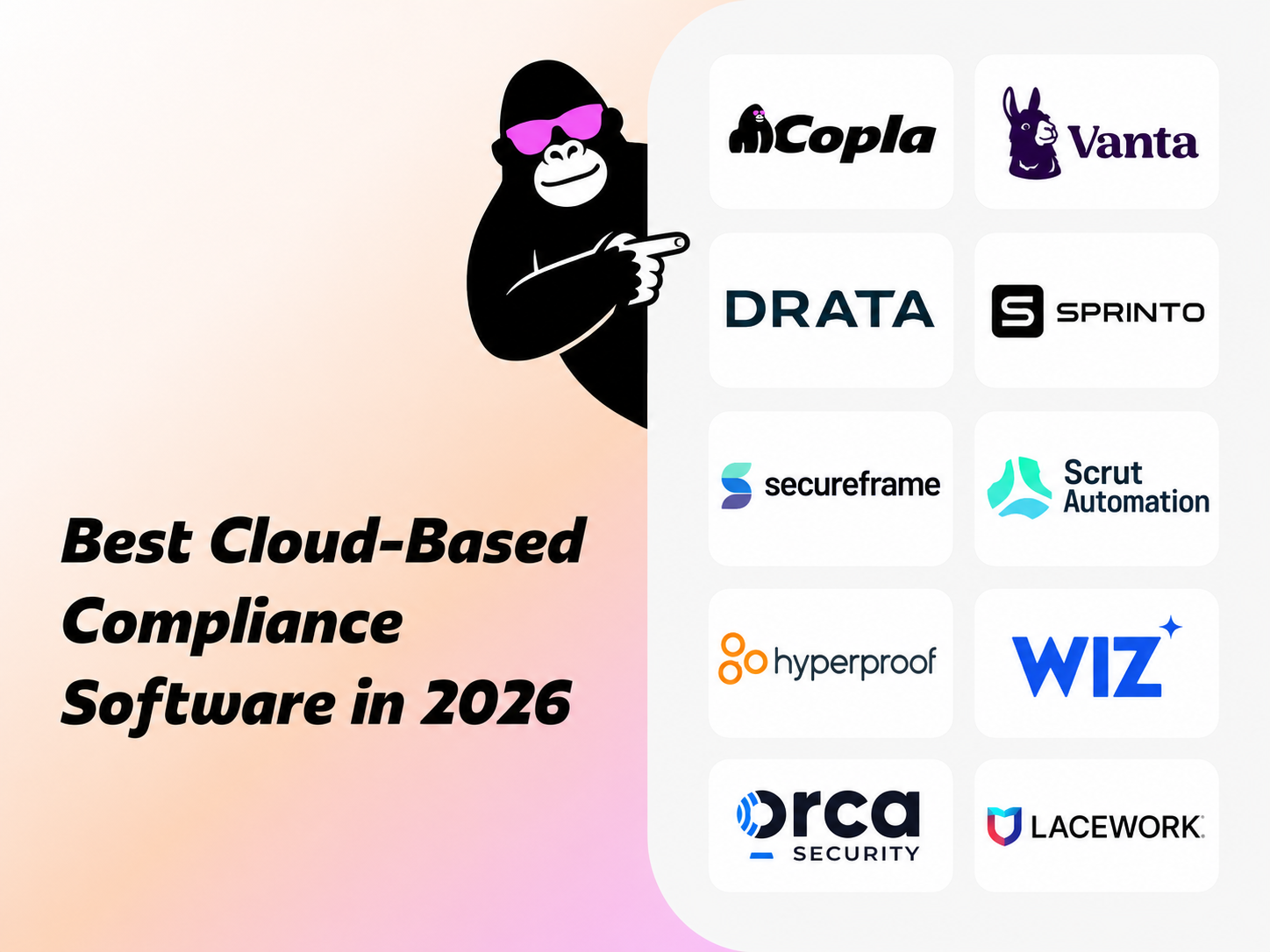


Most companies now run everything in the cloud: their files, their code, their customer data. Sooner or later a customer or a regulator asks for proof that all of it is secure, and someone gets handed the job of finding a tool to help. Cloud based compliance software is that tool. You use it through your web browser, it connects to the tools your company already uses, and it keeps your risk lists, your security measures, and your proof organized and ready for an audit. One heads-up about the list below: seven of the tools help you run that compliance work, while three of them (Wiz, Orca Security, and Lacework FortiCNAPP) are cloud security scanners, called CSPM tools in the industry, that check your cloud accounts for risky settings, and many companies use one of each. This guide compares the top 10 cloud based compliance software tools for 2026 in plain terms.
- Copla
- Vanta
- Drata
- Sprinto
- Secureframe
- Scrut
- Hyperproof
- Wiz
- Orca Security
- Lacework FortiCNAPP
Cloud Compliance Tools at a Glance
| Tool | Type | What it helps with | Expert help included | User rating (July 2026) |
| Copla | Compliance platform | EU rules: ISO 27001, DORA cloud provider oversight, NIS2 | Yes, CISO consultancy included | 4.9 / 5 |
| Vanta | Compliance platform | 400+ connections, automatic hourly checks | Auditor and partner network | 4.6 / 5 |
| Drata | Compliance platform | Daily automatic checks of your cloud tools | Former auditors plus a dedicated contact | 4.7 / 5 |
| Sprinto | Compliance platform | Automatic checks at a startup-friendly price | Support team plus auditor network | 4.8 / 5 |
| Secureframe | Compliance platform | Ready-made templates plus automatic proof | Former auditors on staff | 4.7 / 5 |
| Scrut | Compliance platform | 60+ standards with continuous cloud checks | Dedicated compliance experts | 4.9 / 5 |
| Hyperproof | Compliance platform | Many standards at once, with cloud proof | Support-team led | 4.5 / 5 |
| Wiz | Cloud security scanner | Nothing to install, shows how an attacker could get in | Vendor support | 4.7 / 5 |
| Orca Security | Cloud security scanner | Nothing to install, sorts findings by urgency | Vendor support | 4.7 / 5 |
| Lacework FortiCNAPP | Cloud security scanner | One view of cloud risks plus compliance checks | Vendor support | ~4.7 / 5 (combined)* |
Ratings come from verified user reviews checked in July 2026 and are subject to change. *Lacework FortiCNAPP’s figure combines roughly 625 reviews across several review sites, because a clean separate G2 count does not exist after Fortinet bought and renamed the product.
How We Picked These Tools
We compared each tool on the things that matter to a buyer: how much proof it collects automatically, how well it connects to the tools you already use, how much human help is included, and what users say after living with it for a while. Every rating comes from verified user reviews on G2 and Capterra, checked in July 2026, and every entry includes the complaints reviewers actually make, not just the strengths. No vendor paid to be included.
The Cloud Provider Protects Its Side, You Protect Yours
One idea explains why this software exists at all. Cloud providers like Amazon, Microsoft, and Google keep their own data centers and services secure, but everything you put in the cloud stays your job to protect: your data, your user accounts, who can access what, and how your settings are configured. Amazon calls this the shared responsibility model: the provider handles security of the cloud, you handle security in the cloud. Microsoft’s version says plainly that your data, devices, and user accounts always stay your responsibility, whatever you buy from them. No certificate your cloud provider holds covers your side of that line, and that line is where all cloud security compliance work begins.
The rulebooks have caught up with the cloud too. ISO/IEC 27017 adds cloud-specific guidance plus seven extra cloud security measures to ISO 27002, a widely used list of security measures. And for banks, insurers, and other financial companies in the EU, DORA, the EU’s digital resilience law for finance, treats your cloud providers as outside suppliers you must formally keep watch over, with an EU-level oversight program for the biggest providers because so many companies depend on the same few clouds. Cloud based compliance software exists to help you run your half of all this.
What to Look For Before You Choose a Cloud Compliance Tool
Does It Connect to the Tools You Already Use?
These tools save you time by connecting to your cloud accounts and the other software your company runs, then collecting proof automatically in the background. That only works if the connections exist for your setup. Every tool looks great in a demo built on the vendor’s own example systems; ask to test it against the tools you actually use before you sign anything.
Proof That Holds Up in an Audit
If you use a cloud security scanner, its findings need to land somewhere your auditor can actually use: dated, tied to the security measures they relate to, and showing that problems got fixed. Check how the compliance platform takes in the scanner’s results, and whether the two together give you one organized set of proof or two separate dashboards someone has to reconcile by hand.
The EU Rules Layer
If DORA or NIS2, the EU’s wider cybersecurity law, applies to you, cloud compliance also means keeping formal watch over the providers themselves: the right terms in contracts, ongoing monitoring, a plan for leaving a provider, and for financial companies a required register listing every technology supplier. Tools built for the US market rarely handle this, so ask about it directly or plan to run it elsewhere. The security standards this work feeds into are compared in our ISO compliance software and SOC 2 compliance software guides.
What It Really Costs
Compliance platforms usually cost five figures a year, and price increases at renewal are the most common complaint in reviews across the category. Cloud security scanners like Wiz charge based on the size of your cloud setup, and reviewers consistently describe the leading ones as expensive as you grow. Whatever you pick, remember the audit or certification fees on top.
The 10 Best Cloud Compliance Tools in 2026
1. Copla
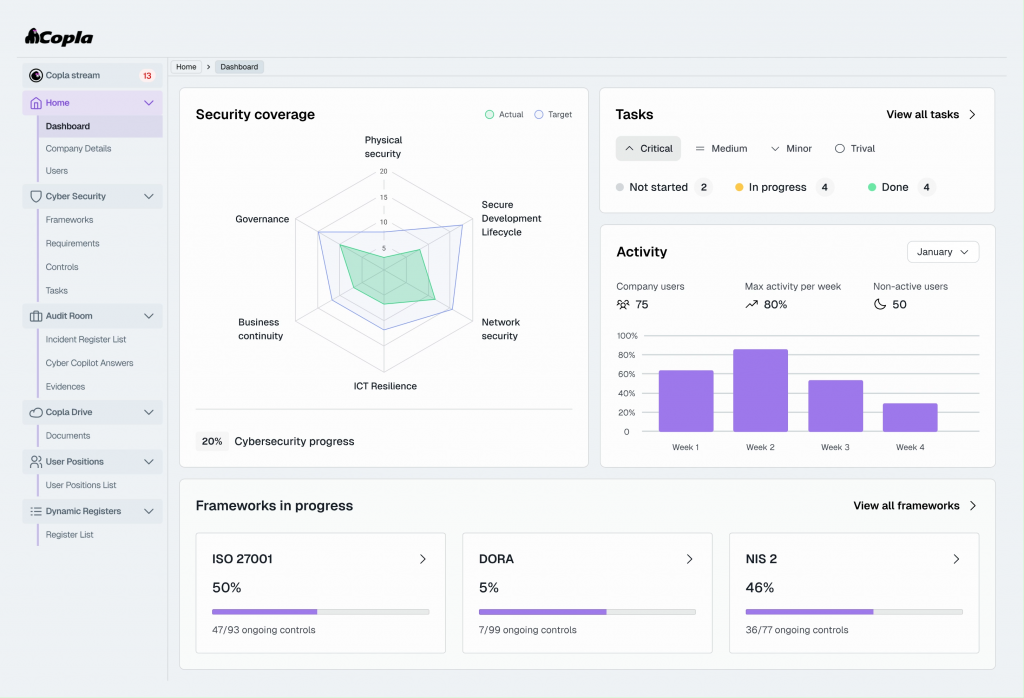
Copla is the pick for regulated European businesses that run in the cloud and want experts alongside the software. The platform builds your lists of risks, systems, and suppliers from real information about your business, and it covers ISO 27001, the international standard for information security, plus DORA and NIS2 in one place, so work done for one rule counts toward the others and your proof stays current. It holds a 4.9 out of 5 across verified user reviews as of July 2026, with every published review rating it five stars.
The cloud angle is specifically European. Under DORA, your cloud providers count as suppliers you must formally keep watch over, and Copla’s supplier register and third-party risk workflows are built to produce exactly the proof regulators ask for. Your dedicated CISO, a chief information security officer included in the engagement, helps you decide how much provider oversight is enough for your setup, and users report 80 to 90 percent less manual work than running compliance in spreadsheets.
One honest boundary: Copla does not scan your cloud accounts for risky settings. Pair it with one of the scanners later in this list, and Copla turns their findings into proof your auditor can use. Copla’s customer case studies show what that looks like in practice.
- User Rating: 4.9/5 as of July 2026, with 100% of reviews rating it five stars.
- Customer Satisfaction: Praised for a clean interface, guided compliance journeys, responsive support, and proof that stays audit-ready.
- Key Features: Lists of risks, systems, and suppliers built from your answers, DORA cloud provider oversight, work that counts across several rules at once, and bundled CISO consultancy.
- Key Strengths: The EU rules side of cloud compliance, run with expert guidance included.
- Frameworks: ISO 27001, DORA, NIS2, SOC 2, PCI DSS, Cyber Essentials, and MiCA.
2. Vanta
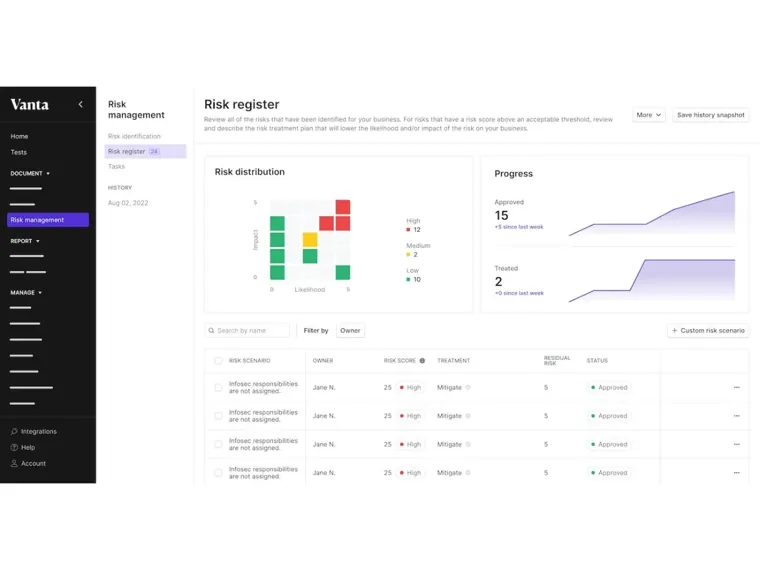
Vanta connects to more of your tools than anyone else in this list: over 400 connections into AWS, Azure, Google Cloud, and the software around them, with your security settings checked automatically every hour and proof collected in the background. For a company that runs entirely on standard cloud tools, that makes it the fastest way to get the compliance work moving.
The recurring reviewer complaints are price jumps of 30 to 50 percent at renewal, extra costs appearing after purchase, and support that is slower on cheaper plans. Its coverage also thins out once your setup strays from the standard cloud tools.
- User Rating: 4.6/5 across roughly 2,400 reviews as of July 2026.
- Customer Satisfaction: Users cite the breadth of connections and the continuous automatic checks.
- Key Features: 400+ connections, hourly checks, automatic proof collection, and a public page that shows customers your security status.
- Key Strengths: Automatic proof collection for companies on standard cloud tools.
- Frameworks: SOC 2, ISO 27001, HIPAA, GDPR, and 35+ in total.
3. Drata

Drata runs automatic checks of your cloud tools every day, lets you adjust its workflows to fit how your team works, and has the best-rated support team in the category. It suits companies whose compliance needs will keep growing, adding standards and people over time.
Reviewers flag price increases of 20 to 40 percent at renewal, weaker automation for unusual setups or systems that run on your own servers, and a first setup that raises a lot of alerts before you tune it.
- User Rating: 4.7/5 across roughly 1,150 reviews as of July 2026.
- Customer Satisfaction: Users cite expert, responsive support.
- Key Features: Daily automatic checks, 300+ connections, a dedicated space where auditors review your proof, and work that counts across several standards.
- Key Strengths: A cloud compliance setup that grows with the company.
- Frameworks: SOC 2, ISO 27001, HIPAA, GDPR, PCI DSS, NIST, and more.
4. Sprinto
Sprinto brings automatic compliance checks to startups and small businesses: proof collected from your cloud tools, work that counts toward several standards at once, and teams getting audit-ready in weeks, all at the affordable end of the category.
The trade-offs: it is built for standard cloud setups and gets thin outside them, reviewers mention occasional bugs in the automatic checks, workflows resist customization, and price increases at renewal come up in reviews.
- User Rating: 4.8/5 across roughly 1,500 reviews as of July 2026.
- Customer Satisfaction: Users cite the depth of automation and responsive support.
- Key Features: Automatic proof collection, 300+ connections, continuous checks, and work reused across standards.
- Key Strengths: The affordable starting point for cloud-based teams.
- Frameworks: SOC 2, ISO 27001, GDPR, HIPAA, PCI DSS, and more.
5. Secureframe
Secureframe pairs ready-made templates written by compliance experts with automatic proof collection across standard cloud tools, and its in-house team of former auditors guides you along the way. It suits companies handling several standards at once on cloud infrastructure.
Reviewers cite price increases at renewal, workflows that force you to do things its way, and some connections that need manual setup.
- User Rating: 4.7/5 across roughly 800 reviews as of July 2026.
- Customer Satisfaction: Users cite support quality and the speed the templates provide.
- Key Features: Expert-written templates, automatic proof collection, readiness dashboards, and 300+ connections.
- Key Strengths: Ready-made content plus in-house expertise.
- Frameworks: SOC 2, ISO 27001, HIPAA, PCI DSS, GDPR, and a growing list.
6. Scrut
Scrut covers more than 60 standards with continuous checks of your cloud tools and dedicated compliance experts included, a fit for mid-sized companies whose cloud compliance spans many obligations at once.
Reviews repeatedly mention that the small program it installs on laptops can lag when reporting in, a learning curve on advanced settings, and pricing available only on request.
- User Rating: 4.9/5 across roughly 1,300 reviews as of July 2026.
- Customer Satisfaction: Users cite hands-on expert support.
- Key Features: 60+ standards, continuous cloud checks, automatic proof collection, and expert support.
- Key Strengths: Breadth across standards with guidance, at a mid-market price.
- Frameworks: SOC 2, ISO 27001, GDPR, HIPAA, PCI DSS, and 60+ in total.
7. Hyperproof
Hyperproof manages many standards at once, with automatic proof collection through connections it calls Hypersyncs and work that counts across standards. It is built for teams whose cloud compliance is one strand of a larger security program.
It assumes an experienced team: reviewers cite the learning curve, limited options for customizing reports, and pricing that starts around $12,000 a year with a median around $40,000.
- User Rating: 4.5/5 across roughly 213 reviews as of July 2026.
- Customer Satisfaction: Users cite having all their security measures managed in one place.
- Key Features: Hypersyncs cloud proof collection, work reused across standards, and clear ownership of each security measure.
- Key Strengths: Cloud proof inside large, established programs.
- Frameworks: SOC 2, ISO 27001, NIST, PCI DSS, HIPAA, and a large library.
8. Wiz
Wiz is the benchmark among the cloud security scanners. It connects to your cloud accounts with nothing to install, maps everything you run within hours, and instead of handing you a long list of isolated problems, it shows how an attacker could chain them together to get in. It checks your settings against major standards and offers AI-written suggestions for fixing what it finds.
Reviewers note that its code-checking features raise some alarms that turn out to be fine and need manual review, that some features are priced by usage, which makes costs harder to predict, and that teams new to cloud security face a learning curve. Wiz checks your cloud accounts; it does not manage your policies, documents, or audits.
- User Rating: 4.7/5 across roughly 795 reviews as of July 2026.
- Customer Satisfaction: Users cite how quickly they see their whole cloud setup and how clearly risks are connected.
- Key Features: Scanning with nothing to install, attack paths shown in context, checks against major standards, and AI suggestions for fixes.
- Key Strengths: The fastest full picture of what you run in the cloud.
- Frameworks: Checks settings against CIS (a widely used checklist of safe settings), SOC 2, ISO 27001, PCI DSS, and more.
9. Orca Security
Orca reads your cloud accounts from the outside using a technique it calls SideScanning, so there is nothing to install, and it checks your systems, settings, and user accounts. Reviewers credit it for making clear which problems matter most instead of burying you in alerts, and it checks your settings against major standards.
The caveats: the sheer amount it finds can overwhelm at first, options for customizing reports are limited, and parts of the interface take learning.
- User Rating: 4.7/5 across roughly 278 reviews as of July 2026.
- Customer Satisfaction: Users cite fast visibility and the quality of its ranking of problems.
- Key Features: SideScanning with nothing to install, findings sorted by urgency, checks against standards, and coverage across cloud providers.
- Key Strengths: Clear signals instead of noise in cloud findings.
- Frameworks: Checks settings against CIS, SOC 2, ISO 27001, PCI DSS, and more.
10. Lacework FortiCNAPP
Lacework, renamed FortiCNAPP after Fortinet bought it, combines a view of your cloud risks with monitoring that watches for unusual activity that could mean an attack, plus compliance checks that score strongly with reviewers. It suits teams that want risky-settings scanning and attack detection from one tool.
Reviewers report that alerts sometimes arrive slowly, that it lacks connections to some other security tools, and that it takes tuning before the alerts are trustworthy. Buyers should also ask about product plans following the acquisition. Its rating combines several review sites rather than a clean G2 figure.
- User Rating: ~4.7/5 combined across roughly 625 reviews on multiple review sites as of July 2026 (a separate G2 figure is not cleanly available after the rename).
- Customer Satisfaction: Users cite one view of everything and clear ranking of threats.
- Key Features: Cloud risk scanning plus attack detection, compliance checks, and coverage across cloud providers.
- Key Strengths: Risky-settings scanning and attack detection in one tool.
- Frameworks: Checks settings against CIS, SOC 2, ISO 27001, PCI DSS, and more.
Honorable Mentions
Scytale pairs compliance automation with a dedicated expert for each customer and holds a 4.8 across roughly 570 reviews as of July 2026; its roughly 100 connections trail the leaders here. SentinelOne and Qualys both extend their security products into cloud compliance scanning and are worth a look if you already use them; they scan for security problems and do not manage your compliance paperwork.
How Copla Supports Cloud Compliance Programs
We work with regulated European businesses that run their operations in the cloud, where compliance covers both your own security measures and your formal watch over the providers you depend on. The platform builds your lists of risks, systems, and suppliers from real information about your business, treats your cloud providers as the suppliers DORA says they are, and turns scanner findings and the certificates your providers publish into proof mapped to ISO 27001, DORA, and NIS2. Your dedicated CISO helps you decide how much provider oversight is enough for your setup.
Schedule a call with Copla to map your cloud setup onto the rules that apply to you.