




GRC stands for governance, risk, and compliance. In plain English, it is the work of setting company rules, managing risks, and proving the business meets the laws, standards, and customer requirements that apply to it. For a small team, that work often starts in spreadsheets, shared drives, and calendar reminders. That can work for a while, but it breaks down quickly once audits, regulations, suppliers, policies, and risk reviews start happening at the same time. Evidence goes missing, owners lose track of tasks, and every audit becomes a last-minute scramble. GRC software brings that work into one system. It helps teams manage risks, controls, policies, evidence, tasks, audits, and reports without rebuilding the same information for every framework or review. The right provider depends on the kind of business you are. Large enterprises usually need heavy GRC suites with deep customization, complex workflows, and dedicated teams to run them. Regulated small and mid-sized businesses often need something different: faster setup, lower overhead, built-in guidance, and enough structure to stay audit-ready without hiring a full GRC department.
This guide compares the leading GRC solution providers for 2026 across both categories, with a clear view of who each platform actually fits.
- Copla
- Vanta
- Drata
- LogicGate
- Centraleyes
- Optro
- Diligent
- MetricStream
- ServiceNow IRM
- Archer
GRC Solution Providers at a Glance
The table groups the providers by kind and shows what each covers, how the expert help is delivered, and how users rate them.
| Provider | Kind | What it covers | Expert help | User rating (July 2026) |
| Copla | Newer, risk-first | Risk, compliance, policy, vendors, DORA/ISO/NIS2 | Yes, in-house experts plus partners | 4.9 / 5 |
| Vanta | Newer, automation | Compliance, automatic checks, light risk | Auditor and partner network | 4.6 / 5 |
| Drata | Newer, automation | Compliance, automatic checks, risk, vendors | Auditor and partner network | 4.7 / 5 |
| LogicGate | Newer, mid-market | Risk, compliance, audit, build-your-own workflows | Paid services and partners | 4.6 / 5 |
| Centraleyes | Newer, mid-market | Cyber risk, vendor risk, 180+ standards | Through partners | 4.5 / 5* |
| Optro | Enterprise suite | Audit, risk, compliance, vendor risk | Own services plus consulting firms | 4.6 / 5 |
| Diligent | Enterprise suite | Audit, risk, compliance, board reporting | Paid services and partners | 4.3 / 5* |
| MetricStream | Enterprise suite | The full enterprise GRC range | Outside consulting firms | 3.9 / 5* |
| ServiceNow IRM | Enterprise suite | Risk, compliance, audit on ServiceNow | Outside consulting firms | 4.4 / 5 |
| Archer | Enterprise suite | The full risk range, deeply customizable | Own services plus consulting firms | 4.1 / 5* |
Ratings are drawn from verified user reviews checked in July 2026 and can change. *Centraleyes has too few public reviews for a reliable overall rating in this category. MetricStream and Archer have few reviews on general software review sites, so their scores from Gartner Peer Insights are shown (MetricStream 3.9 across about 47 reviews; Archer 4.1 across about 69 reviews, both in Gartner’s integrated risk management category). Diligent’s 4.3 is for its Diligent One Platform product listing; the company’s average across all its products is 4.4.
How We Compared These Providers
We compared each provider on the things that decide a real purchase: what it covers, how fast it gets running, how much expert help is included, and what it costs to own. Every rating comes from verified user reviews on G2 and Gartner Peer Insights, checked in July 2026, and every entry includes the complaints reviewers actually make, not just the strengths. Where a provider has too few reviews for a reliable rating, the table says so instead of guessing a number. No vendor paid to be included.
PCI DSS Compliance, without the panic
Turn PCI DSS into a guided, automated journey.
What to Look For in a GRC Solution Provider
Six questions matter more than any feature list.
Match the Provider to Your Size and Budget
Match the provider to your company, not the other way around. An enterprise suite forced onto a lean team becomes expensive software nobody opens; a startup tool stretched across a global company runs out of depth. Be honest about your scale and budget before anything else, and check the tool can grow with you as your business and the rules change. Buying too big wastes money and stalls in setup; buying too small leaves you short later.
What a GRC Solution Should Cover
Real GRC covers more than compliance. Check the provider handles the areas you need: a risk register (a living list of the risks your business faces and what you are doing about them), policy management, internal audits, vendor tracking, and clear reports for leadership, all in one place. Some “GRC” tools are really compliance tools with a thin risk feature added on, which is fine if compliance is all you need; if that describes you, our comparison of compliance management platforms covers that category directly. Vendor risk tracking matters if your business depends on outside suppliers.
Risk-First or Checklist-First
The strongest GRC programs start from risk, not from a checklist. A risk-first provider asks what could actually go wrong in your business and puts the most important security measures first, which is what auditors and regulators expect to see. A checklist-first tool hands you every rule and leaves you to work through the pile. The 93 controls in ISO/IEC 27001, the international standard for information security, are a good test: a risk-first platform helps you explain which ones apply to you and why.
Setup Time and Expert Support
Ask how long setup takes, who does the work, and where the expertise comes from. This matters most if nobody on your team has done GRC before, and even when someone has, that person’s time is often claimed by more urgent work. The enterprise suites are set up by outside consulting firms such as Deloitte, PwC, or Accenture, which you hire and pay separately. The automation tools point you to audit firms and service partners instead of including advice. Some tools are the exception as they include their own security experts, CISOs (chief information security officers) in the engagement and manage the relationship with the outside auditor for you.
Coverage of the Rules You Must Follow
The standards and laws you must meet should be supported properly, not as an afterthought. Work done for one standard should also count toward another: the same security measure tested once, the same proof reused for several sets of rules instead of collected separately for each. Over the life of a program, that reuse is one of the biggest time savings a platform can deliver. European organizations increasingly need ISO 27001, DORA (an EU regulation on digital resilience for financial firms), and NIS2 (an EU cybersecurity law), and many US-first tools added these late. If DORA applies to you, run a DORA gap analysis before you choose, so you know exactly what the platform has to support.
What a GRC Solution Really Costs
Cost separates the two kinds more sharply than any feature. Enterprise suites routinely run to six figures a year before you add the consulting fees needed to set them up, most vendors publish no prices at all, and reviewers across several platforms report notable increases at renewal. Budget for the full picture: the license, add-ons, setup, the audit itself, and any consultants needed to fill gaps. The newer platforms cost far less, and even among them prices differ. Copla is priced for exactly this gap: one of the more affordable platforms in the comparison, flexible on terms, with the expert help included so advice never shows up as a second bill.
Modern GRC Platforms for Mid-Sized and Regulated Businesses
These providers fit mid-sized companies and smaller regulated businesses that need a real GRC program without a Fortune 500 budget or a dedicated department. They get running in weeks rather than months and are designed for small teams. The trade-off is less depth at the extreme top end of corporate complexity.
1. Copla
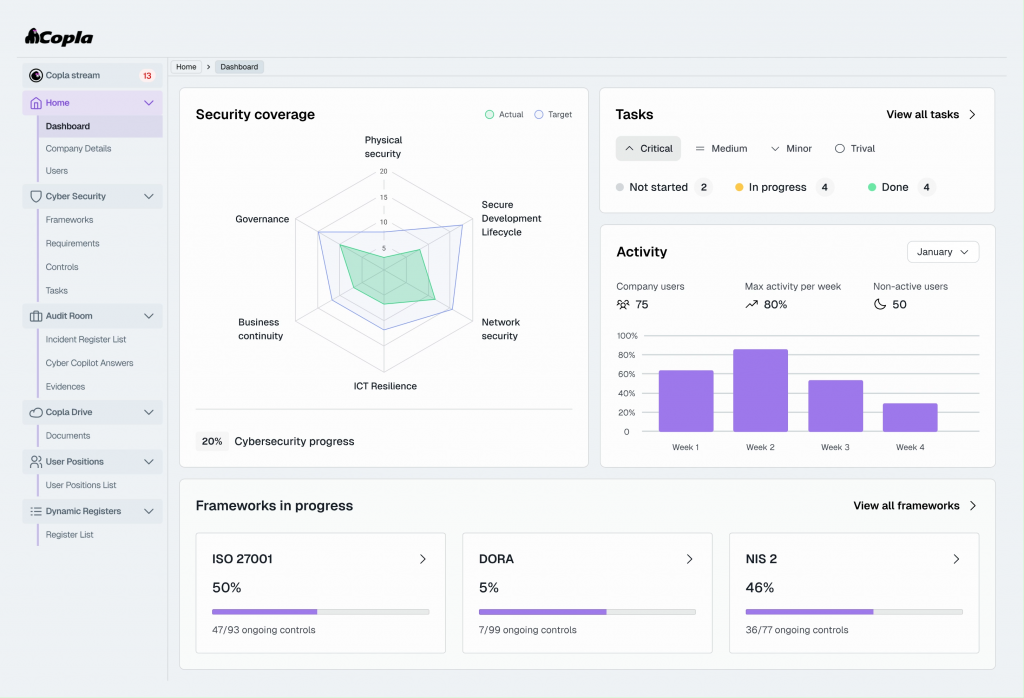
Copla is a risk-first GRC platform built in Europe. It combines AI-driven automation with hands-on help from experienced CISOs, and it is made for businesses under strict rules: fintechs and payment firms, but also healthcare providers, software companies, and others. It holds a 4.9 out of 5 across verified user reviews as of July 2026, one of the highest ratings here, with every published review rating it five stars, and it sits in the gap between the heavyweight enterprise suites and the self-service automation tools.
What sets Copla apart is that it starts from your risks, not from a checklist. You describe your business, your systems, your data, and your suppliers, and the platform builds a risk register and an asset list from that, then recommends only the security measures that fit your actual situation, with a clear reason for each. That reasoning is exactly what auditors want to see. It also reuses your work across standards, so proof gathered for ISO 27001 counts toward DORA or NIS2 instead of being collected twice.
Because Copla is built for European rules rather than adapted to them, it goes deep where US-first tools stay shallow. For companies under DORA, it covers the harder duties: managing technology risk, tracking third-party suppliers, reporting incidents, and keeping the record of suppliers that regulators expect. Its AI assistant, Copla Stream, guides teams through tasks in real time, and users report 80 to 90 percent less manual work than running everything in spreadsheets.
The support model is where Copla differs from almost everyone else here. Most providers send you to outside partners or auditor networks that you hire and pay separately. Copla instead includes its own CISO consultancy as part of the engagement and manages the relationship with the outside auditor for you: the platform produces the documents and tracks the security measures, your dedicated CISO handles the difficult questions, and Copla supports your team through each stage of assessment. Pricing reinforces the fit: Copla is one of the more affordable platforms in this comparison and flexible on terms, with the expert guidance included rather than billed separately, so a regulated business without a big team gets the platform and the expertise in one predictable engagement. Copla’s customer case studies show how this works in practice.
- User Rating: 4.9/5 as of July 2026, one of the highest on this list, with 100% of its roughly 80 verified reviews rating it five stars.
- Customer Satisfaction: Praised for a clean interface, guided compliance journeys, responsive support, and proof that stays ready for the audit.
- Key Features: Risk and asset registers built from your answers, work reused across standards, automatic policy and document generation, vendor risk tracking, the Copla Stream AI assistant, and included CISO consultancy.
- Key Strengths: In-house expert help included in the engagement rather than sent to a partner, a risk-first method auditors trust, real depth on EU rules, affordable and flexible pricing compared with the big incumbents, and 80 to 90 percent less manual work than spreadsheets.
- Frameworks & domains: ISO 27001, DORA, NIS2, SOC 2, PCI DSS, Cyber Essentials, MiCA; risk, compliance, policy, and vendor management.
2. Vanta
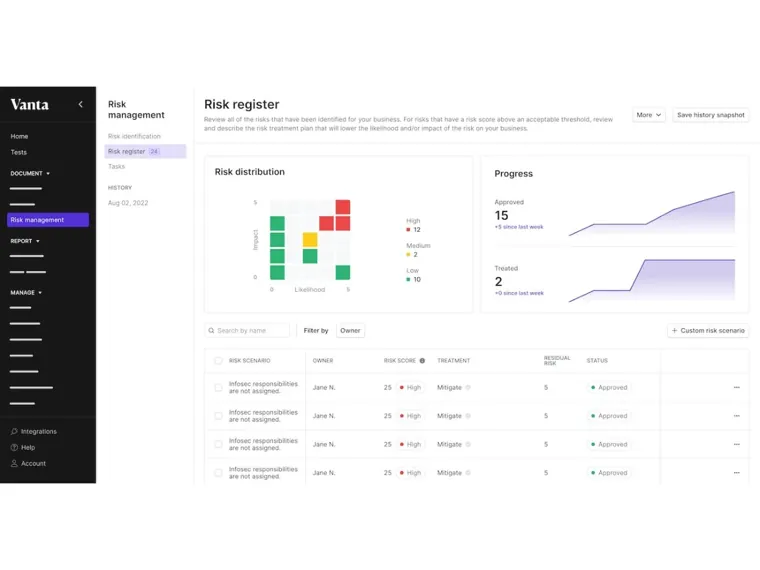
Vanta markets itself as a GRC solution, but its heart is compliance rather than company-wide risk. It connects to more than 400 of the tools companies already use and collects proof automatically, which suits a software company working toward its first SOC 2, a security report American customers often ask software companies to show, mainly in the US market.
Its risk and GRC features have grown, but they remain lighter than a dedicated risk platform: the risk register is a feature of the product, not its foundation. It is strong at showing you meet the rules through automatic proof collection and constant checking, but its risk assessments are lighter than those in more risk-centered platforms.
Vanta is largely self-service. Expert help is available through its auditor network and service partners, but that is a separate contract with a third party, not advice built into the platform. Reviewers say the platform works best when someone owns compliance internally, and buyers mention price increases at renewal once the introductory rate ends.
- User Rating: 4.6/5 across roughly 2,350 verified reviews as of July 2026.
- Customer Satisfaction: Users cite speed to a first SOC 2 and the breadth of connections.
- Key Features: 400+ connections, automatic checks every hour, about 90% of proof collected automatically, a public trust page for customers, and an AI agent.
- Key Strengths: A large connection library and a fast path to a first audit for US-focused software companies.
- Frameworks & domains: SOC 2, ISO 27001, HIPAA, GDPR, and 35+ standards; compliance and monitoring with lighter risk.
3. Drata

Drata takes an automation-first approach similar to Vanta but is built for programs that grow more complex over time, with more adjustable workflows for risk, vendor risk, and audit coordination. Its quality-of-support score in verified reviews stands at 9.6 out of 10.
Compared with Vanta, Drata checks daily rather than hourly and connects to fewer tools, but its audit workflows and adjustable setup suit teams that expect to add standards and people as they scale. Its 2025 purchase of SafeBase added customer-facing trust features, and work done for one standard counts toward others, cutting duplicate effort. Like Vanta, its expert help comes through an auditor alliance and service partners rather than in-house advisors.
Reviewers describe the interface as less intuitive than some alternatives, setup as taking more effort, and pricing at the premium end of the market, which can be steep for the smallest teams.
- User Rating: 4.7/5 across roughly 1,100 verified reviews as of July 2026.
- Customer Satisfaction: Users cite responsive, in-platform support (9.6/10 quality of support).
- Key Features: 300+ connections, daily automatic tests, adjustable risk, vendor, and audit workflows, and a SafeBase trust page.
- Key Strengths: Adjustable depth for compliance programs that keep growing.
- Frameworks & domains: SOC 2, ISO 27001, HIPAA, GDPR, PCI DSS, NIST; compliance, monitoring, risk, and vendors.
4. LogicGate
LogicGate Risk Cloud is a mid-market GRC platform built around a drag-and-drop workflow builder. Teams design and adjust their own risk, compliance, and audit processes without writing any code and without waiting on a long consultant-led project, so non-technical people can build or change a process without help from IT.
Its focus is flexibility. Where enterprise suites are set up by specialists and startup tools are rigid, LogicGate lets a capable administrator shape the platform to the business, bringing risk, compliance, and audit together in one place and replacing spreadsheets. Setup runs through its own service packages or partners such as Optiv and CDW.
The flip side of flexibility is effort: building and tuning workflows takes time, advanced reporting often needs extra setup or third-party tools, and reviewers see its AI features as less mature than some rivals.
- User Rating: 4.6/5 across roughly 190 verified reviews as of July 2026.
- Customer Satisfaction: Consistently high satisfaction in user reviews across consecutive quarters.
- Key Features: Build-your-own workflows and applications with no code, risk, compliance, and audit in one place, automation, and adjustable dashboards.
- Key Strengths: Flexibility for teams that want to shape their own processes.
- Frameworks & domains: Adjustable to many standards; company and operational risk, compliance, audit, and policy.
5. Centraleyes
Centraleyes is a mid-market GRC platform built around cyber risk, sitting between the startup-focused tools and the enterprise heavyweights. Its standout feature is an AI risk register that writes up risks for you, matched against more than 180 standards, with automatic workflows for fixing problems and a way to put a money value on cyber risks. It also helps teams spot new risks as they appear. Getting started takes days rather than months.
For a security-led buyer that wants a risk program quickly and broad coverage of standards, Centraleyes gets to value fast without the weight of an enterprise suite. Services come through a partner network of resellers, security service firms, and risk consultants rather than an in-house advisory team.
Two caveats. Reviewers note the interface can feel slow when moving between modules, though this is reportedly improving, and its public review base is small, so it has no reliable overall rating in this category. Treat the praise as genuine but based on fewer voices.
- User Rating: 4.5 / 5 aggregate feedback across reviewing platforms.
- Customer Satisfaction: Users cite fast onboarding and the automatic risk register.
- Key Features: AI risk register, 180+ standards library, automatic fix workflows, vendor risk, and executive dashboards.
- Key Strengths: Fast time to value with a cyber-risk focus.
- Frameworks & domains: Cyber and IT risk, vendor risk, compliance across 180+ standards, risk valuation.
Enterprise GRC Suites for Large Organizations
These providers are built for large, complex organizations: global banks, insurers, and Fortune 500 companies with whole teams dedicated to GRC. They are powerful and deep, but they often cost six figures a year, take months to set up, and the setup is usually done by outside consulting firms you hire separately. For most mid-sized regulated businesses they are more than needed.
6. Optro
Optro, the platform formerly known as AuditBoard until its 2026 rebrand, is built for large organizations running many compliance and audit programs at once. It brings compliance, internal audit, information security, and risk into one connected place and supports more than 40 standards. A single security measure can satisfy ISO 27001, SOC 2, and NIST (a set of US security standards) at the same time, tested once.
As AuditBoard, it appeared as a category leader in user-review rankings across audit, GRC, and vendor risk for more than 20 consecutive quarters, and reviewers describe it as workable for coordinating audits across large teams. Setup and strategic advice run through its own services team and large consulting firms such as Deloitte, EY, and Protiviti. Its dashboards report in real time across large programs. For buyers whose priority is the audit work itself rather than the full GRC suite, our compliance audit software comparison looks at that category directly.
Reviewers note it is not sensibly priced or sized for teams that do not need full enterprise GRC breadth. A mid-sized company will find it more than it needs.
- User Rating: 4.6/5 across roughly 1,585 verified reviews as of July 2026, under the new Optro listing.
- Customer Satisfaction: Users cite audit coordination across large teams.
- Key Features: Audit, risk, information security, and compliance in one place, AI-driven GRC, vendor risk, and analytics.
- Key Strengths: One unified GRC view for enterprises with dedicated audit teams.
- Frameworks & domains: 40+ standards; audit, company-wide risk, IT risk, vendor risk, compliance.
7. Diligent
Diligent, through its Diligent One Platform (formerly HighBond), is a long-established name in GRC, and the research firm Gartner named it a Leader in its 2025 market ranking. Its particular strength is combining internal audit, risk, and compliance with reporting for the board, which makes it relevant for organizations where the board and audit committee are closely involved.
Reviewers cite its breadth, its relative ease of use for a platform of this depth, and its support. It scales across large companies and the upper mid-market, with setup handled by its own services team and a partner network of more than 120 consultancies.
The criticisms are a steep learning curve for new users, weak onboarding for beginners, and occasional stability issues around frequent updates. Like the other enterprise suites, it rewards organizations with the time and people to adopt it properly.
- User Rating: 4.3/5 across roughly 150 verified reviews for the Diligent One Platform as of July 2026; the company’s average across all its product listings is 4.4.
- Customer Satisfaction: Users cite feature depth, relative usability, and support.
- Key Features: Audit, risk, and compliance together, board and governance reporting, risk assessment, and analytics.
- Key Strengths: Audit and board reporting covered in one platform.
- Frameworks & domains: Internal audit, company-wide risk, IT and vendor risk, compliance, policy, board governance, ESG.
8. MetricStream
MetricStream is a long-standing enterprise GRC provider, recognized in analyst firm IDC’s market assessment of GRC tools, with a broad set of modules spanning company-wide and day-to-day risk, compliance, audit, vendor risk, and keeping the business running after a disruption. It is built for the complex, global rulebooks that very large organizations face.
Its strengths are flexibility across many standards, reporting for the board, and the depth that global banks, insurers, and Fortune 500 companies require. Setup is led by consulting firms such as Deloitte, PwC, and Infosys.
The trade-offs are the classic enterprise ones: a complex, resource-heavy setup, a steep learning curve, some rigidity when you want custom changes, and slower support at times. Its user ratings also sit below most platforms on this list. It is not a realistic choice for a small or mid-sized company.
- User Rating: 3.9/5 across roughly 47 verified reviews on Gartner Peer Insights (integrated risk management category) as of July 2026; its sample on general software review sites is too small to be meaningful.
- Customer Satisfaction: Valued for flexibility and leadership-level reporting in large enterprises.
- Key Features: Risk management across many standards, workflow automation, risk scoring, board reporting, and a broad set of GRC modules.
- Key Strengths: Enterprise depth and flexibility at scale.
- Frameworks & domains: Company-wide risk, operational risk, IT and cyber risk, vendor risk, compliance, audit, business continuity.
9. ServiceNow IRM
ServiceNow Integrated Risk Management (IRM) puts risk, compliance, audit, and policy on the same platform many large organizations already use to run their IT. Its distinctive feature is a deep link to ServiceNow’s built-in inventory of a company’s systems and assets (the CMDB), which ties each risk directly to the specific system or incident it belongs to and gives a live view across programs.
For a company already standardized on ServiceNow, adding GRC to the same platform is a natural step, with automation and reporting built on what is already there. Its live checks can spot when a security measure quietly stops working and alert the team when a gap appears. Setup is typically carried by large consulting firms such as Accenture and Deloitte alongside ServiceNow’s own services.
The value depends heavily on that existing investment. Reviewers note that the price is hard to justify on its own, the learning curve is steep with little built-in onboarding, and the initial setup, especially that systems inventory, demands significant internal expertise and time. It is an enterprise choice, not a mid-market one.
- User Rating: 4.4/5 across its two product listings (roughly 130 verified reviews combined) as of July 2026.
- Customer Satisfaction: Users cite having everything on one platform and being able to trace each risk to a specific system.
- Key Features: Risk, compliance, audit, and policy on the ServiceNow platform, connection to the systems inventory, heat maps, and rich reporting.
- Key Strengths: A live, connected view for existing ServiceNow customers.
- Frameworks & domains: Company-wide risk, operational risk, IT and cyber risk, vendor risk, audit, policy, regulatory change.
10. Archer
Archer (formerly RSA Archer) is one of the oldest names in risk software, with more than two decades of enterprise deployments and deep, highly adjustable coverage across risk, compliance, audit, and resilience. It remains relevant for large, established organizations that have built their processes around it.
Its strength is that it can be shaped to almost any risk process, as long as the company has an in-house team to run it, supported by its own services and partners such as Crowe and Protiviti. That breadth can genuinely reduce risk, but only for organizations with the internal capacity to use it well.
The honest weakness is age. Reviewers point to a dated, less user-friendly interface, a heavy setup, and a long wait before the tool pays off compared with newer cloud rivals, and its share of market attention has declined year over year. It suits organizations already invested in it more than new buyers starting fresh.
- User Rating: 4.1/5 across roughly 69 verified reviews on Gartner Peer Insights (integrated risk management category) as of July 2026; its sample on general software review sites is small.
- Customer Satisfaction: Valued for its adjustability by large, established users.
- Key Features: Highly adjustable risk and compliance platform, advanced workflow engine, data feeds, and dashboards.
- Key Strengths: Deep adjustability for established enterprise programs.
- Frameworks & domains: Company-wide risk, IT and security risk, operational risk, vendor risk, audit, compliance, resilience, policy.
Honorable Mentions
A few more providers are worth a shortlist place depending on your situation.
Hyperproof fits mid-sized to large teams running a maturing program across several standards, with ownership of security measures and proof management as its focus, though it assumes you already have a program up and running. OneTrust is a privacy-focused platform with deep GDPR and data-privacy tooling, though reviewers describe it as expensive and complex, and a difficult fit for teams without dedicated people. Riskonnect is an enterprise suite with a specialty in business continuity and insurable risk, priced firmly at the enterprise end. Scrut is a mid-market automation platform with broad coverage of standards and hands-on support for teams that want guidance without enterprise weight.
How Copla Supports GRC Programs
We work with regulated businesses across Europe: fintechs and payment firms, but also healthcare, software, and other companies that need a working governance, risk, and compliance program without building a large team to run it.
The work starts with a workshop: we map your systems, confirm which rules apply to you, and check where you stand today, so gaps show up early. The platform then builds your risk and asset registers from real information about your business, a guided set of questions produces your full policy pack, and we put security measures in place in order of risk, so effort goes where it matters most. Policies, vendor risk, proof, and reporting live in one place and stay current between audits instead of being rebuilt before each one. Your dedicated CISO handles the difficult questions in-house, and we manage the auditor relationship through each stage of assessment, so audits stop being a separate event.
Schedule a call with Copla to walk through how this would look for your team.


