




Choosing the compliance software gets harder after the third demo, not easier. Every platform claims automation and broad framework coverage, and by the fourth call the pitches blur into one slide deck with a different logo. If you inherited this budget along with the deadline, nothing has told you which platform is different yet.
This guide skips what you already know about a compliance and risk management platform and goes straight to what separates one from another: the right category, real depth on your regulations, what genuinely runs without a person, and where the judgment sits once the software stops. A fifth question almost nobody asks decides more than category, regulatory depth, automation, and judgment combined.
First, work out which category you are buying
Nobody writes about this step, which is exactly why it causes the most expensive mistakes. Ask what compliance software actually means and you get four distinct products, each demoed as though it belongs to the same category as the others. Confuse them and you end up comparing tools that share a feature list but not a purpose.
| Category | Built for | Who it suits | The catch |
|---|---|---|---|
| Compliance Automation Platforms | Continuous control testing and audit evidence, pulled straight from your infrastructure | Teams that already know their scope, often chasing SOC 2 or ISO 27001 | It automates control testing, not the risk thinking behind what gets collected |
| Enterprise GRC Suites | Deeply configurable risk and compliance management for an organisation that already runs the function | Banks and insurers with a dedicated risk team of a dozen or more, one owner per module | It is a programme, not a subscription. Every decision the software leaves open becomes your team’s decision alone |
| Point Tools | One job done well: document management, a vendor questionnaire, an access review platform, a risk register | Teams that have already solved how the pieces fit together | Buy three in sequence and you get three logins, three exports, and no shared record connecting them |
| Platform Plus Expertise | Risk assessments, control decisions, and audit prep reviewed by compliance professionals, inside the same system that runs the workflow | Teams with no dedicated compliance or security function: a founder or ops lead covering compliance alongside a real job | Check whether the expertise is actually inside the product or a support ticket that takes three days and comes with a job title |
This is also where GRC solution providers tend to differ most, and it rarely shows up until you ask directly.
Most of the regret buyers feel eighteen months in traces back to choosing the wrong category, not to a missing feature.
The six questions that actually decide it
Once you know which category you are shopping in, six questions do more work than any feature comparison or requirements checklist. They are ordered deliberately: each one narrows the field further than the last, and every one is short enough to ask out loud on a call without it sounding like an audit.
Ask them in order. The answers compound.
How deep are you on my regulations, not how many do you list?
Framework count is the vanity metric of this category. A vendor who lists forty frameworks is not telling you they go deep.
Six frameworks covered properly beats forty covered as a checkbox.
You will see vendors and buying guides cite a number, support for thirty-five or more regulatory standards, as if that alone makes a compliance solution advanced. It does not: a tool built to span that many industry standards at once is optimised for coverage, not depth on any single one.
Depth looks specific once you know what to look for. A control library built from the ground up for a regulation reads differently from one mapped onto it afterward: the first anticipates what trips most companies up, the second discovers it mid-implementation. Ask the vendor which part of your framework’s regulatory requirements causes the most trouble in practice, and whether updates reach you in real time when the regulation itself changes, or two release cycles later. A team that has built for your framework answers in seconds. A team that mapped it in from a template pauses.
This matters more if you are an EU financial entity, where the regulatory environment moves faster than most tools were designed for. DORA, NIS2, and MiCA carry structural expectations, such as contractual provisions and board-level oversight, that a tool shaped around NIST and HIPAA does not carry.
Most of this category was built for the US market first, then stretched to cover multiple frameworks in the EU without rebuilding for how regulatory compliance actually works there. Knowing how DORA and NIS2 differ is a reasonable proxy question: a vendor who answers it cleanly has built for European regulation rather than bolted it on.
Does the tool start from risk or from a checklist?
Ask this one directly: does the platform open with a framework template and ask you to collect evidence against it, or does it start from your assets and a business impact analysis, identifying risks and deriving controls from what you would actually lose if something failed?
| Dimension | Framework-first | Risk-first |
|---|---|---|
| Starting point | A generic template calibrated to a company like yours | Your assets and a business impact analysis |
| What you end up with | Controls sized to nothing in particular, not your actual risk exposure | Controls tied to a named risk and an actual business process |
| When a supervisor asks why a control exists | “The checklist said so” | The reasoning traces back to what you would actually lose |
That gap surfaces at the worst possible moment, when an examiner asks why a specific control is set at the level it is. Risk-first tools give you an answer that traces to an actual business process. Framework-first tools give you the checklist. That is proactive risk management instead of reactive box-ticking, and the difference shows up exactly when a supervisor starts asking why.
What runs without a person, and what just gets a draft?
Automated compliance workflows are the section of the pitch every vendor is proudest of, and the word automated covers three genuinely different things vendors rarely distinguish.
| Type | What it means | Example |
|---|---|---|
| Fully automated | Collects itself, no person involved | A configuration setting, an access log, a patch level |
| Drafted, not automated | The software produces it; a person has to confirm it is right | A policy, a risk narrative, a business impact analysis |
| Entirely manual | A human decision by nature, not something software can shortcut | A board sign-off, a risk acceptance, a contract term |
Ask precisely how much of the vendor’s automated evidence collection actually reaches your controls, for your framework, not for their best-case customer running SOC 2. Then ask what happens to the rest: is there a workflow with an owner and a deadline, or does your compliance status just degrade quietly, tracked manually if at all, until the gap surfaces the week before the audit with no audit trail showing who owned it.
A vendor who answers “not much, for that one” is telling you more than a vendor who claims every workflow is automated. The second answer is the one that should worry you.
Where does the expert judgment come from?
Every platform in this category handles expert judgment one of three ways: built into the product, sold as a separate engagement, or left out entirely on the assumption you will hire a consultant when needed.
For a team of one or two people, this decision shapes the outcome more than any line on the feature sheet. Software can flag a gap. Software cannot always tell you whether a flagged gap is a compliance risk, a shortfall against your own internal governance standards, or something that gets a contract flagged during a supervisory review.
Ask the vendor directly:
- How long between a question and an answer from someone qualified to give one?
- Does the expert review your actual evidence, or only point you toward a template?
- Does that person work inside the same system you do, with your real risk register in front of them?
- Will they put their name on a decision, or only offer options and leave the call to you?
Copla’s in-house CISO team is one version of the first model. Plenty of platforms only offer the third.
What team does this assume I have?
Every platform in this category has an implied org chart, and none states it on the pricing page. Enterprise GRC suites assume a risk function with named owners for each module. Self-serve automation platforms assume your compliance operations already know what a well-run programme looks like and just need a faster way to prove it.
Neither assumption gets said out loud in a demo, because no vendor wants to disqualify itself. That is exactly why you have to ask.
The question that surfaces the truth: which compliance officer or ops lead operates this day to day at a company my size, and can I speak to them?
Not a reference logo three times your headcount. Someone running the same tool under the same constraints you have. If the answer is vague, or the vendor can only offer a customer twenty times larger, that tells you more about fit than any feature list. It is also the fastest way to sort genuine compliance software for SMEs from tools that run on a small compliance team but were never built for one.
What happens to the price when I add a framework?
Licence cost is the least useful number in this entire evaluation, because it rarely reflects what you actually pay to run the thing. Model the real cost instead:
- Implementation effort in the first quarter;
- Internal hours spent feeding the system information nobody else can supply;
- Whether expert review is included or billed separately once you exceed the standard hours;
- What changes, in euros and in hours, the moment you add a second framework or your compliance needs scale past whatever headcount threshold triggers a new tier.
Compare that total against what a consultant would have charged for the same scope of work, not against doing nothing, which was never the real alternative.
One question exposes how a vendor really prices this: show me what my invoice looks like in year two if I add NIS2.
A vendor who can answer that on the call has modelled its own pricing honestly. A vendor who needs to “follow up with a proposal” is telling you the number depends on the negotiation, not on what the work actually costs.
The question almost nobody asks: your compliance platform is a vendor too
Here is the question every evaluation skips. You are about to hand a third party a complete map of your security configuration, your personnel records, your control gaps, and every risk you have not yet closed. That is arguably the most sensitive data in the business, going to a company you are choosing partly because it promised to help you manage third-party risk.
Worth saying plainly, once: Copla is a GRC platform, and it operates in exactly the market this article describes. Everything below applies to us too. A buyer’s guide that quietly exempts its own publisher is not a buyer’s guide.
“Every compliance platform on your shortlist becomes an ICT third party service provider the moment you sign the contract. We tell prospects to run the same due diligence on us they would run on any other provider, because that is what the regulation expects, and because it is what we would expect from you.”
– Grigorij Strelec, CISO team lead, Copla
If you are a financial entity in DORA scope, there is a sharper point most vendors in this category never write down, because most were built for a US market with no equivalent requirement. Your compliance platform likely meets what counts as an ICT service under DORA, and that one classification pulls in everything else:
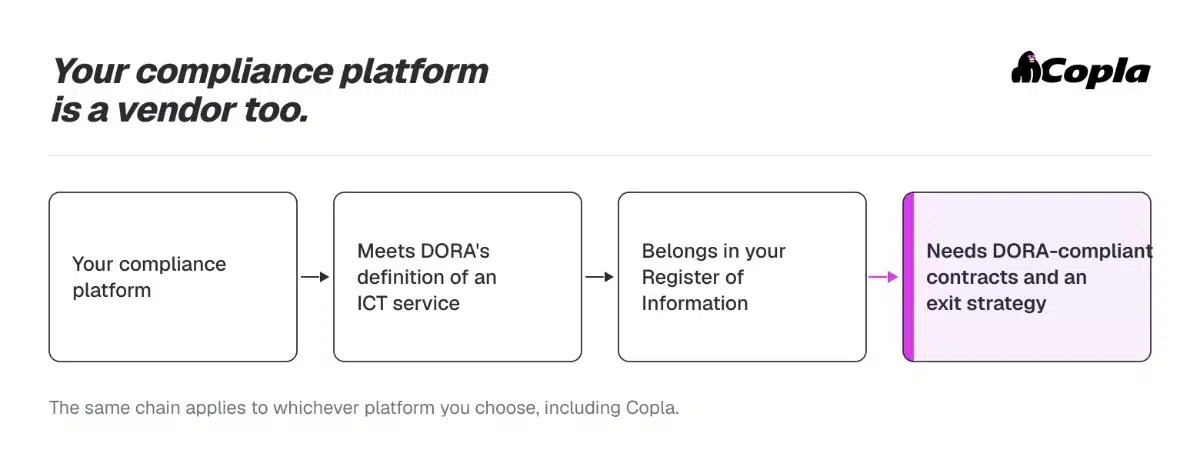
Signing this contract also onboards a vendor into the exact regime the tool exists to help you run.
Ask what they would ask you
Assessing vendor risk does not stop at your own suppliers. Put the vendor through the same assessment you would run on any other critical provider, using a real security assessment questionnaire rather than whatever their sales page volunteers:
- Which certifications do they actually hold, and can you see the report rather than the logo?
- Where is your data hosted, and what encryption and access controls sit around it?
- Who inside their company can see your control gaps?
- What is their breach history?
- What happens to your evidence if you leave?
Ask Copla the same five questions. We are a vendor in this category, and every one of them deserves a specific answer from us, not a reassurance.
A vendor who fumbles their own security questionnaire, hedges on a direct question, or answers with marketing language instead of a fact has told you something important before you have signed anything.
Check the contract before the demo impresses you
The demo is designed to impress you. The contract is not, and it is the part that actually matters if you are regulated.
Look for the specific provisions that DORA contractual arrangements are expected to carry:
- Audit and access rights that are real rather than symbolic;
- Subcontracting terms that tell you who else touches your data;
- Notice periods that give you enough runway to actually leave;
- Clear terms for data return on exit.
None of this is exotic. It is contract compliance, the same discipline your internal policies already apply to any other supplier.
The contract terms that matter most rarely come up during a sales call, because they are not designed to.
They surface at renewal, when a term nobody negotiated turns out to matter, or during a supervisory review, when an examiner asks for a clause that was never in the contract to begin with. Read the paperwork before the pitch has time to make you forget to.
Have an exit plan before you have a contract
Nobody asks this during a sales process, which is exactly why it needs asking. How do you actually leave? Can you export your evidence, your control mappings, your risk register, and every other compliance document, complete with its audit trail, in a form another system or an auditor can use, or does it come out as a PDF dump nobody can work with?
Under DORA, DORA exit strategy requirements are not a nice-to-have for arrangements supporting a critical or important function. They are a requirement to meet before you sign, not something to improvise after a provider fails you.
A platform holding your entire compliance record with no clean way out is a concentration risk, the exact kind this whole category exists to help you reduce.
Building one into your own stack while shopping for a tool to manage third-party concentration risk is the kind of mistake that only shows up when you actually need to leave.
How to run the evaluation
Criteria only get you so far. This is how to choose compliance software once the checklist is done: run the evaluation so it surfaces reality instead of a rehearsed pitch.
- Insist on a real proof of concept connected to your existing systems, whether that is HR, document management, or whatever holds your evidence today. Not a sandbox, not a slide deck. The gap between a demo environment and your actual estate is where the disappointment tends to live: an integration that looked simple on the call but leaves your team back at manual data entry once your real systems are on the other end.
- Pick two or three of your genuinely awkward controls, the ones that never quite fit a template, and ask each vendor to evidence those specifically. A generic demo can survive anything. Your actual environment is the real test.
- Get a reference call with a customer at your size and in your regulatory scope, not the vendor’s flagship logo. A two-hundred-person compliance function tells you nothing about how the tool behaves for a team of two.
- Bring the person who will operate the platform into the room. They spot in ten minutes what a buyer sitting through three calls misses, because they live inside the workflow rather than just approving it.
- Ask every vendor the same six questions from this guide, and check whether its reports are customisable enough for your board rather than fixed to a default dashboard. Write down the actual answers rather than your impression of them.
The differences mostly show up side by side, not in the moment a good answer sounds convincing. A vendor who resists a real trial, a real reference call, or a straight answer has already answered a question you did not have to ask out loud.
Red flags
Some answers are red flags on their own, no follow-up question needed.
- A vendor who cannot say what does not automate answers every automation question with the same confident yes.
- A framework list longer than their control library can support shows up the moment you ask for specifics past the first few.
- Demos that only run cleanly on the vendor’s own sample data break the moment you bring your own.
- Expert support that turns out to be a chatbot and a help centre once you need an actual judgment call.
- Pricing nobody can model two years out, even roughly, once a second framework or extra headcount enters the picture.
- Anyone who tells you the platform makes you compliant or eliminates non-compliance issues on its own. That is not something software can do, and no serious vendor claims it.
Every platform in this category has real limits, and none of them guarantees regulatory adherence or makes you audit ready by itself.
The vendors worth buying will tell you their limits before you sign, not after.
For a wider look at how the options stack up, compliance management software compared is a reasonable next stop when you are choosing the right one for your size.
None of this makes the decision for you. It gives you six questions and a vendor test that help you find the right compliance software on any platform in this category, including the one publishing this guide. Book a demo and put Copla through the same six questions before you decide anything.


