


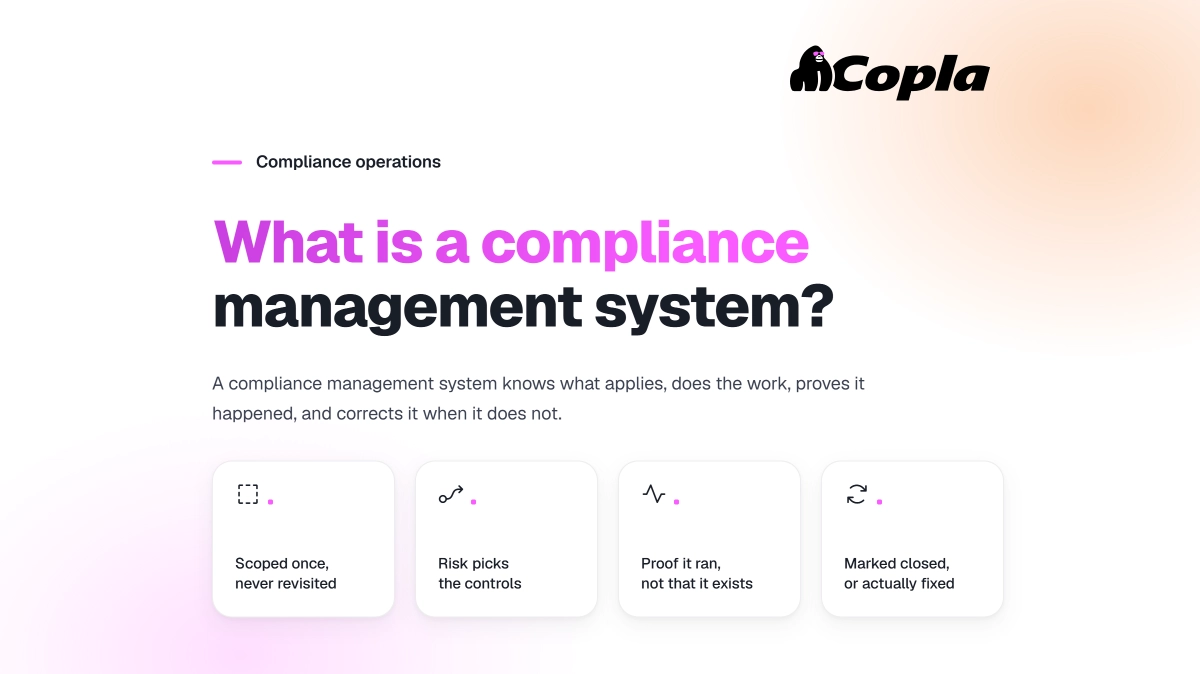


A compliance management system, often shortened to CMS, is the structure an organisation uses to know what it must comply with, do the work, prove it happened, and correct it when it does not: governance, policies, controls, evidence, and someone accountable for each.
Search for the term and the first results describe one specific version, built for a market most readers never answer to. The phrase means three different things depending on who is using it, and the definition ranking first is usually not the one that applies to you.
This guide separates the three, then works out what a compliance management system actually looks like inside EU financial or security regulation, the same ground a compliance and risk management platform like Copla operates on.
The term means three different things
This is not a pedantic distinction. Each meaning implies a different owner, a different type of proof, and a different answer to the question a board or an auditor is actually asking when they say the words. Three versions circulate under the same name: a US supervisory model built for consumer-finance examiners, a formally defined structure inside ISO standards, and a category of software vendors sell. Confuse them and you either build the wrong thing or buy a tool and assume the system now exists on its own.
A supervisory model from US consumer finance
Open almost any definition of the term and the same shape appears: a board that oversees compliance, a named compliance officer, a compliance programme built on written policies and compliance training, a process for handling consumer complaints under federal consumer protection laws, and compliance audits that check the rest is actually working.
That shape has a specific origin. It is the model the US Consumer Financial Protection Bureau uses to examine banks, credit unions, non-bank lenders, and other financial institutions under its supervision, set out in its own examination manual and tested module by module during a supervisory visit.
The model is genuinely well built. Board and senior management oversight sits at the top, a compliance programme with real policies and tailored employee training sits underneath it, consumer complaints get logged and answered rather than ignored, and monitoring or audit checks whether any of that held up in practice.
The board-officer-audit triad is real, well built, and designed for a regulator most of this audience will never answer to.
It is, specifically, a framework for consumer financial protection in the United States. If you run an EU payments firm, a crypto-asset service provider, or a SaaS company chasing ISO 27001, nobody examining you is asking about your consumer complaint process under this model. They are asking about something else.
A management system in the ISO sense
“Management system” is not a loose phrase in ISO’s own standards. It is a formally defined structure that every ISO management system standard, from quality to environmental management to information security, is required to share. Strip out the subject-specific detail and seven clauses remain: understanding the organisation and its context, leadership and policy commitment, planning and risk treatment, support and resources, operation, performance evaluation, and improvement.
This is the Harmonized Structure, and it is the reason a company running both ISO 27001 and ISO 9001 finds the two systems slot together rather than compete for the same meetings.
ISO/IEC 27001 is exactly this structure applied to information security. That is why the result is called an ISMS, an information security management system, and why what ISO 27001 actually is matters here: the Annex A controls everyone associates with the standard sit underneath this structure, as the output of it, not as the standard itself. A company can implement every Annex A control it likes and still fail an audit, because the auditor is not there to count controls.
An auditor is there to test the seven clauses: whether leadership set the policy, whether risk treatment drove the control choices, whether performance gets reviewed and acted on.
A folder of controls with no management system running above it is not what ISO 27001 certifies, and it is not what this meaning of the term describes.
A category of software
The third meaning is the one every vendor page uses, usually without saying so. Compliance management software is the platform: the obligation register, the controls, the evidence store, the task list, and the reporting layer, all in one place instead of scattered across drives and inboxes. It is a real, useful category, and compliance management software compared is worth reading once you are choosing between options.
Having the software is a different thing from having a system that works. An organisation can buy the platform, load in a framework template, and still not have a working system, because nobody defined the scope, nobody set the policy, and nobody actually owns the risks the controls are meant to address.
The platform will hold that decision once it is made. It will not make the decision for you.
This is the single most common misunderstanding in the category, and it is why a demo can look finished on day one and still leave the actual system unbuilt.
| Meaning | What it actually is | Who checks it | What it does not give you alone |
|---|---|---|---|
| CFPB compliance management system | A US consumer-finance supervisory model: board oversight, a compliance programme, complaint handling, audit | Bureau examiners, for institutions under their supervision | Relevance, if you are not under US consumer-finance supervision |
| ISO management system | A formally defined structure of seven clauses, applied to a subject such as information security | An accredited certification body, against the standard | A certificate, unless someone builds and runs the structure first |
| Compliance management software | The platform holding the register, controls, evidence and reporting | Nobody, by itself; it holds what you put into it | A system, unless scope, policy and ownership exist behind it |
What every compliance management system has to do
Pick whichever meaning applies to you: the job underneath does not change. Any of the three forms has to be able to answer the same handful of questions when someone asks. That is a practical test you can run against your own organisation right now, section by section, whether the answer sits in a CFPB-style programme, an ISO-certified ISMS, or a spreadsheet nobody has opened since the audit.
Know what applies to you
Every system starts with a list: which regulations, standards, contractual commitments, and internal policies actually apply, which business lines each one touches, and what would trigger a review, a regulatory change chief among them, before the next scheduled one.
A payments firm answers to different legal and regulatory requirements than a pure SaaS vendor, and a group with subsidiaries in three countries answers to more applicable laws than either.
Most organisations build this list once, early, under pressure from a specific deal or a specific regulator, and then never revisit it. That is the part everything downstream inherits without noticing. A new product line, a new market, a new vendor relationship, or a new regulatory authority taking an interest can quietly change what applies, and a scoping exercise done two years ago has no way of knowing that.
Understand the risk underneath
A system built on the obligation list alone produces controls calibrated to nothing in particular: a template applied evenly across a business it was never designed around. What closes that gap is a proper risk assessment: understanding what the business actually depends on, what happens if each dependency fails, and which risks that failure creates. A business impact analysis is the standard tool for working that out.
This is what makes a control set specific to one organisation rather than inherited wholesale from a framework document. It is also why both the ISO management system structure and DORA’s ICT risk management framework put this step before the controls rather than after it.
Controls chosen before this work exists are controls chosen for no particular reason.
Put controls and policies in place
This is the layer most people picture first: internal policies that state what is supposed to happen, internal controls that make it happen, and a map connecting each one back to the requirement it satisfies. ISO 27001 policies and procedures is a reasonable model for what a policy actually needs to say, regardless of which framework you are building for.
The part worth knowing before you start: frameworks overlap heavily. Access control, incident response plans, and business continuity show up, in some form, in nearly every standard and regulation an organisation is likely to face.
A system that maps a control once, against every requirement it happens to satisfy, gets several frameworks served by the same piece of work. A system that rebuilds the mapping from scratch for each framework pays for the overlap every single time.
Prove it happened
The standard here is precise, and easy to understate. A control has to have operated, with a record of that control testing specific enough for someone outside the organisation to follow without being talked through it: proof of existence is a lower bar, and it does not clear it. A policy document proves a control was designed. It does not prove anyone followed it last Tuesday, and it says nothing about control effectiveness.
Evidence also expires. An access review from eight months ago says nothing about who has access today, and a penetration test from last year says nothing about a system that has since been rebuilt. A system without ongoing compliance monitoring to keep that evidence current has the opposite problem from a shortage: a growing pile of artefacts nobody can actually rely on, because nobody can say which ones are still true, which is exactly what an external audit exists to catch.
Name someone accountable
This is the layer that separates a system from a document that describes one. Every obligation, every control, and every open gap needs control owners and a deadline, not a compliance function it theoretically belongs to.
The three meanings of the term disagree about almost everything else, and agree completely here. The CFPB model names a compliance officer who answers to the board. ISO’s Clause 5 puts leadership itself on the hook for the policy and the resources behind it. DORA and NIS2 go further and put the management body on the hook personally, alongside the institution. The mechanics differ by model.
The principle underneath does not: a system with no named owner is a set of good intentions with a due date nobody is checking.
Correct and improve
The loop closes here, or it does not close at all. Audit findings, incidents, and routine reviews all have to turn into corrective actions with an owner and a deadline. That work has to get verified as actually done, not merely marked closed. And the system itself has to change as a result: a policy gets rewritten, a control gets added, a review interval gets shortened to keep pace with emerging risks.
A programme where the same finding shows up in three consecutive audits, each time duly noted and never quite fixed, is a reporting exercise wearing the vocabulary of the real thing.
What actually moved downstream of a finding is the real measure of whether the loop closed.
What a compliance management system means under EU regulation
Search for a compliance management system inside EU financial regulation and you will not find it. The phrase does not appear in DORA, in NIS2, or in any adjacent EU text. That is precisely why a reader here ends up on a page written for someone else: the search results describing the term were never going to describe your obligations, because your regulator never used that phrase to begin with.
What applies instead is specific, and it has a name. Under DORA, the management body bears ultimate responsibility for the entity’s ICT risk, approving and overseeing everything from the ICT business continuity policy to the budget behind it. Article 6 sets out the DORA ICT risk management framework itself, reviewed at least once a year and after any major incident.
NIS2 runs a parallel structure, and who NIS2 applies to is a wider question than DORA’s scope: essential and important entities across sectors well beyond finance, with the management body approving the cybersecurity risk-management measures, overseeing their implementation, and facing liability when the entity fails to comply, a liability some national transpositions apply personally rather than only to the entity.
ISO 27001 sits underneath both as the certifiable structure that gives a governance requirement somewhere concrete to live.
| DORA | NIS2 | ISO 27001 | |
|---|---|---|---|
| What it is | EU regulation, directly binding | EU directive, transposed into national law | International standard, adopted voluntarily |
| Who it binds | Financial entities and, indirectly, their critical ICT providers | Essential and important entities across a defined range of sectors | Whoever chooses to implement or certify against it |
| Governance requirement | Management body bears ultimate responsibility for ICT risk | Management body approves and oversees risk-management measures, and can be held liable | Clause 5 puts leadership on the hook for policy and resources |
| What it builds | An ICT risk management framework, reviewed at least annually | A defined set of risk-management measures across ten categories | A full management system across seven clauses |
Put the three together and the practical answer emerges. If you are an EU regulated entity, your compliance management system is the ICT risk management framework required of you, plus the governance sitting above it. The closest formal analogue is an ISMS. It is not the CFPB’s version, however many search results describe that one as though it were the only kind.
How to build one
The two pages a search for this phrase currently surfaces both run a version of the same sequence: evaluate your needs, commit to continuous improvement at the end. True, and not something anyone could act on by Monday morning. The order below says why each step comes where it does, because the order is the part that goes wrong.
- Establish which meaning applies to you, and list your actual obligations. Skipping this is why organisations end up building the wrong model entirely.
- Work out what the business depends on, and where the real risk sits. This has to happen before controls exist, not after, for the reasons covered above.
- Set the policy and assign accountability at leadership level. Without a named owner at this level, every later step has somewhere to stall.
- Build the controls the risk actually justifies, and map each one across every framework it satisfies. This is the step every demo shows, which is why most organisations start here instead of at step one.
- Decide how evidence gets collected and how often it gets refreshed. Collection without a refresh cycle is a countdown to stale proof.
- Set the review cadence, and the triggers that force a review outside it. A calendar date catches routine drift. An incident or a new regulator does not wait for the calendar.
How to build a compliance programme covers this same sequence applied specifically to information security.
Sequence beats tooling, and most evaluations still buy the tool before they have done the sequence.
Copla’s in-house CISO team is one way to get expert judgement on the first three steps; plenty of organisations reach the same result with a consultant or a hire instead.None of this requires knowing which of the three meanings started the search. It requires knowing which one actually applies, and building toward that one specifically. Book a demo to see how Copla approaches the version built for EU financial and security regulation.
FAQ
-
What is the difference between compliance management and a compliance management system? +
Compliance management is the ongoing activity behind regulatory compliance: monitoring obligations, running training, tracking issues. A compliance management system is the structure that activity runs inside: the governance, the policies, the roles, and the evidence trail that make the activity provable rather than just performed. You can do plenty of compliance management inside a system that barely qualifies as one, which is usually how the gaps get found.
-
What are the components of a compliance management system? +
The specific list depends on which meaning you are working with, but the pattern repeats across all three. Know what applies to you, understand the risk behind it, put controls and policies in place, prove they operated, name an owner for each one, and correct what the evidence turns up. The CFPB names these differently than ISO does, but the six jobs underneath are close to identical.
-
Is a compliance management system the same as an ISMS? +
Not quite, and the difference is useful to know. An ISMS is ISO’s specific, certifiable version, scoped to information security and built on the seven-clause structure covered above. It is the closest formal match for EU regulatory obligations, but it is one implementation of the idea, not the only one. A CFPB-style programme or a software platform can each claim the same general label without meeting ISO’s structure at all.
-
Do EU regulated companies need a compliance management system? +
By that exact name, no law requires one. By substance, most EU regulated entities already have to build the equivalent: DORA’s ICT risk management framework and governance requirements for financial entities, NIS2’s risk-management measures for essential and important entities, and ISO 27001 for anyone choosing to certify. Whether an examiner or supervisor ever uses those specific words, they are asking for what one contains, and the gap between the two is where non-compliance actually gets found.
-
Is compliance management software the same as a compliance management system? +
No, and this is the mix-up covered earlier in this guide. The software is the platform where the register, the controls, and the evidence live. The system is the working combination of scope, policy, accountability, and evidence that the software holds. Buying the platform is often the easy part; building the system around it is the part that actually determines whether an audit goes well.