


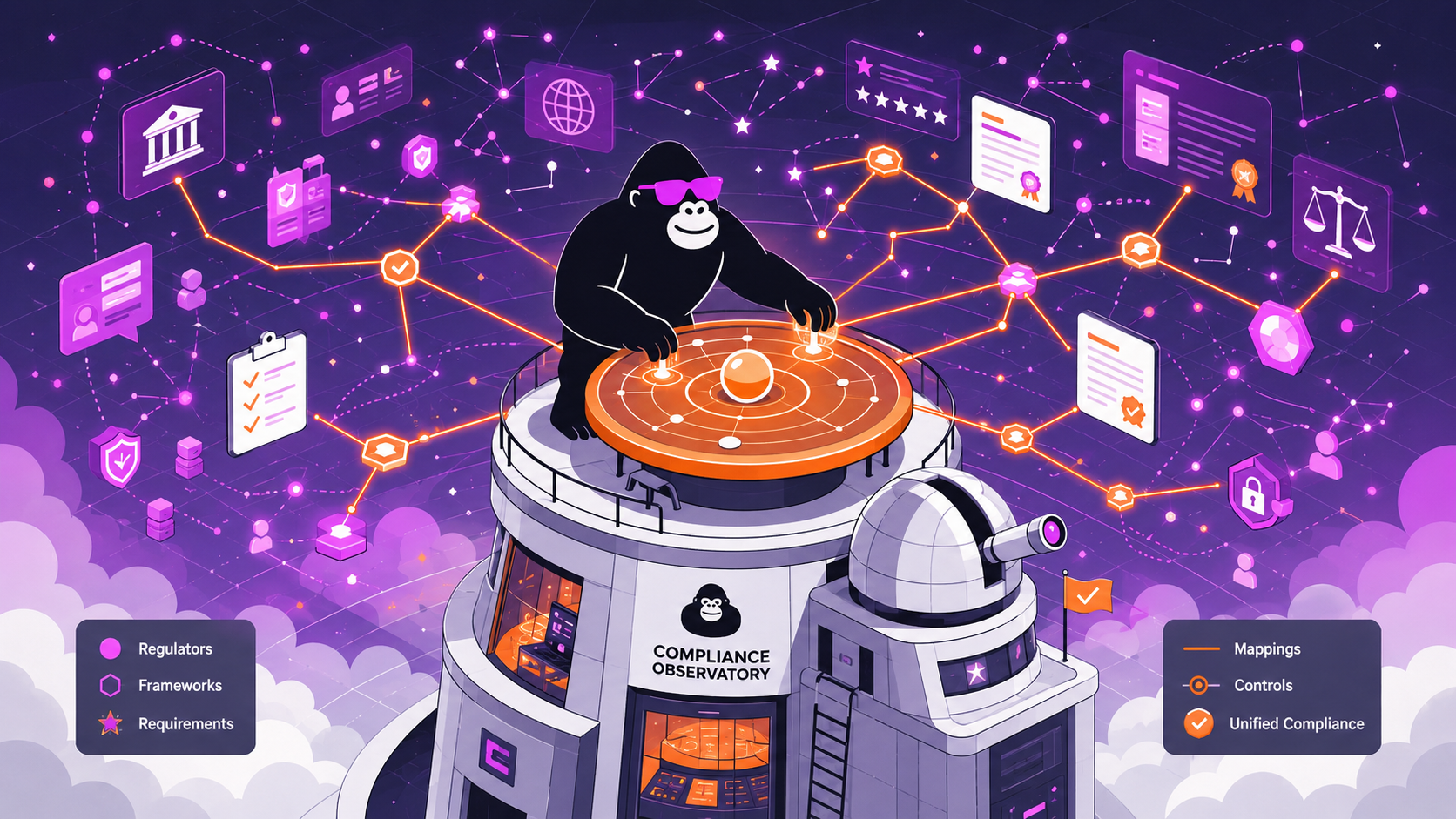


What does compliance actually mean in a cybersecurity context, and which frameworks apply to your organisation? The answer depends on your industry, geography, the data you handle, and the clients you serve. Cybersecurity compliance is the practice of meeting the security requirements defined by laws, regulations, industry standards, and contractual obligations that apply to your business. Some of those requirements are mandatory, backed by regulators who can impose fines. Others are voluntary standards that customers and partners expect you to demonstrate. This guide maps the landscape: which frameworks and regulations matter, how they differ, and how to build a compliance programme that covers your obligations without duplicating effort.
What Is Cybersecurity Compliance?
Cybersecurity compliance is the process of conforming to established rules, standards, and regulations that govern how an organisation protects its information systems, data, and digital infrastructure. It involves implementing specific security controls, documenting those controls, and providing evidence that they operate effectively.
Compliance is not the same as security. An organisation can be compliant with a specific standard and still have security gaps, just as an organisation with strong security practices may not be formally compliant with a regulation it has never assessed against. The two are complementary: compliance provides a structured baseline, and security operations build on that baseline to address the organisation’s specific risk landscape.
The requirements that drive cybersecurity compliance come from three sources:
- Laws and regulations. Government-mandated requirements with legal consequences for non-compliance. Examples include the General Data Protection Regulation (GDPR), the Network and Information Security Directive (NIS2), and the Digital Operational Resilience Act (DORA).
- Industry standards and frameworks. Voluntary or quasi-mandatory standards developed by standards bodies and industry groups. Examples include ISO 27001, SOC 2, the NIST Cybersecurity Framework (CSF), and PCI DSS.
- Contractual obligations. Requirements imposed by customers, partners, or supply chain agreements. Enterprise procurement teams routinely require specific certifications or attestations as a condition of doing business.
Mandatory Regulations vs Voluntary Frameworks
The distinction between what is legally required and what is commercially expected matters for prioritisation. Regulations carry enforcement mechanisms. Frameworks carry market consequences.
Key Regulations
GDPR (General Data Protection Regulation). Applies to any organisation that processes personal data of EU residents, regardless of where the organisation is based. Requires specific security measures, data breach notification within 72 hours, and appointment of a Data Protection Officer in certain cases. Penalties reach up to 20 million euros or 4% of global annual turnover.
NIS2 (Network and Information Security Directive 2). The EU’s updated cybersecurity directive, applicable since October 2024. Covers essential and important entities across 18 sectors, including energy, transport, health, digital infrastructure, and ICT service management. Requires risk management measures, incident reporting, supply chain security, and board-level accountability. Penalties can reach 10 million euros or 2% of global turnover. Organisations navigating both EU and US standards will find that understanding how NIS2 compares to SOC 2 clarifies which obligations overlap and where additional controls are needed.
DORA (Digital Operational Resilience Act). An EU regulation targeting the financial sector, fully applicable since 17 January 2025. Covers approximately 22,000 financial entities and their ICT third-party service providers. Requires ICT risk management, incident reporting, digital operational resilience testing, third-party risk management, and information sharing. Understanding the full scope of DORA audit requirements is essential for any financial institution or ICT provider serving the sector.
HIPAA (Health Insurance Portability and Accountability Act). A US regulation governing the protection of health information. Applies to healthcare providers, health plans, clearinghouses, and their business associates. Requires administrative, physical, and technical safeguards for Protected Health Information (PHI).
CMMC (Cybersecurity Maturity Model Certification). A US Department of Defense requirement for all entities in the defence supply chain. Requires third-party certification against defined maturity levels. Level 1 certification is required for all defence contractors by 2026.
Key Frameworks and Standards
ISO 27001. The international standard for Information Security Management Systems (ISMS). Certifiable through third-party audit. Covers 93 controls across organisational, people, physical, and technological categories. Widely requested by enterprise customers globally and often used as the foundation for a broader compliance programme. For a detailed breakdown, see the complete guide to ISO 27001.
SOC 2. An attestation framework developed by the AICPA (American Institute of Certified Public Accountants). Evaluates controls against five Trust Services Criteria: security, availability, processing integrity, confidentiality, and privacy. The standard request in North American enterprise procurement. Organisations evaluating both standards should understand the key differences between ISO 27001 and SOC 2.
NIST Cybersecurity Framework (CSF 2.0). A risk management framework developed by the US National Institute of Standards and Technology. Organised around six functions: Govern, Identify, Protect, Detect, Respond, and Recover. Not certifiable, but widely used as a risk management reference, particularly in the US. The relationship between NIST and ISO 27001 is one of the most common comparison questions from organisations building their first compliance programme.
PCI DSS (Payment Card Industry Data Security Standard). Applies to any organisation that stores, processes, or transmits payment card data. Maintained by the PCI Security Standards Council. Not a government regulation but contractually required by payment card brands.
CIS Controls. A prioritised set of 18 security controls developed by the Center for Internet Security. Often used as a practical starting point for organisations that need to improve their security posture before pursuing formal certification.
How Frameworks Overlap
Most cybersecurity frameworks share common control areas. Access control, encryption, incident response, and risk assessment appear in nearly every standard. The overlap is significant enough that organisations pursuing multiple frameworks can map controls across standards and avoid implementing the same control twice under different names.
Typical mapping overlaps include:
- ISO 27001 and SOC 2 share approximately 70–80% of their control requirements, particularly in access control, encryption, change management, and incident response.
- ISO 27001 and NIST CSF overlap substantially in the Identify and Protect functions. ISO 27001 Annex A maps closely to the NIST CSF subcategories.
- DORA and ISO 27001 share common ground in ICT risk management, incident management, and business continuity, though DORA adds financial-sector-specific requirements for third-party risk and resilience testing.
- NIS2 and ISO 27001 overlap in risk management, incident handling, and supply chain security, though NIS2 adds sector-specific obligations and enforcement mechanisms.
This overlap is the reason that organisations pursuing compliance across multiple frameworks benefit from platforms that map controls once and apply them across standards. Without cross-mapping, the documentation burden multiplies with each additional framework.
Building a Cybersecurity Compliance Programme
A compliance programme that scales across frameworks follows a consistent structure, regardless of which specific standards apply.
1. Identify your obligations. Determine which regulations are legally mandatory for your organisation based on industry, geography, and the data you handle. Then identify which frameworks your customers, partners, and market position require. This produces a prioritised list of standards to address.
2. Conduct a risk assessment. Every framework starts with understanding your risk landscape. ISO 27001 requires a formal risk assessment. NIST CSF starts with the Identify function. DORA requires ICT risk identification. The risk assessment is the foundation that determines which controls are necessary and proportionate.
3. Select and implement controls. Based on the risk assessment and the applicable frameworks, select the controls that address identified risks. Where frameworks overlap, implement the control once and document its applicability to each standard. This is where cross-mapping between frameworks reduces effort significantly.
4. Document policies and procedures. Every compliance framework requires documentation. Policies define what the organisation commits to. Procedures define how controls are executed. Evidence records prove that controls operate as described. Documentation is what auditors evaluate, and incomplete documentation is the most common reason for audit findings.
5. Monitor and collect evidence. Compliance is not a one-time project. Controls must be monitored continuously, and evidence must be collected on an ongoing basis to demonstrate that controls are operating effectively. Automated evidence collection reduces the manual burden and ensures that evidence is current when audit season arrives.
6. Prepare for and undergo audit. For certifiable standards (ISO 27001, SOC 2, PCI DSS), the compliance cycle culminates in a formal audit by an independent assessor. Preparation includes internal audits, gap remediation, and evidence review. The certification or attestation report is the deliverable that satisfies customer and regulatory requirements.
Common Mistakes in Cybersecurity Compliance
Organisations new to formal compliance programmes often encounter the same set of problems.
Starting with the framework instead of the risk. Compliance should follow risk assessment, not replace it. Organisations that start by trying to implement every control in a standard without first understanding their risk profile end up with controls that do not match their actual threats and gaps where the standard does not cover organisation-specific risks.
Treating compliance as a project rather than a programme. Certification is a milestone, not a destination. Controls need to be maintained, evidence needs to be collected continuously, and the ISMS needs to be reviewed and improved on an ongoing cycle. Organisations that treat certification as the finish line face difficult recertification audits.
Duplicating effort across frameworks. Implementing ISO 27001, SOC 2, and NIS2 as three separate initiatives triples the documentation and evidence burden. Cross-mapping controls from the start means that a single access control policy can satisfy requirements across all three frameworks.
Underestimating documentation. Auditors do not assess what you do. They assess what you can prove you do. Organisations with strong technical controls but weak documentation consistently receive more audit findings than organisations with documented, evidence-backed processes.
Frequently Asked Questions
What is the most common cybersecurity compliance framework?
ISO 27001 is the most widely adopted cybersecurity compliance framework globally, with certifications issued in over 150 countries. In the United States, SOC 2 is the most commonly requested attestation in enterprise procurement. The NIST Cybersecurity Framework is widely used as a risk management reference but is not certifiable. The most common framework for any specific organisation depends on its industry, geography, and customer requirements.
Is cybersecurity compliance mandatory?
It depends on the regulation. GDPR, NIS2, DORA, and HIPAA are legally mandatory for organisations that fall within their scope, with penalties for non-compliance. Frameworks like ISO 27001 and SOC 2 are voluntary in the legal sense but are effectively mandatory for organisations selling to enterprise customers who require them as a condition of doing business.
How long does it take to achieve cybersecurity compliance?
Timelines vary by framework and organisational maturity. ISO 27001 certification typically takes 6 to 18 months from initial scoping to certificate issuance. SOC 2 Type 2 requires a 3 to 12 month observation period plus preparation time. Simpler frameworks like CIS Controls can be implemented in weeks. The timeline depends on the organisation’s existing security posture, the scope of the certification, and the resources available.
Can one compliance programme cover multiple frameworks?
Yes. Most cybersecurity frameworks share significant control overlap. An organisation can build a single set of controls, map them to multiple frameworks, and satisfy multiple compliance requirements simultaneously. This approach requires a compliance platform or structured methodology that supports cross-framework mapping, but it reduces total effort substantially compared to running separate compliance programmes.
How Copla Supports Cybersecurity Compliance Programmes
Building a compliance programme that spans multiple frameworks means managing overlapping controls, coordinating evidence collection, and maintaining documentation across standards. Copla’s platform handles this by mapping controls across ISO 27001, SOC 2, NIS2, DORA, PCI DSS, and other frameworks, so that a control implemented once satisfies requirements across every applicable standard. The onboarding process begins with scoping the relevant frameworks, and Copla’s structured intake generates the policy and procedure documentation pack. Consultants work alongside your team to implement controls, close gaps, and prepare for audits. The result is a single compliance programme that covers multiple certifications without duplicating effort.
Book a consultation with Copla to walk through how this would look for your team.