




A few years back, I was helping a mid-sized financial services firm navigate the complexities of ISO 27001 GDPR compliance. They had just completed their ISO 27001 certification and felt confident they had data protection under control. That confidence quickly faded during their first GDPR audit.
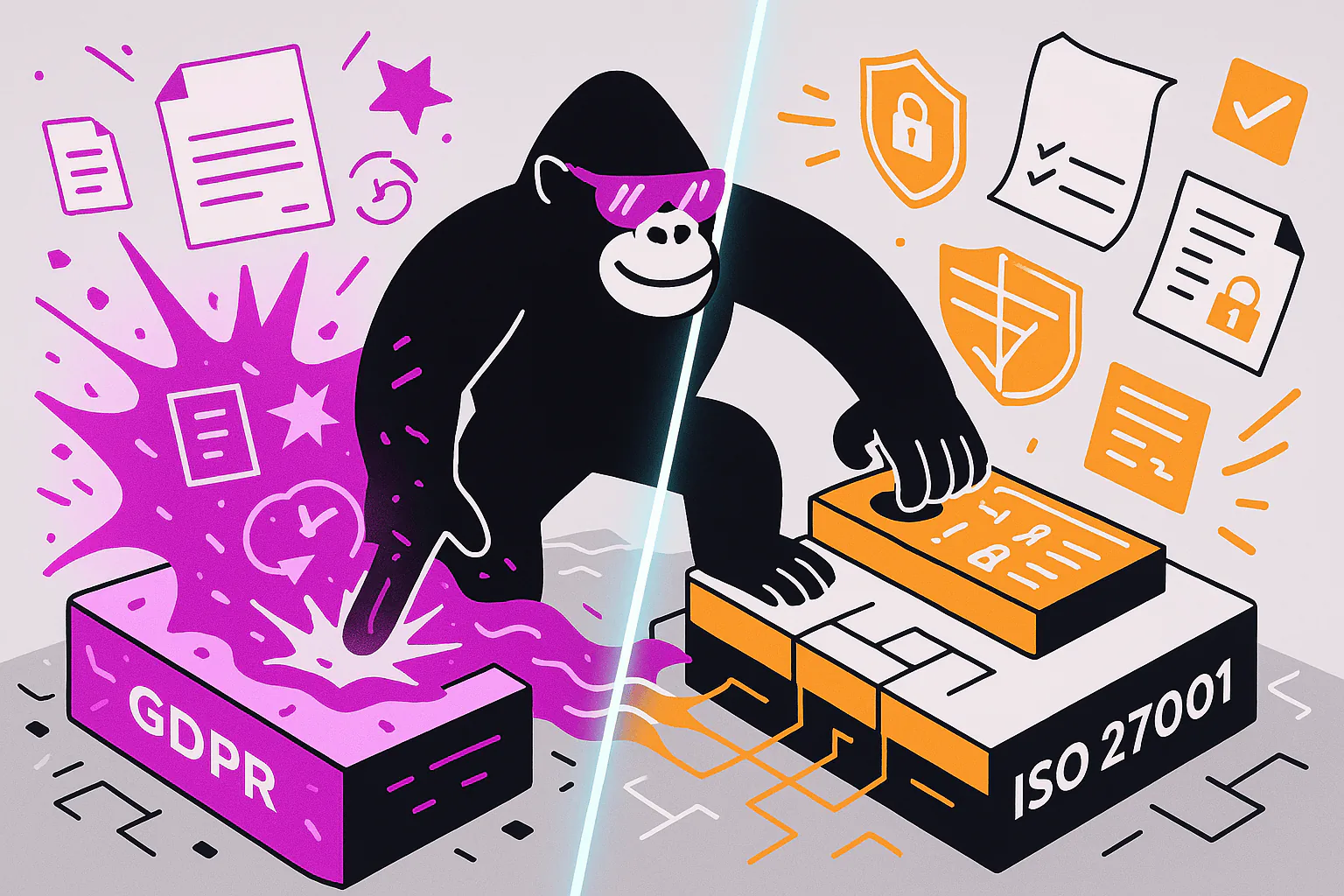
What surprised them—and what surprises many organizations—is how GDPR and ISO 27001 overlap but don’t entirely align. It’s a common misconception that achieving ISO 27001 certification automatically means you’re GDPR compliant. The reality is more nuanced, and understanding these distinctions can save your organization from costly compliance missteps.
Let’s explore where GDPR vs ISO 27001 stand apart, where they converge, and how you can align both effectively.
Understanding the scope: privacy vs. security
At first glance, GDPR and ISO 27001 appear to address similar concerns: protecting sensitive data. But their foundational scopes differ in a key way.
GDPR, or the General Data Protection Regulation, is a regulation designed to protect personal data and uphold individuals’ rights in the EU. It’s legally binding and comes with hefty fines for non-compliance. The focus is on privacy.
ISO 27001, on the other hand, is an international standard focused on establishing, implementing, and maintaining an Information Security Management System (ISMS). It doesn’t just cover personal data but extends to all forms of information assets. The emphasis is on security.
To clarify how these two frameworks compare in scope and intent, here’s a breakdown:
| Criteria | GDPR | ISO 27001 |
|---|---|---|
| Primary focus | Personal data protection | Information security management |
| Legal status | Mandatory EU regulation | Voluntary international standard |
| Applicability | Any organization processing EU citizens’ data | Any organization seeking structured security practices |
| Data types covered | Personal data | All forms of data (personal, corporate, intellectual) |
| Enforcement | Supervisory authorities, with legal penalties | Certification bodies, no legal penalties |
This fundamental distinction leads us to a practical question: does ISO 27001 cover GDPR? Only partially. While ISO 27001 provides a strong foundation for securing data, it doesn’t address all GDPR requirements, particularly around data subject rights, consent, and breach notification timelines.

Pro tip
Assign dual owners for data sets—one for security (ISO 27001) and one for privacy (GDPR). This ensures that access controls protect data while privacy obligations like consent and minimization remain in focus.
Requirements and controls: aligning structure with compliance
The structural difference between the two frameworks also creates some confusion. GDPR is a principles-based regulation with obligations like transparency, lawfulness, and purpose limitation. ISO 27001, in contrast, offers a controls-based structure built around risk management.
A practical way to understand how to integrate GDPR with ISO 27001 is to map specific GDPR articles to ISO 27001 controls. This helps organizations ensure they’re not only ticking boxes but aligning privacy with broader security practices.
| GDPR Article | Relevant ISO 27001 Control(s) |
| Art. 5: Principles relating to processing | A.8.2.3 (Handling of assets), A.18.1.4 (Privacy and protection) |
| Art. 6: Lawfulness of processing | Not directly covered; requires legal basis beyond ISO 27001 |
| Art. 24: Responsibility of the controller | A.5.1.1 (Policies), A.6.1.1 (Information security roles) |
| Art. 32: Security of processing | A.9.2 (Access control), A.10 (Cryptography), A.12 (Operations security) |
| Art. 33: Notification of a breach | A.16.1 (Information security incident management) |
| Art. 35: Data Protection Impact Assessments | A.6.1.2 (Risk assessment), though ISO focuses on security risk |
While many controls align, you’ll notice gaps. For instance, ISO 27001 won’t help you assess the legal basis for data processing or manage data subject access requests. That’s why a hybrid approach—integrating GDPR-specific policies and procedures into your ISMS—is often the most effective.
This integration isn’t just about mapping controls; it’s about adapting the ISMS to reflect GDPR’s principles. For example, ISO 27001 encourages identifying risks to information assets. You can extend this by including risks related to privacy rights and non-compliance penalties.
Pro tip
Supplement your ISO 27001 risk assessment template with a GDPR risk impact layer. Include fields for data subject categories, likelihood of harm, and potential regulatory exposure to meet Art. 35 obligations more comprehensively.
Implementing both: pitfalls and practical guidance
One of the recurring challenges I see when organizations attempt ISO 27001 GDPR compliance is treating the frameworks as identical checklists. This results in blind spots—especially in areas like consent management or ensuring data portability.
Instead of trying to force GDPR into ISO 27001’s structure, use GDPR as a lens to interpret and expand your ISMS. For example, when conducting risk assessments, incorporate risks tied to GDPR non-compliance. When reviewing access controls, consider not just whether access is secure, but also whether it’s lawful and proportionate under GDPR.
Regular audits and awareness training also serve as critical junctions for integration. Ensure GDPR obligations are part of your security audit scope. Update awareness programs to include GDPR principles like data minimization and user rights.
Pro tip
When reviewing your ISMS, use GDPR breach notification timelines (72 hours) to calibrate incident detection and response SLAs. Ensure your SIEM or incident management platform can flag and escalate personal data breaches accordingly.
How Copla aligns ISO 27001 and GDPR without the guesswork
For fintechs navigating both ISO 27001 and GDPR, compliance can feel like juggling two competing frameworks. Copla simplifies this by bridging the gap between privacy and security—automating the controls, evidence collection, and documentation you need for both. Our platform maps ISO 27001 controls directly to GDPR articles, helping you identify overlap, highlight gaps, and build workflows that serve both standards without duplication.
Through real-time compliance checks via Slack or Teams, employees are guided through policy updates, consent practices, and access controls that align with both frameworks. Our risk assessment engine goes beyond technical vulnerabilities by incorporating GDPR-specific impacts like data subject harm and regulatory exposure—ensuring your risk register reflects both legal and operational realities.
And with expert support from our fractional CISOs, you’re not left interpreting complex obligations alone. We help tailor your ISMS to privacy principles, calibrate incident response to GDPR timelines, and embed GDPR awareness into your security culture. With Copla, you don’t just meet ISO 27001 or GDPR—you align them into one seamless, auditable, and future-proof compliance strategy.
Bridging the gap between privacy and security
Understanding the nuances of GDPR and ISO 27001 isn’t just an academic exercise—it’s a practical necessity for modern compliance programs. While ISO 27001 offers the infrastructure for managing security risks, GDPR demands that we consider the human impact of data misuse.
If your organization is already ISO 27001 certified, use it as a springboard to refine your GDPR strategy. And if you’re just starting out with privacy compliance, don’t overlook the value of structured security practices.
Privacy without security is fragile. Security without privacy is blind. The future lies in aligning both thoughtfully—not just on paper, but in practice.