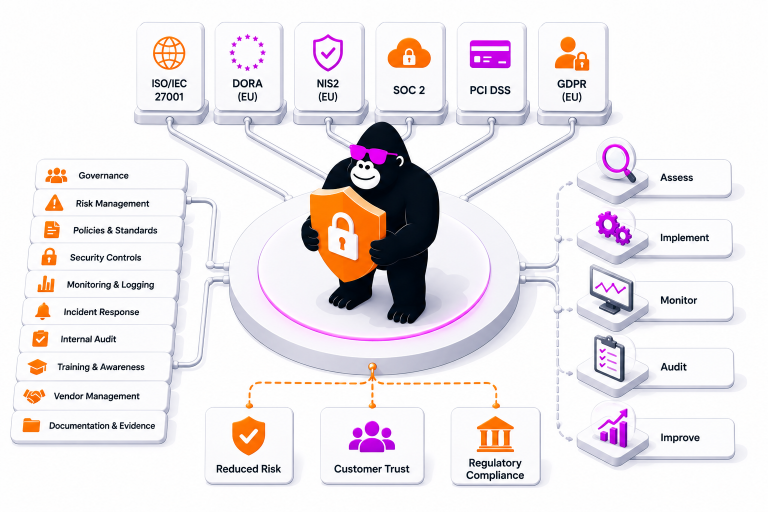


A vendor security assessment questionnaire is the structured set of questions an organisation sends to a third-party supplier to evaluate its security posture before onboarding and at regular intervals throughout the relationship. For financial institutions, the questionnaire is not merely a due diligence formality — it is the primary mechanism for collecting the evidence that DORA’s third-party risk management requirements, ISO 27001’s supplier security controls, and GDPR’s processor assessment obligations all require.
This guide covers what a vendor security assessment questionnaire should contain, how to structure it by risk domain, how to scale depth to vendor tier, and how to make the responses auditable.
What a Vendor Security Assessment Questionnaire Is For
The questionnaire serves three distinct purposes that are easy to conflate but important to separate.
Risk identification: The questionnaire helps identify material risk from third party vendors, which now account for more than 60% of enterprise cyber risk, by surfacing potential vulnerabilities your risk register needs to account for. A vendor that discloses it has no patch management process, no incident response procedure, or no business continuity testing is telling you something material about the residual risk your organisation carries by relying on that vendor.
Regulatory evidence: A robust vendor risk assessment questionnaire is also a proactive risk management tool for regulated organisations, acting as a frontline defense against avoidable threats and costly compliance failures. DORA Article 28 requires financial institutions to conduct due diligence on ICT third-party service providers before entering a contract. ISO 27001 control A.5.19 requires that information security requirements be agreed with suppliers and assessed. GDPR Article 28 requires that processors provide sufficient guarantees about their security measures. The questionnaire — and the documented responses — is how you demonstrate that these assessments were conducted.
Contractual baseline: The questionnaire responses establish the vendor’s security commitments at the point of onboarding. If a vendor subsequently suffers a breach that contradicts their questionnaire responses, those responses are relevant evidence in any contractual or regulatory dispute.
All three purposes require the questionnaire to be documented, version-controlled, and stored in a form that can be produced to an auditor or regulator on request, while helping protect sensitive data and support the wider vendor relationship.
How to Tier Your Questionnaire Depth
Not every vendor warrants the same depth of assessment. Applying a full 150-question questionnaire to a supplier of office stationery wastes resource and damages vendor relationships. Applying a 20-question lite questionnaire to a cloud provider with access to your customer payment data creates regulatory and security exposure.
A tiered approach uses risk tiers to scale questionnaire depth to vendor risk:
Critical vendors — those supporting critical or important functions, with access to sensitive data or systems whose failure would significantly disrupt operations — receive the full questionnaire covering all security domains in depth. Vendors handling the most sensitive data or supporting critical assets belong in the highest tier. Under DORA, this tier maps to ICT third-party providers supporting critical or important functions, which require enhanced due diligence.
Important vendors — those with access to non-critical systems or limited data, whose failure would cause disruption but not critical operational impact — receive a standard questionnaire covering the core security domains without the depth of sub-questions applied to critical vendors.
Standard vendors — those with no access to systems or data, or access only to publicly available information — receive a lightweight questionnaire or are assessed through a self-certification against minimum requirements.
The tiering decision should be documented and defensible: what factors determined the tier, who made the decision, and when it was made. Tiers should reflect the vendor’s environment and the sensitivity of the data or systems involved.
The Core Domains of a Vendor Security Assessment Questionnaire
Information Security Governance
This section assesses whether the vendor has a structured approach to information security management — not just ad hoc technical controls.
Key questions:
- Does the vendor have a documented information security policy, approved by senior management and reviewed at least annually?
- Does the vendor provide current compliance certifications and audit reports as evidence of alignment with relevant compliance frameworks? This helps confirm adherence to relevant regulations such as GDPR or HIPAA, as well as standards like SOC 2.
- Is there a named information security officer or equivalent function with defined responsibilities?
- Does the vendor conduct a formal annual risk assessment covering their information assets, and does their security program align with recognised frameworks such as NIST or ISO standards?
- Are information security responsibilities communicated to all staff through documented training and awareness programmes?
Why it matters: Vendors without governance structures are more likely to have unmanaged gaps across all other domains. Structured governance review helps identify security gaps and supports consistent evaluation across vendor assessments, especially when questionnaires are built against recognised benchmarks. Close alignment between organised risk reviews and established benchmarks helps avoid blind spots.
Access Controls and Identity Management
This section assesses how the vendor controls who can access the systems and data relevant to your engagement.
Key questions:
- Is multi-factor authentication (MFA) enforced for all access to systems processing or storing your organisation’s data as a core vendor security practice?
- Does the vendor operate a formal access provisioning and de-provisioning process, including timely revocation when staff leave?
- Are access rights reviewed at regular intervals (at minimum quarterly for privileged accounts)?
- Is least-privilege access to production systems restricted to named individuals with a documented business need, as defined in the vendor’s security policies?
- Are third-party and subcontractor access rights subject to the same controls as internal staff during vendor onboarding and ongoing reviews of security practices?
Why it matters: Compromised or over-provisioned credentials are among the most common vectors for third-party breaches. Under ISO 27001 controls A.5.15 through A.5.18, supplier access must be managed with the same rigour as internal access.
Data Protection and Encryption
This section assesses how the vendor protects the data it processes on your behalf.
Key questions:
- Is data classified according to sensitivity, and are protection requirements defined for each classification level?
- Is your organisation’s data encrypted at rest? What encryption standard is applied (AES-256 or equivalent)?
- Is data encrypted in transit using TLS 1.2 or higher for all communications?
- Where is your organisation’s data stored, processed, and transmitted within the vendor’s environment? In which countries or regions?
- Does the vendor transfer your data to subprocessors or subcontractors? If so, which ones, and under what contractual protections for regulated organisations that need this visibility to meet relevant regulations and oversight obligations?
- What is the vendor’s data retention policy for your organisation’s data, and how is data securely deleted at contract end?
Why it matters: Data Governance tracks where sensitive data is stored, processed, and transmitted. For GDPR compliance, you need to know where personal data is processed and whether it leaves the EEA. Compliance standards confirm adherence to regulations like GDPR, HIPAA, or frameworks like SOC 2. For DORA, you need to know the data locations and subcontractor arrangements for ICT services supporting critical functions. A robust vendor risk assessment questionnaire is essential for organisations operating in regulated industries, as it helps ensure compliance with frameworks like SOC 2, HIPAA, and PCI DSS, which require oversight of third-party vendors. For PCI DSS, credit card data at the vendor must be encrypted at rest and in transit.
Vulnerability Management and Patch Management
This section assesses how the vendor identifies security gaps and potential vulnerabilities in the vendor’s environment and manages known vulnerabilities in their systems.
Key questions:
- Does the vendor operate a formal vulnerability management programme covering all systems in scope for your engagement?
- How frequently are Network Security checks conducted, including firewalls, intrusion detection systems, and regular vulnerability scanning?
- What is the vendor’s defined SLA for patching critical vulnerabilities (CVSS score 9.0+)?
- Does the vendor conduct annual penetration testing on in-scope systems? Is testing conducted by an independent third party?
- How are vulnerability management results reported to the vendor’s management, and are they tracked to remediation?
Why it matters: Unpatched vulnerabilities are the most common technical root cause of third-party security breaches. A vendor with no defined patch SLA for critical vulnerabilities is a documented risk that must appear in your risk register.
Incident Response and Breach Notification
This section assesses how the vendor detects, responds to, and notifies you of security incidents.
Key questions:
- Does the vendor have documented incident response plans for detecting, containing, and reporting data breaches? Have they been tested in the last twelve months?
- What is the vendor’s contractual commitment to notify your organisation of a security incident affecting your data? Is it consistent with GDPR’s 72-hour notification requirement?
- Does the vendor maintain logs sufficient to support forensic investigation of a security incident? For how long are logs retained?
- Has the vendor experienced any prior security breaches in the last 24 months where customer or sensitive data was affected? If so, what was the nature of the incident and how was it resolved?
- Is the vendor’s incident response process aligned to a recognised standard (ISO 27035, NIST SP 800-61)?
Why it matters: Under DORA, financial institutions must ensure that ICT third-party contracts include incident notification obligations. Under GDPR, processors must notify controllers without undue delay of personal data breaches. The questionnaire establishes these commitments before contract signature and helps assess the vendor’s security posture over time.
Business Continuity and Operational Resilience
This section assesses whether the vendor can maintain services under adverse conditions, and the answers should feed into broader questionnaire data review and operational risk planning.
Key questions:
- Does the vendor have documented Recovery Time Objectives (RTOs) and Recovery Point Objectives (RPOs) for the services it provides to your organisation?
- Has the vendor tested its backup and recovery procedures in the last twelve months, and how often are backups performed? What were the test results?
- Does the vendor have a documented business continuity plan covering the scenarios most relevant to your engagement (ransomware, infrastructure failure, key personnel loss) and the protection of critical assets during disruption scenarios?
- Does the vendor have redundant infrastructure or failover arrangements for critical services?
- What is the vendor’s process for communicating service disruptions to your organisation?
Why it matters: DORA requires financial institutions to assess whether ICT third-party providers can perform under adverse conditions. The business continuity assessment is one of the pre-contractual due diligence requirements under DORA Article 28, and it should inform risk management strategies as well as uptime expectations.
Subcontractor and Supply Chain Security
This section assesses the vendor’s management of their own third-party dependencies.
Key questions:
- Does the vendor use subcontractors or fourth-party providers to deliver the services provided to your organisation? If so, who are they?
- Are subcontractors subject to security assessment before onboarding, and does the vendor assess its own subcontractors and suppliers as part of third-party risk assessments?
- Are subcontractors contractually required to meet security standards equivalent to those the vendor applies to its own systems?
- How does the vendor use vendor questionnaires or other checks to monitor subcontractor security practices on an ongoing basis?
- Would the vendor notify your organisation of material changes to its subcontractor arrangements?
Why it matters: DORA Article 28 requires financial institutions to assess concentration risk across the supply chain, including fourth-party dependencies. ISO 27001 control A.5.21 specifically addresses ICT supply chain security. A vendor that cannot disclose or assess its own subcontractors is a material supply chain risk and weakens a resilient vendor ecosystem.
Regulatory Compliance Status
This section documents the vendor’s compliance with the compliance frameworks and regulatory requirements relevant to your engagement.
Key questions:
- Is the vendor subject to GDPR? If so, has a Data Processing Agreement been signed or is one available?
- Is the vendor subject to PCI DSS? If so, what is their current compliance level and when was their last assessment?
- Is the vendor subject to any sector-specific regulatory requirements (financial services regulation, HIPAA)?
- Has the vendor been subject to any regulatory investigation, enforcement action, or fine in the last three years relating to information security or data protection?
- Does the vendor have a named Data Protection Officer (DPO) as required under GDPR Article 37?
Why it matters: Regulatory compliance status affects both the vendor’s risk profile and your own compliance position. GDPR, HIPAA, and the Digital Operational Resilience Act (DORA) can require active third-party risk reviews as part of vendor assessments. Structured vendor assessments also reduce the chance of failed audits, penalties, and reputational damage in regulated vendor relationship contexts. A vendor that has been subject to GDPR enforcement action in the last three years is a material risk that must be documented and accepted by senior management.

PRO TIP
Create a centralized “Questionnaire Registry” in your GRC platform or spreadsheet that tracks each vendor’s latest completed questionnaire, version number, and review date. This single source of truth prevents duplicate requests and ensures you always reference the most up-to-date risk data.
Making Questionnaire Responses Auditable
A questionnaire that is completed and filed is not an assessment — it is a document. For the questionnaire to function as evidence in an audit, regulatory review, or contract dispute, the response process must be auditable. Where possible, automation helps security teams handle multiple questionnaires and streamline the questionnaire process.
Version control: Record the version of the questionnaire used, the date it was issued, and the date responses were received. If the questionnaire is updated between assessment cycles, document what changed and why, and retain previous questionnaires for comparison.
Evidence collection: For critical domains — access controls, encryption, incident response, business continuity — request supporting evidence alongside the questionnaire responses. Certification documents, penetration test executive summaries, and backup test results transform self-reported responses into independently supported claims. Standardized information gathering approaches such as SIG can also be used where appropriate.
Scoring and risk recording: Apply your risk scoring methodology to the questionnaire responses to produce a vendor risk rating. Quantitative scoring supports more consistent evaluation and helps reduce subjective bias. Document gaps — areas where the vendor’s responses indicate controls below your requirements — as findings in the risk register, with the treatment decision and remediation timeline recorded against each one.
Reassessment scheduling: Record when the next reassessment is due based on the vendor’s risk tier. Set the next reassessment date in your vendor register at the point of completing the current assessment, not at some future point when the cycle is due. Organisations should treat vendor assessments as ongoing and support them with continuous monitoring, especially for high risk vendors.
A vendor security assessment questionnaire is only as useful as the process around it. The questions themselves are the easy part; the discipline of collecting evidence, scoring responses consistently, recording findings in the risk register, and tracking remediation to completion is where most programmes fall short. Financial institutions that build that discipline — and that maintain it across the full vendor lifecycle rather than only at onboarding — are the ones that can demonstrate genuine third-party risk management to auditors, regulators, and customers.

Get a free third-party security questionnaire template!
Avoiding common mistakes
One common mistake is overloading the questionnaire with too many technical or irrelevant questions. Vendors may struggle to respond effectively, leading to incomplete or unusable answers. To address this, keep your questions concise and focused on practical insights.
Another challenge is failing to communicate the purpose behind the questionnaire. Explaining how their responses will influence risk management fosters collaboration and trust.
PRO TIP
Include a “Purpose Statement” at the top of your questionnaire that explains why each section matters (e.g., “Section 3: Access Management ensures only authorised users can view your data”). Context boosts the completeness and accuracy of vendor responses.
Streamlining the process with automation
Despite their importance, security questionnaires are notoriously time-consuming. A single questionnaire can include over 100 questions, and organizations often manage multiple questionnaires at the same time. This can overwhelm even the most experienced teams.
Platforms like Copla offer an easy solution by automating the security questionnaire process. Here’s how it works:
| Step | Description |
| Upload previous questionnaires | Start by uploading completed questionnaires in Excel format. |
| AI learns your processes | The platform analyzes past answers and builds a knowledge base of your organization’s security protocols and compliance measures. |
| Automate answer generation | For new questionnaires, Copla generates responses automatically, which can be reviewed, edited, and approved with minimal effort. |
| Continuous learning | The tool refines its knowledge base as more questionnaires are completed, ensuring greater accuracy and efficiency over time. |
By automating up to 90% of the questionnaire process, Copla significantly reduces manual effort, ensuring consistent and compliant responses while freeing up your team for higher-priority tasks.
Best practices for automation
Automation is a powerful tool, but it is most effective when combined with human oversight.
Ensure that:
- Responses are reviewed carefully to avoid errors or misinterpretations.
- The knowledge base is updated regularly to reflect new security practices or policies.
- Automation tools are aligned with compliance frameworks like NIST and ISO 27001 for greater accuracy.
Before you start automating, creating a fail-proof template for security questionnaires is important. In the table below, we provide pointers on what good questionnaires should include:
| Section | Example questions |
| General information | – What services do you provide, and how do they support our operations? |
| – What certifications or compliance standards (e.g., ISO 27001, SOC 2) do you hold? | |
| Data protection | – How do you encrypt data at rest and in transit? |
| – Do you conduct regular vulnerability assessments on your data storage systems? | |
| Access management | – How do you ensure secure access to systems handling sensitive data? |
| – Are role-based access controls (RBAC) and multi-factor authentication (MFA) implemented? | |
| Incident response | – How do you notify clients in the event of a data breach? |
| – Have you conducted a security incident simulation within the past year? | |
| Vendor oversight | – Do you subcontract any services? If so, how are subcontractors vetted and monitored for compliance? |
| – What processes do you use to ensure your vendors meet industry security standards? |
This template balances depth and usability, ensuring you collect actionable insights while respecting vendors’ time.
PRO TIP
Schedule a monthly “Answer quality audit” where your security team reviews a random sample of AI-generated responses against source evidence. This spot-check cycle ensures the tool’s knowledge base stays aligned with your evolving policies.
Adapting to emerging risks and threats
The cyber threat landscape is evolving rapidly, with risks like ransomware targeting supply chains, AI-driven phishing attacks, and zero-day vulnerabilities. To stay ahead, your vendor security questionnaires must adapt. Here are practical steps to ensure they remain relevant:
| Focus area | Actionable advice |
| Update regularly | Review and update questionnaires annually to include questions about emerging threats, such as ransomware and AI risks. |
| Incident response | Ask how vendors test recovery plans and simulate attacks: “How often do you conduct ransomware drills?” |
| Subcontractor oversight | Assess how vendors monitor third parties: “How do you ensure subcontractor compliance with security standards?” |
| Continuous monitoring | Schedule quarterly check-ins to track vendor updates and risk changes. |
| Automate for efficiency | Use automation to generate follow-up questionnaires and flag incomplete or inconsistent responses. |
By focusing on these steps, your organization can adapt its assessments to address new threats, reduce risks, and maintain strong vendor oversight.

How Copla Supports Vendor Security Assessment Programmes
We work with financial institutions to design and operate vendor security assessment programmes that support a broader vendor risk assessment process within your security program and satisfy DORA, ISO 27001, and GDPR requirements from a single workflow. The engagement starts with questionnaire design — building a vendor security questionnaire calibrated to your vendor tiers and the data classifications most relevant to your supply chain.
The Copla platform manages the questionnaire distribution, response collection, and evidence storage workflow, automating the entire process, and scores vendor responses against your risk criteria to produce a risk rating that feeds directly into your vendor risk register while enabling continuous monitoring across the wider vendor ecosystem. Assessment schedules are tracked automatically so that critical vendors are reassessed on time rather than when someone remembers to initiate the process. For organisations subject to DORA, the platform maintains the Register of Information in the format required by the European Supervisory Authorities, drawing on the assessment data collected through the questionnaire workflow. Automated workflows also help security teams maintain consistent evaluation across vendor onboarding and reassessment.
Frequently Asked Questions
How long should a vendor security assessment questionnaire be?
Length should match vendor tier. A full questionnaire for a critical vendor covering all security domains typically runs 80 to 150 questions. A standard questionnaire for an important vendor covers the core domains in 30 to 60 questions. A lightweight self-certification for a standard vendor can be 10 to 20 questions. Quality of questions matters more than quantity — a well-designed 80-question questionnaire produces more useful output than a generic 200-question template where half the questions are irrelevant to the vendor’s service type.
Can a vendor’s ISO 27001 certificate replace the security assessment questionnaire?
No, but it reduces the depth required. An ISO 27001 certificate from an accredited certification body provides independent evidence that the vendor has implemented an ISMS meeting the standard’s requirements. It does not tell you which specific controls are in scope, whether there are known gaps, or how the vendor manages the specific risks relevant to your engagement. A reduced-scope questionnaire focused on the areas most relevant to your data and systems is still appropriate for ISO 27001-certified vendors.
How often should vendor security assessments be repeated?
At minimum annually for critical vendors, every one to two years for important vendors. Reassessment should also be triggered by material changes: a significant security incident at the vendor, a change in the services provided, a change in the vendor’s ownership or subcontractor arrangements, or a material change in your own risk appetite or regulatory obligations.
What should happen if a vendor fails the security assessment?
A vendor that does not meet your minimum requirements on critical domains should not be onboarded without a remediation plan. Document the gaps as findings, agree a remediation timeline with the vendor before contract signature, and track the remediation to completion. For existing vendors, gaps identified at reassessment should follow the same process. Risks that cannot be remediated must be formally accepted by senior management and documented in the risk register.